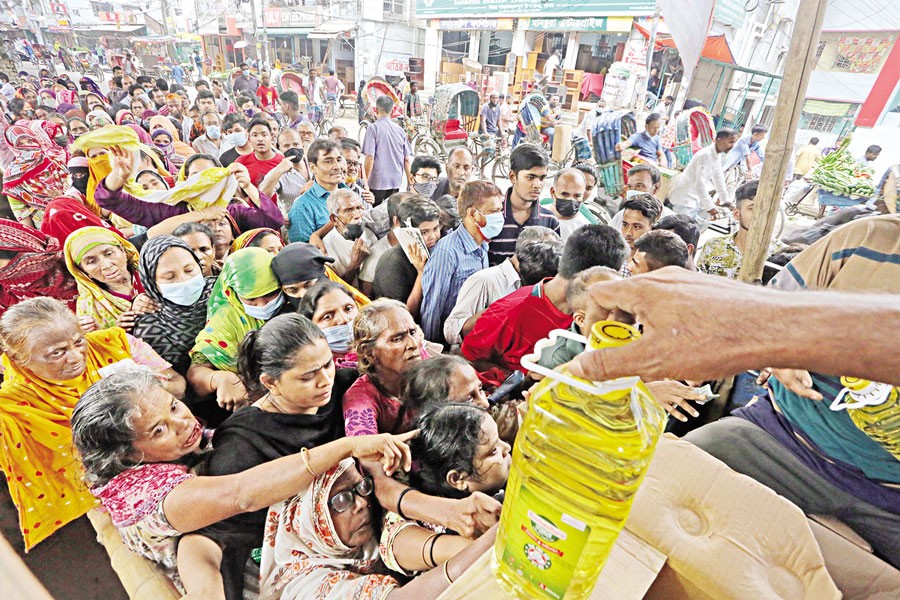
 Rush for essentials at subsidised prices reflect how inflation erodes real purchasing power of low income people in Bangladesh —FE File Photo
 Public debate often reveals insights that formal policy discussions overlook. Occasionally a thoughtful reader’s question captures the essence of a national economic problem more sharply than lengthy technical policy reports. Such was the case when I received the following email in response to my recent article, “Central Bank and Monetary Policy.” [FE, P-4 March 2, 2026] The message raises a question that goes directly to the heart of Bangladesh’s current inflation dilemma. I reproduce the email below exactly as it was written:
“This email is to express my appreciation for your article on ‘Central Bank and Monetary Policy’. I completely agree with you that an effective monetary policy will require a thorough understanding of the transmission mechanisms and the ability to fathom early signals for impending macroeconomic troubles. Certainly, having the prudence and capacity to take appropriate measures to stem the risks is way more important than high academic accomplishments.
I take this opportunity to know your views about the stubborn inflation in Bangladesh. Do you think reigning in the supply side constraints (which, in my opinion, is more of a rent-seeking behaviour and logistical hurdles, rather than a shortfall in supply) could have yielded better outcomes than following a sustained contractionary monetary policy? The concerned authorities do not seem to pay much heed to this argument. They opine that the market, especially the market for essential foods, is very competitive.
I look forward to hearing your views on this and how you think the Bank can play a more constructive role in tackling inflation.”
The email was sent by Professor Ferdousi Naher (Chairman, Economics Department, University of Dhaka), and it raises an analytical question that deserves careful reflection. Her observation touches a crucial issue in Bangladesh’s ongoing inflation debate—whether the problem is fundamentally monetary or whether it originates in deeper structural distortions within the country’s supply chains and market institutions.
Inflation, as economics textbooks explain, can arise from two broad sources: demand pressures or supply constraints. When excessive demand pushes prices upward, central banks normally respond by tightening monetary policy—raising interest rates, reducing liquidity, and restraining credit growth. This contractionary approach works because it cools aggregate demand and reduces the pressure that excessive spending places on prices.
Inflation becomes far more complicated when it originates not from excessive demand but from distortions within the supply chain itself. In such situations prices rise even when overall demand in the economy is not expanding dramatically, because the mechanisms through which goods move from producers to consumers become inefficient or strategically distorted. Bangladesh’s current inflation exhibits many characteristics of this second type. Prices of essential commodities—rice, edible oil, onions, and other staples—often rise not because the country faces a genuine shortage of goods but because the channels through which these goods travel from farms, import points, or factories to retail markets are frequently inefficient or manipulated.
In theory, markets for essential food commodities should be highly competitive. A competitive market contains many buyers and sellers, allows free entry and exit, provides transparent pricing, and adjusts rapidly to changing supply and demand conditions. Under such circumstances, abnormal profits quickly disappear because new suppliers enter the market and arbitrage eliminates price disparities. Yet the actual structure of many commodity markets in Bangladesh often diverges significantly from this textbook description. Import channels, wholesale distribution networks, and storage facilities are frequently dominated by a limited number of traders. This concentration creates conditions conducive to oligopolistic behaviour, allowing market participants to coordinate supply decisions or exert influence over price formation. In everyday language, such arrangements are commonly described as syndicates.
Under these circumstances prices can rise even when aggregate supply is not genuinely scarce. Professor Naher’s observation that the problem may reflect “rent-seeking behaviour and logistical hurdles rather than a shortfall in supply” therefore deserves serious consideration. Her comment highlights an institutional dimension of inflation that often receives insufficient attention in conventional macroeconomic discussions.
Rent-seeking occurs when economic actors generate income not through productive activity but by controlling access to markets. When intermediaries restrict distribution channels, manipulate inventory flows, or exploit regulatory loopholes, they can create artificial scarcity. Prices increase not because goods are unavailable but because access to those goods is strategically constrained.
If inflation is driven by such structural distortions, the effectiveness of contractionary monetary policy becomes inherently limited. Higher interest rates may suppress investment and slow credit growth, but they do little to dismantle bottlenecks supply or disrupt collusive behaviour among dominant market participants. Excessive reliance on monetary tightening may even produce unintended consequences. When borrowing costs rise, transportation, storage, and distribution expenses increase as well. These higher operating costs may be passed on to consumers, ironically reinforcing the very inflation policymakers are attempting to suppress.
This issue also intersects with a broader analytical debate in macroeconomics concerning the limits of conventional frameworks such as the Phillips Curve. The Phillips Curve assumes that inflation is largely driven by demand conditions and therefore linked to employment and output fluctuations. Yet in economies where inflation emerges from supply-chain distortions, rent-seeking behavior, or distributional inefficiencies, this relationship weakens considerably. Inflation can persist even when economic growth slows because the forces pushing prices upward lie outside the traditional demand-driven mechanism.
Bangladesh’s recent experience may well illustrate such a structural phenomenon. Persistent food inflation despite slower economic momentum suggests that price dynamics are being shaped by institutional and market-structure factors rather than purely by macroeconomic demand conditions.
The central challenge therefore lies in correctly diagnosing the origins of price increases. If inflation stems primarily from demand expansion, contractionary monetary policy remains the appropriate response. But if inflation arises from supply-chain distortions, administrative bottlenecks, or rent extraction within distribution networks, policy responses must extend beyond the central bank’s conventional tools.
Addressing such inflation requires improvements in market monitoring, stronger competition policy, better logistics infrastructure, and more effective regulatory oversight. The objective is not simply to reduce liquidity in the financial system but to ensure that goods move smoothly and efficiently from producers to consumers. This does not imply that the central bank lacks a constructive role. Even when inflation has structural roots, monetary authorities can contribute by improving economic surveillance, strengthening price data analysis, and identifying early signals of supply disruptions. Close coordination with fiscal authorities and regulatory agencies can help ensure that policy responses target the underlying causes of inflation rather than merely its symptoms.
Professor Naher’s email highlights an important feature of healthy economic discourse. Sound policy debates do not emerge exclusively from official institutions or academic circles. They also evolve through thoughtful engagement between analysts, policymakers, and informed citizens who examine economic developments critically. Her question reminds us that inflation is rarely a simple monetary phenomenon. Prices rise within an institutional environment shaped by incentives, market structures, and regulatory frameworks. When those structures are distorted, monetary policy alone cannot restore stability.
Understanding inflation therefore requires looking beneath the surface of price statistics and identifying the deeper forces shaping market behaviour. Without such diagnosis, even well-intentioned policy measures may fail to address the real problem. The debate on inflation in Bangladesh must therefore continue—not only about how tight monetary policy should be, but also about whether the true sources of inflation are being correctly identified.
In that sense, thoughtful questions from engaged readers are not merely comments on published articles. They often illuminate the path toward better economic understanding and better policy.
Dr Abdullah A. Dewan, Professor Emeritus of Economics, Eastern Michigan University (USA); Former physicist and nuclear engineer, Bangladesh Atomic Energy Commission.
aadeone@gmail.com
© 2026 - All Rights with The Financial Express

