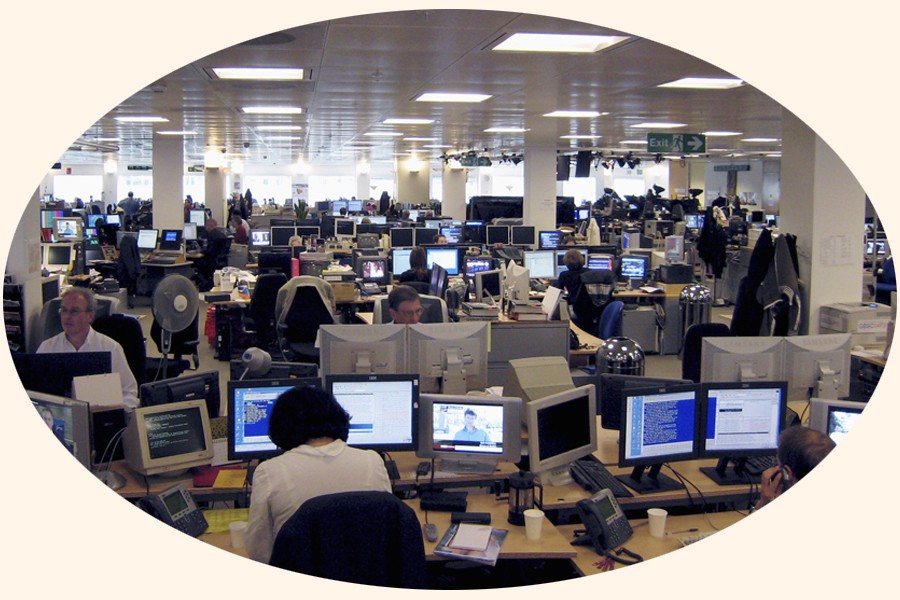
There was a time when newsrooms set the rhythm of public life. The editor decided what mattered, the reporter chased the facts, and the printing press or the evening bulletin carried the collective heartbeat of a society. But that order has collapsed. Today, the news no longer waits for deadlines; it chases algorithms. The newsroom has moved to the feed. And with that shift, journalism is no longer just a profession, it’s a business of attention.
Back then, journalism felt like a craft. Something you built with care. You double-checked facts, argued over headlines, and waited; yes, waited for the paper to hit the stands or come to your home. But in this new ecosystem, the old newsroom values like accuracy, verification, and balance are struggling to survive against metrics like reach, impressions, and engagement. Publishers now measure success not by the quality of investigation but by how long a user stays on a page. Every click has a cost and a profit margin. Journalism, once driven by curiosity, is now driven by conversion rates.
When I open my phone today, I don’t see journalists competing for truth. I see everyone—friends, influencers, random accounts with blue ticks are competing for attention. The timeline is the new front page. Engagement is the new credibility. And `breaking news’ doesn’t mean something just happened anymore; it means someone just posted.
If I be honest, journalism has always been influenced by business. Newspapers sold ads, TV chased ratings. But social media changed the game completely. The new economy runs on clicks, likes, shares. Every story, every headline, every thumbnail is a tiny business decision.
And here’s the uncomfortable truth: outrage sells. Emotion spreads. But Facts? often don’t.
The business model of news has changed so fast that ethics are gasping for air. Once, newspapers earned through subscriptions and advertisers who valued credibility. Now, platforms earn through engagement.
Editors are now competing not only with rival outlets but with influencers, vloggers, and citizen reporters who have mastered the art of ‘virality’. In this market, journalism is forced to mimic entertainment to survive. The “breaking news” banner has turned into a clickbait strategy; the line between editorial and advertisement has blurred into branded content.
So, journalists face a constant dilemma. Do I write what matters, or do I write what performs? Because those two aren’t always the same thing.
In many digital newsrooms today, the morning meeting sounds less like a discussion on public interest and more like a briefing on analytics. Which story is trending? Which keyword performs better? What thumbnail brings more clicks? These are business questions, not editorial ones, yet they increasingly dictate newsroom priorities.
The ethical dilemma deepens because the economics of online journalism reward speed, not accuracy. When ad revenue depends on page views, being first often matters more than being right. Verification takes time, and time costs money. The result is a constant tension between the moral responsibility to inform and the commercial need to perform.
I’ve seen good reporters burn out trying to keep up with algorithms. Imagine working years to build credibility, only to watch a meme account get more traction than your investigative piece that took months. It’s disheartening. And yet you can’t ignore the platforms. That’s where audiences live now.
The irony is that social media platforms, not newsrooms, now own the audience. Tech giants decide what gets seen and what gets buried. Their opaque algorithms curate reality itself. News outlets, in turn, optimise headlines and stories to please those algorithms, not the readers. In effect, journalism has become a supplier to platforms, not a service to citizens.
We are witnessing the rise of what scholars call “platform journalism,” where the story is shaped not by editorial judgment but by data-driven incentives. A newsroom editor might say, ‘Let’s cover this story because it’s important.’ A platform dashboard, however, says, ‘Cover that story because it performs.’ In this quiet tug-of-war, journalism’s moral authority erodes.
Let’s talk numbers for a moment. Because behind this moral shift, there’s a massive business machine. In 2024 alone, digital advertising revenue in the U.S. hit $258.6 billion; that’s a 14.9 per cent jump from the year before. Search ads made up over $102 billion of that total.
Globally, digital advertising now takes about 74 per cent of all ad spending. That’s nearly three-quarters of the world’s marketing money flowing through screens, clicks, and algorithms. You can almost hear the cash register in the background of every “breaking” notification.
So when we talk about ethics in journalism today, it’s not just about truth and bias anymore. It’s also about the business of attention. Every like, every share, every headline tweak, they’re all part of a global competition worth billions. And when attention equals money, the pressure to sensationalise becomes almost irresistible.
The economics of attention has also reshaped the journalist’s identity. Many reporters are now personal brands, measuring their worth through followers, likes, and engagement. Publishers encourage it because visibility drives traffic, but at what cost? When journalists become influencers, objectivity risks becoming performance.
None of this means that social media has only harmed journalism. It has democratised voices, broken monopolies, and made storytelling interactive. But it has also turned the news into a product designed for consumption rather than reflection. The business incentives have changed the very DNA of truth-telling.
There’s something paradoxical about that. The more journalism depends on digital platforms for survival, the less control it has over its own soul. Once, we wrote for readers. Now, we write for the algorithm and pray the readers still find us.
That’s the ethical dilemma of our time: journalism is still chasing truth, but truth now runs on a treadmill powered by metrics.
What happens when truth and profit share the same timeline? Maybe this is where our ethics need to evolve. To survive this storm, journalism must rediscover its balance between ethics and economics. That means investing in quality reporting even when it’s not trending. It means creating business models where credibility pays through subscriptions, reader loyalty, or independent funding, instead of depending solely on ad algorithms.
Journalism must reclaim its audience from the platforms by rebuilding trust, not chasing traffic. Because if truth becomes just another click, the public loses far more than the press ever gains. The feed may rule the business, but the truth must still rule the craft. Because credibility is still the currency that lasts longer than clicks. And as journalists, that’s the only wealth worth protecting.
Mahadi Hasan, Senior Lecturer, Dept. of Communication and Media Studies, University of Development Alternative. mahadihbk@gmail.com
© 2026 - All Rights with The Financial Express

