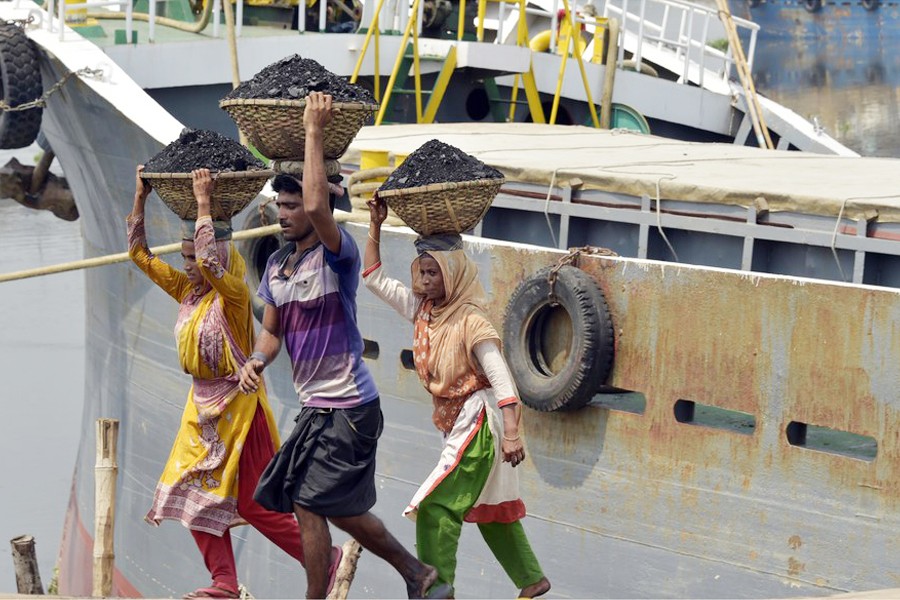
 Labourers unload coals from a ship at a river bank in Dhaka, Bangladesh on April 30, 2023 —Xinhua Photo
 In the midst of the demographic transition, Bangladesh is experiencing rapid shifts in the relative numbers of children, the working-age population, and elderly persons. Here, changes in the age structure suggest that two-thirds of the total population are of working age, which could be a stimulus to the first demographic dividend in socioeconomic advances.
Addressing demographic change should remain a top priority on the political agenda, given the timeframe to achieve the first demographic dividend by 2036, following the National Transfer Accounts (NTA), while the dependency ratio will be at its lowest in 2045 (World Population Prospects 2024 Revision, United Nations), and changes in gender composition on the labour market. The labour-force composition in Bangladesh can play a significant role in its economic development.
The country has made progress in women's labour- market participation, but there is still a wide gap between men and women. Here, female workforce participation remains significantly lower than that of their male counterparts. The low participation of women in the workforce could seriously affect the country's chance of achieving the first demographic dividend. Thus, it is necessary to explore the scenarios of gender differentials in labour- force participation and to adopt essential urgent actions to reap the benefit.
In addition, to attain the International Conference on Population and Development Programme of Action (ICPD PoA) on Gender Equality, Equity, and Empowerment of Women; and Sustainable Development Goals (SDG-8): Promote sustained, inclusive, and sustainable economic growth, full and productive employment, and decent work for all; and SDG-5: Achieve gender equality and empower all women and girls, current gender gap in the labour-force participation should be set right.
Here, change has been observed in the rising participation of women in the labour market, with the rate rising from around 8.0 per cent in the mid-1980s to almost 42 per cent in 2022, according to the Labour Force Survey (LFS) of the Bangladesh Bureau of Statistics (BBS). Despite the increase, the female-participation rate remains much lower than the male rate. Here, the rate of growth of the female labour force and/or the annual average change in the participation rate has slowed over the past decade.
The low female labour-force -participation rate, low educational attainment of the labour force, high youth -unemployment rate, a large youth population not in employment, education, or training (NEET), and substantial underemployment restrict the country from realising the full potential of the demographic structures. Thus, interventions are required at the policy level, as well as at the functional or operational levels.
At the policy level, recommendations include ensuring the availability of updated data on female labour-force participation at regular intervals, creating enabling environment for females, ensuring fair opportunity for all in the job market, and ensuring women-friendly services (entrepreneurship and creation of employment opportunities at local/community/rural level- with emphasis on technical education, trade courses etc), gender norm-centric policies as traditional gender norms and patriarchal values often restrict women's mobility and constrain their activities in the labour market, institutional coordination/reforms and updating the national-policy documents to stimulate female labour-market participation, with a number of institutional coordination and reforms, policies and social protection to stimulate the participation of women in the labour market, like providing daycare facilities, extending the provision of maternity and post-maternity leave, and introducing flexible and part-time working hours, strategies to adapt to technological change and automation (to spread the benefits of technological change and automation more equitably, in the short run, different tax incentives and social protection can be useful), strategies to address the domino impact of COVID-19 and climate change on vulnerable girls, and seeking professional employment opportunities abroad and to protect the human rights of the migrant workers.
Functional level- or operational-level recommendations include (a) implementation of 'The Child Marriage Restraint Act 2017' (b)avoiding early pregnancies and continued education and integration in income-generating activities (c) skill development at the local level (d) strengthening the activities like Joyeeta Foundation by the Department on Women Affairs (DWA) (e) outsourcing market opportunities in the developed countries (f) to revisit tertiary education curriculum for demand-driven professional human resource development (g) to create more economic zones and employment opportunities (h) to encourage Technical and Vocational Education and Training (TVET) and adopting example from successful foreign countries (I) to ensure a gender-friendly environment in education/training institutes (j) women's inclusion in the formal sector (k) to address the gender gap in wage differentials and unpaid family work.
To capitalise on the first demographic dividend's opportunity, short- and long-term policy actions can be taken, considering the timeframe left. A critical question is 'how to engage the female working-age population in the labour market.. If the right public policies ensure empowerment, education, and employment, economic returns can be high. A comprehensive way of addressing gender differentials can make economic growth a reality.
Women can access and use family planning without barriers, and this has to be ensured here so that women and couples can choose the number, timing, and spacing of children. It allows women to participate in the labour force and contribute more to the family's economic wellbeing.
As an essential step towards gender equity and fostering economic growth, Bangladesh needs to develop and enforce policies that enable girls to go to higher secondary school to combat child marriage and adolescent pregnancy and equip them with skills to compete for higher-paying jobs. Women in poor conditions may have lower access than men to mass media and technology, leaving them less informed and less empowered. Thus, women need improved access to information that will help them shape and improve their own lives and those of their children.
Also critical for gender equality are equitable land rights and access to credit for women. When women have access to credit and generate profits, they are more likely than men to use their income to improve their families' wellbeing. Thus, improving women's access to these assets brings Bangladesh closer to reaping the first demographic dividend and the gender dividend by achieving gender equality and empowering women.
In brief, to address the gender differentials, Bangladesh needs to increase female workforce participation, invest more and improve education for girls and women, prevent gender-based violence and eliminate child marriage, and increase women's representation in leadership and change norms and necessary supports to women's participation in the formal labour market.
Dr Mohammad Mainul Islam is a professor and former chairman of the Department of Population Sciences at the University of Dhaka. He can be reached at mainul@du.ac.bd
© 2026 - All Rights with The Financial Express

