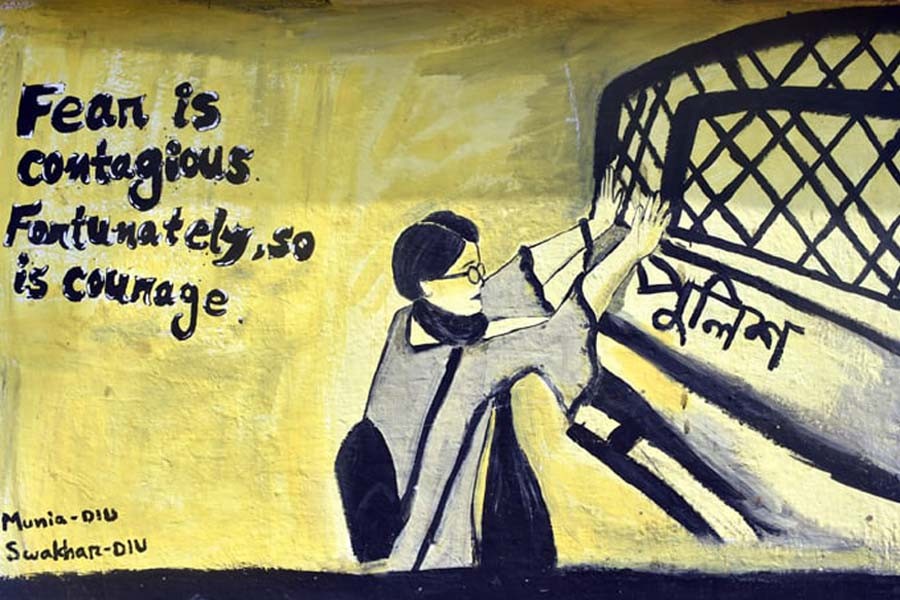
 A graffiti of July uprising —BSS Photo
  When a bullet leaves the barrel of a gun, it bears no name. But when that bullet pierces the chest of a protesting student demanding justice, it inscribes itself in history, writing the death warrant of an unjust regime. Not every killing by the state is immediately recognised as tyranny, especially when the victims are from marginalised communities. But when an unarmed, ordinary student is shot dead in broad daylight and the moment is captured on camera, the cruelty becomes undeniable. No theoretical justifications offered by the state can obscure the reality that such a killing is the starkest form of oppression.
The tyranny of the Awami League had long been evident to the public. July was merely the eruption of years of suppressed anger. Thanks to the tactical brilliance of student leaders, that rage found a targeted direction. A series of strategic missteps by the Awami League made its downfall inevitable.
My doctoral research at the University of Oxford centres on the July Uprising. While my full analysis is extensive, I would like to share some of my emerging arguments in hopes of generating feedback that may further enrich my study. Let me begin by discussing a few theoretical insights I have already proposed.
The identity of the “student” played a central role in shaping the trajectory of the July movement. In Bangladesh, the figure of the student carries a moral sanctity—historically perceived as the bearer of justice. No Bangladeshi government has survived long after spilling student blood. Once branded as “student-killers,” regimes face an indelible moral stain. In contrast, killings of working-class people—such as garment workers—even after the uprising, often go unheeded by the urban middle class due to class divisions and alienation.
During July, many autorickshaw drivers, labourers, madrasa students, and destitute people lost their lives. Yet, the names most frequently remembered as martyrs are Abu Sayed and Mugdho—because they created transformative moments in the eyes of the middle class. These figures were perceived as “worthy” martyrs, whereas politically affiliated figures like Wasim were not embraced in the same way. One of the primary reasons for the success of the movement was its deliberate strategic non-partisanship—it was portrayed as free from the taint of party politics. I will explore this further in a future essay.
While Abu Sayed’s murder was a major turning point in the uprising, it was by no means the only one. The movement was shaped by many such moments. Without deeper fieldwork, it is difficult to say which specific incidents resonated most with the public. However, preliminary observations suggest that the government’s decision to shut down the internet was another transformative event. Rather than suppressing the movement, this miscalculation brought hundreds of thousands to the streets—many of whom would have otherwise confined their protests to online platforms. The internet blackout acted as a catalyst for offline mobilisation, particularly among the urban, educated middle class.
But can the mobilisation of millions be explained only by the internet shutdown or student killings? I believe many took to the streets because of the wounds inflicted by the Awami League’s long history of repression. The suppression of protests, enforced disappearances, extrajudicial killings, and torture in secret detention centres left deep scars. In my research, I have identified over a hundred personal testimonies detailing abuses by the ruling party’s student wing. If surveyed, I suspect a significant proportion of these individuals would be found to have joined anti-government protests. Beyond these recorded stories lie thousands more—many shared on social media.
The brutal murder of Abrar Fahad was one of the clearest indications that the ruling party’s student wing had become a terrorist organisation—something that was recognised by many even before the interim government’s recent acknowledgements. For countless students, the actions of the ruling party’s cadres transformed the Awami League into a monstrous entity, the defeat of which became a moral obligation.
Moreover, large-scale injustices—such as forced disappearances, killings, corruption, and money laundering—mobilised not just students, but also ordinary citizens against the regime. This explains why, after July 18, millions of people beyond the student population joined the movement to oust Sheikh Hasina. Once the murder of Abu Saeed reached the public, the movement had no path left but a single demand—resignation. Although some argue that this was the result of a long-term plan to remove Hasina, I believe the movement had its own endogenous momentum, shaped by transformative moments and martyrdoms. The intensity of the moment made the one-point demand inevitable. Even without the formal announcement, the people were already moving in that direction—and at that point, the leadership had no choice but to follow.
Each death largely fueled this momentum of the moment. Based on my analysis, I propose that the movement grew stronger with every killing, rather than weakening. My data shows a statistically significant relationship between deaths in a particular division and the number of protests the following day. Machine learning analyses also indicate that various forms of repression—especially disproportionate use of force—served as reliable predictors of protest activity. Thus, not only the long history of oppression but the immediate, unfolding violence of July served to intensify the uprising.
These findings challenge a dominant theory in social movement literature, which argues that intense repression leads to demobilisation or radicalisation. But our July did not cower in fear. It stood face-to-face with tyranny and vowed to uproot it from Bangladesh.
In my book Bidroho theke Biplob, published earlier this year, I argued that the July Uprising had its roots in the 2018 Road Safety Movement. I now believe that it began even earlier—something many now acknowledge, including the official page of the interim government. A detailed chronicle of these past injustices—and an understanding of their impact on public consciousness—could be of tremendous value to scholars of social movements. If we can identify which forms of repression people remember, and which ones move them to stake their lives on the streets, it could significantly advance our understanding of mobilisation. Not only would this be an academic contribution—it would also be a lesson for future politics: to ensure that no future government dares to resurrect the Awami model of tyranny. Just as Awami repression ignited July, the people of Bangladesh—who never forget the insult of injustice—will not hesitate to rise again if oppression returns.
However, July is not just a topic for scholarly inquiry. It is a moment of national consciousness and moral awakening. The movement’s core aspiration was to dismantle the unjust apparatus of the state and build a new, just society in its place. We are still far from that goal. On this first anniversary of the July Uprising, it is a critical time for us to recommit to that struggle. We must ensure that, unlike previous movements, July does not become another hijacked revolution. For that, both student activists and ordinary citizens must work to ensure that the interim or subsequent elected governments commit to deep structural reforms and to building a just state and society. Otherwise, we will have to return to the streets once again—risking more bloodshed, more lives.
But I hope we can activate our democratic institutions so that our people no longer have to bleed. Let our collective pledge on the anniversary of July be this: Carry on the struggle until that vision is realised.
Anupam Debashis Roy is the Editor-in-Chief of Muktipotro and DPhil Canddiate in the Department of Sociology at the University of Oxford. anupam.roy@sociology.ox.ac.uk
© 2026 - All Rights with The Financial Express

