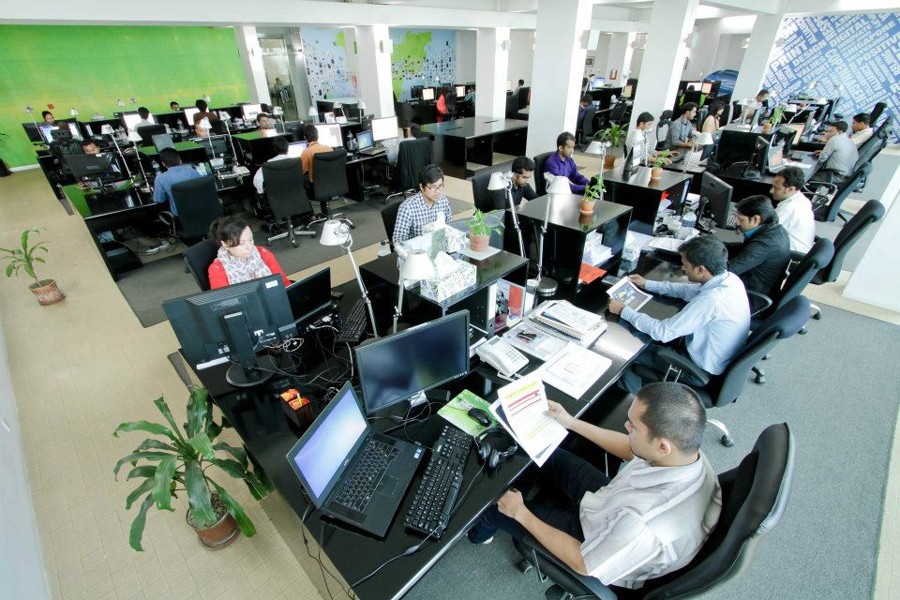
Bangladesh's rapid socio-economic transformation is often celebrated as one of the most compelling success stories in the Global South. The rise of the ready-made garment industry, the expansion of mobile banking and digital finance, the push toward technology-enabled services, and the ambition to build a modern, knowledge-oriented economy have created a sense of accelerating progress. Yet beneath this optimistic narrative lies a more complex and less visible story-one that concerns the deepening patterns of inequality produced by the digital transition itself.
The inequality unfolding today is not simply an extension of older divides. It reflects a restructuring of power through digital systems, new knowledge hierarchies, technological access barriers, and ideological narratives that determine who benefits from digitalisation and who is left behind. These emerging patterns cannot be understood solely through traditional measures of income or wealth. They are embedded in socio-epistemic structures that shape how individuals acquire knowledge, participate in networks in an increasingly technology-dependent society.
A sophisticated lens for understanding this dynamic is offered by Bolivian sociologist and data theorist Ricardo Alonzo FernándezSalguero. In his 2025 work, "A Synthetic Theory of Socio-Epistemic Structuration: Capital, Ideology, and Agency in the Age of Digital Inequality", Salguero argues that inequality in the digital era is shaped by the interplay of material capital, epistemic capital, and ideological power. His framework is especially relevant for Bangladesh as the country continues to push forward with its digitalisation drive.
Salguero's core argument is that inequality today operates through dual structures. Material capital still matters, but epistemic capital-the ability to acquire, interpret, and strategically deploy digital knowledge-has become the decisive determinant of social mobility. This includes proficiency in global languages, familiarity with digital platforms, access to networks, and the capacity to shape narratives about innovation and progress. In Bangladesh, where digital expansion is rapid but uneven, epistemic capital has emerged as the sharpest line dividing those who benefit from the transition from those who remain marginalised.
This marks a shift from older patterns of stratification based primarily on land, income, or assets. While these factors remain influential, they no longer fully capture the dynamics of upward mobility. The current digital landscape in Bangladesh shows that access to devices, internet connectivity, or platforms does not necessarily translate into real empowerment. Instead, cognitive capacity, cultural orientation, and ideological framing determine who can convert digital tools into meaningful opportunities.
The ready-made garment sector offers a microcosm of this paradox. Millions of women from rural areas migrate to industrial cities seeking better livelihoods. They form the backbone of Bangladesh's export economy and contribute significantly to national growth. With the expansion of affordable smartphones, many now possess devices that could serve as gateways to financial literacy, online education, and digital entrepreneurship. Yet, for most, these devices remain tools for communication or entertainment rather than instruments of empowerment.
This gap is structural rather than individual. Salguero identifies this as a failure in socio-epistemic structuration. Workers are materially included in the economy but remain excluded from the epistemic structures necessary for strategic digital agency. They have physical access to technology but lack the cognitive, educational, and institutional support required to benefit from it. Their participation is visible, yet their empowerment remains limited.
Urban, English-proficient youth in sectors like ICT, e-commerce, software development, fintech, and global freelancing occupy the opposite pole. They enjoy the advantages of both material and epistemic capital. They grow up in environments that foster digital fluency, exposure to global media, and access to mentors, networks, and high-speed connectivity.
This dual advantage enables them to shape markets, influence policy, and secure high-value opportunities. Their narratives of success are often used as evidence of inclusive digital progress. But their achievements reflect an accumulation of structural privileges that remain inaccessible to many. Digital inequality here is not merely technological-it is fundamentally cognitive and ideological.
Education intensifies these divides. Students in English-medium or elite urban private schools absorb epistemic capital almost effortlessly. They encounter digital platforms early, solve problems in dynamic learning environments, and develop the confidence required to navigate international spaces. Their trajectory naturally aligns with globalised digital labour markets.
In contrast, rural and government-school students experience limited and uneven exposure to digital learning. Even when devices or connectivity are introduced, teaching methods often remain mechanical and disconnected from the skills needed for genuine digital participation. As a result, opportunities in freelancing, remote work, start-up ecosystems, and digital entrepreneurship become stratified before young people even reach adulthood.
Mobile financial services present similar contradictions. Platforms such as bKash, Nagad, and Rocket are frequently cited as examples of financial inclusion. Their reach is impressive, yet their usage patterns reveal deep disparities. Urban professionals use these tools for investment, savings, digital commerce, and wealth planning, while rural households use them primarily for remittance transfers. The difference is not access but strategic capacity.
Without financial education, digital literacy, and exposure to long-term planning, the transformative potential of mobile finance remains concentrated within a narrow elite. Digital access without cognitive empowerment simply reproduces old inequalities under new technological conditions.
Ideology plays a subtle but powerful role in reinforcing these patterns. The national digital transformation agenda celebrates start-ups, fintech innovation, and youth entrepreneurship. These narratives highlight the achievements of digitally fluent urban professionals while rendering invisible the structural challenges faced by others. The discourse promotes an implicit hierarchy that legitimises the privileges of the digitally empowered and obscures the systemic barriers confronting the digitally excluded.
The gig economy provides a particularly revealing example. Online platforms claim to be open, merit-based systems. Yet those who succeed are typically equipped with advanced English proficiency, strong digital portfolios, algorithmic literacy, and socio-cultural flexibility. Those without these skills are often confined to low-wage, low-skill tasks that offer little mobility. The digital labour market is therefore stratified not by access alone but by epistemic capital.
Gender overlays these inequalities in profound ways. Women constitute a major force in Bangladesh's economy, especially in the informal and garments sectors, yet their participation in high-value digital sectors remains limited. Restrictive social norms, unequal access to education, constraints on mobility, and limited exposure to technology prevent many women from acquiring the digital competencies needed to enter emerging professions. While urban middle-class women are increasingly entering ICT roles, rural and low-income women continue to face structural barriers. Digitalisation thus intersects with gender to produce multilayered inequalities.
Rural-urban migrants represent another group caught in this structural divide. Their labour sustains major cities, yet their participation in the digital economy remains minimal. Their employment is typically informal, insecure, and low-paid, with limited opportunities for digital upskilling.
Salguero's theory helps explain why these inequalities persist and deepen. Inequality is recursive: those who possess both material and epistemic capital shape institutions in ways that reproduce their advantages. In Bangladesh, private universities, elite schools, well-funded tech incubators, corporate ecosystems, and urban innovation hubs create environments that favour those who already have the prerequisites for digital success. These structures define what counts as knowledge, whose expertise is valued, and whose presence is marginalised.
Bangladesh is now at a crucial juncture. The digital transition is expanding rapidly, but without deliberate policy intervention, the socio-epistemic divide will widen further. Reducing this divide requires more than expanding connectivity or distributing devices. It calls for embedding cognitive digital competencies into the national education system, reimagining skills development as a lifelong process, and ensuring that marginalised groups can participate meaningfully in the digital economy.
Strengthening digital literacy through public institutions, promoting community-based technology hubs, supporting women's digital leadership, expanding rural innovation centres, and protecting gig workers through inclusive labour policies are essential steps. Equally important is ensuring that the digital economy recognises and values diverse forms of knowledge rather than privileging only those aligned with global corporate cultures.
If Bangladesh is to build a technology-driven future that is equitable and inclusive, it must democratise not only access to technology but also access to epistemic power. Simply providing the tools of digital participation is not enough. Individuals must have the cognitive, cultural, and institutional support to use these tools as pathways to empowerment rather than reinforcement of existing hierarchies.
The true challenge of the digital transition is not technological. It is social, cognitive, and ideological. Bangladesh's digital future will depend on whether the country can transform its digital growth model into a foundation for shared prosperity rather than a new architecture of inequality.
Dr Matiur Rahman is a researcher and development professional.
matiurrahman588@gmail.com
© 2026 - All Rights with The Financial Express

