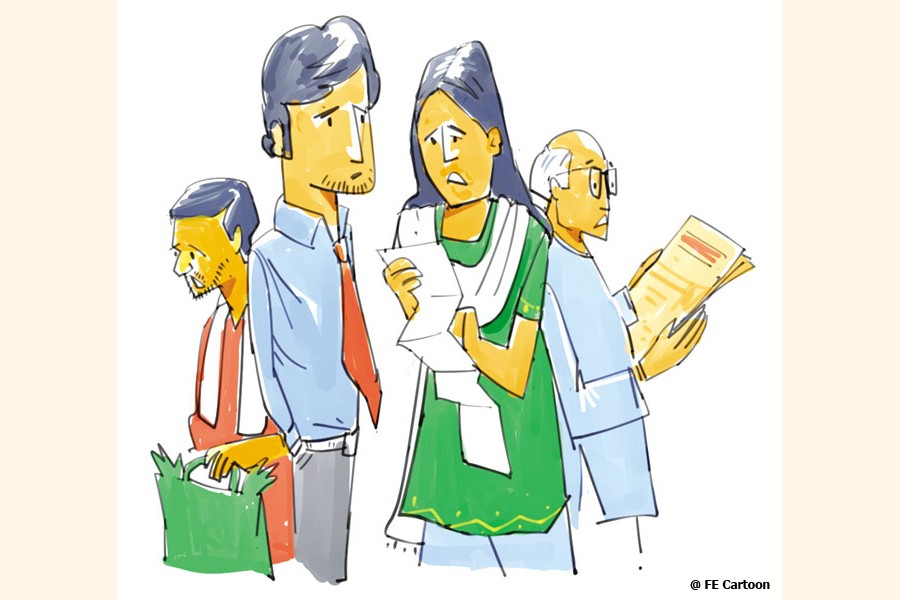
National budgets are usually discussed in the language of economics. Analysts focus on revenue collection, fiscal deficits, inflation management, and growth targets. Yet a budget is much more than a financial document. It is also a social contract. It reveals how a state prioritises competing needs, allocates resources among different groups, and imagines the future of its citizens. From a sociological perspective, therefore, a budget is not merely about counting money; it is about measuring justice.
The proposed national budget for fiscal year 2026–27, amounting to Tk 9.38 trillion, is the largest in Bangladesh’s history. The government has set a GDP growth target of 6.5 per cent and aims to bring inflation down to 7.5 per cent. Total expenditure is projected to increase by 19 per cent, while development spending is expected to rise by an impressive 47 per cent to Tk 3.16 trillion. Revenue collection has been targeted at Tk 6.95 trillion, and the budget projects a fiscal deficit of Tk 2.43 trillion, equivalent to 3.6 per cent of GDP. Presenting the budget in parliament, Finance Minister Amir Khosru Mahmud Chowdhury described it as a “Journey Towards a Democratic, Humane and Inclusive Economy.” These figures undoubtedly reflect ambition. However, the sociological question is whether this ambition will translate into greater social justice and improved well-being for ordinary citizens.
The timing of this budget is particularly significant. Bangladesh is confronting a combination of economic pressures that directly affect the everyday lives of its people. Inflation remains stubbornly high despite repeated policy interventions. According to the latest data released by the Bangladesh Bureau of Statistics, point-to-point inflation rose to 9.42 per cent in May 2026, the highest level in sixteen months. Food inflation climbed to 9.06 per cent, while non-food inflation reached 9.71 per cent. Even more concerning is the fact that inflation in rural areas stood at 9.48 per cent, higher than in urban areas. These figures indicate that the burden of rising prices is falling disproportionately on lower-income households and rural communities.
For economists, inflation is a macroeconomic indicator. For sociologists, it is a lived reality. It determines whether families can afford nutritious food, healthcare, education, transportation, and housing. When inflation consistently outpaces wage growth, social vulnerability increases. The World Bank recently observed that the wages of low-income workers in Bangladesh have not kept pace with rising prices, resulting in declining purchasing power. In practical terms, this means that millions of people are working just as hard as before but are able to buy less with their earnings. Such a situation inevitably widens social inequalities and deepens feelings of economic insecurity.
The poverty situation further reinforces this concern. For decades, Bangladesh was celebrated as one of the world’s most successful poverty reduction stories. Between 2010 and 2022, according to the World Bank, approximately 34 million people escaped poverty. However, recent trends suggest a troubling reversal. The World Bank estimates that the national poverty rate increased from 18.7 per cent in 2022 to 21.4 per cent in 2025, pushing an additional 1.4 million people below the poverty line. The institution attributes this deterioration largely to persistent inflation, weak income growth among vulnerable groups, and broader economic instability.
These statistics challenge a long-standing assumption that economic growth automatically improves social welfare. Bangladesh averaged approximately 6 per cent GDP growth over the past decade, a remarkable achievement by international standards. Yet the World Bank now warns that the country faces weak growth, elevated poverty, high inflation, and financial sector stress simultaneously. Growth alone, therefore, cannot guarantee social progress. The quality and distribution of growth matter as much as growth itself.
This brings us to the issue of inequality, arguably the most important sociological lens through which the budget should be examined. Inequality is often discussed in terms of income, but its social dimensions are far broader. It encompasses disparities in access to education, healthcare, technology, information, employment opportunities, and political influence. A child born into an affluent family in Dhaka begins life with advantages that remain inaccessible to many children in rural or marginalised communities. Such disparities are reproduced through institutions and social structures, creating unequal life chances long before individuals enter the labour market.
The World Bank’s Poverty and Equity Assessment notes that after 2016, Bangladesh’s pattern of growth became less inclusive, with income growth increasingly favouring wealthier households. This finding should concern policymakers because rising inequality can undermine social cohesion even when average incomes increase. When economic opportunities appear concentrated among a small segment of society, public trust in institutions weakens, and social frustrations intensify.
Employment generation represents another critical challenge. Bangladesh’s demographic profile offers tremendous potential, but only if productive jobs can be created. A large youth population is entering the labour market each year with expectations of stable employment and upward mobility. Yet, the recent economic slowdown has raised concerns regarding the capacity of the economy to absorb new entrants. According to Reuters, economic growth slowed from 5.78 per cent in fiscal year 2022–23 to 4.22 per cent in 2023–24 and an estimated 3.49 per cent in the outgoing fiscal year. Such a decline inevitably affects job creation prospects.
Recognising this challenge, Bangladesh Bank recently announced a Tk 600 billion stimulus package aimed at supporting businesses and creating approximately 250,000 jobs. While this initiative is encouraging, it also highlights the magnitude of the employment challenge confronting the country. Employment is not merely an economic issue; it is a social issue tied to dignity, identity, and citizenship. Sociological research consistently demonstrates that prolonged unemployment or underemployment contributes to social alienation, declining self-esteem, and weakened social integration. Young people need more than jobs; they need meaningful opportunities to participate in society.
The budget’s emphasis on development expenditure deserves attention in this context. The planned increase of development spending to Tk 3.16 trillion signals a commitment to infrastructure, investment, and economic expansion. Major transport projects, including metro rail development and urban infrastructure initiatives, are expected to receive substantial allocations. Infrastructure can undoubtedly stimulate economic activity and improve connectivity. However, sociology reminds us that roads, bridges, and railways are means rather than ends. Development should ultimately be evaluated by its impact on human well-being rather than the volume of concrete poured or kilometres constructed.
Human development requires sustained investment in education and healthcare. These sectors are not simply components of social expenditure; they are foundations of social mobility. Access to quality education enables individuals to acquire skills and improve their life prospects. Effective healthcare protects families from catastrophic expenditures that often push vulnerable households into poverty. If Bangladesh is serious about building an inclusive economy, investment in human capabilities must remain as important as investment in physical infrastructure.
Another crucial dimension concerns social protection. The World Bank estimates that nearly 62 million Bangladeshis remain vulnerable to falling back into poverty when confronted with illness, natural disasters, or economic shocks. This figure is particularly significant because vulnerability extends far beyond those officially classified as poor. A large segment of the population exists only one crisis away from economic hardship. Social safety net programmes, therefore, represent not charity but social insurance. They protect citizens against risks that individuals cannot manage alone.
Climate vulnerability adds further urgency to this discussion. Bangladesh remains among the countries most exposed to climate-related risks. Floods, cyclones, salinity intrusion, river erosion, and extreme temperatures disproportionately affect poorer communities because they possess fewer resources for adaptation and recovery. Climate resilience is therefore not simply an environmental issue; it is fundamentally a social justice issue. Future budgets will increasingly be judged by their ability to protect vulnerable populations from climate-related disruptions.
At a deeper level, the FY2026–27 budget raises important questions about the relationship between the state and its citizens. Revenue collection is expected to reach Tk 6.95 trillion despite ongoing challenges in tax administration. Yet taxation is sustainable only when citizens perceive public institutions as fair and accountable. People are more willing to contribute when they believe public resources are being used effectively to improve collective welfare. Trust, therefore, is as important as taxation in sustaining a functioning social contract.
Ultimately, the success of Bangladesh’s largest-ever budget will not be determined solely by whether growth reaches 6.5 per cent or inflation falls to 7.5 per cent. It will be judged by whether ordinary citizens experience tangible improvements in their lives. Do families feel more economically secure? Do young people find decent employment? Do poor households gain greater access to healthcare and education? Do vulnerable communities receive protection from economic and environmental shocks? Do citizens perceive public institutions as fair and responsive?
These are not merely economic questions. They are questions of social justice. Budgets count taka, but societies measure fairness, dignity, and opportunity. The true significance of Budget 2026–27 lies not in its historic size but in its capacity to transform public resources into human well-being. If it succeeds in reducing inequalities, strengthening social protection, expanding opportunities, and restoring public confidence, it will represent more than a fiscal plan. It will represent a meaningful step toward a more inclusive and equitable Bangladesh.
Dr. Matiur Rahman is a researcher and development professional.
matiurrahman588@gmail.com
© 2026 - All Rights with The Financial Express

