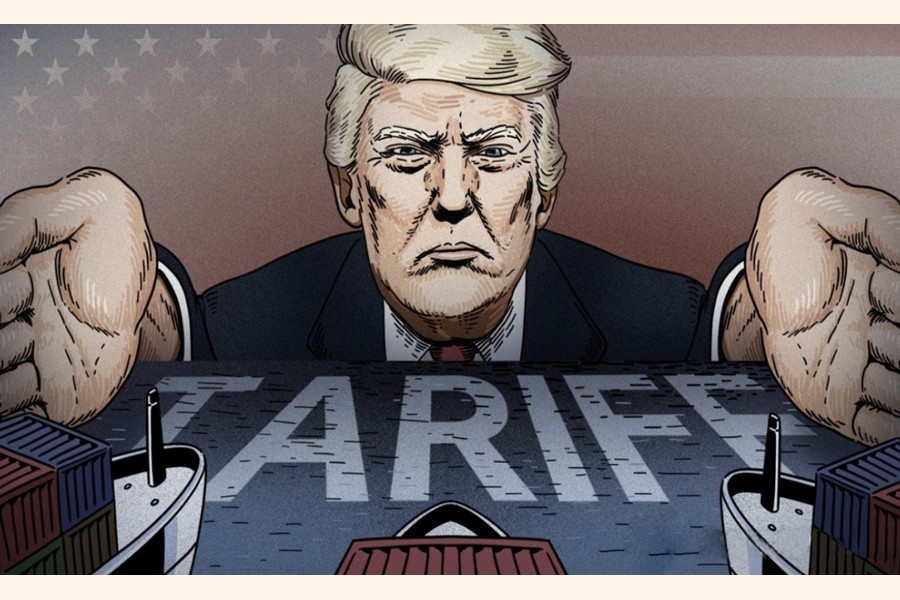
Aimed at pulling up the cost of foreign products, protecting domestic industries, and raising revenue, tariffs are taxes or duties imposed by a government on imported commodities. These are used as an important tool in inter-governmental economic policy-making, as they influence foreign trade, affect consumer prices, but often lead to disputes between nations. However, economists have traditionally considered them as potentially self-defeating protectionism that hinder international trade and increase prices for the people they are supposed to protect. This has been the philosophy that led to a decline in tariff rates levied by the global economic super-power USA from 18.4 per cent in 1934 to below 2 per cent in 2007.
Times, however, have changed and the current administration of the US President Donald Trump appears hell-bent to raise tariffs on commodities from over 90 countries of the world. The Trump administration's approach to tariffs is linked to some key economic and political objectives, which includes a desire to protect American industries and workers from perceived unfair foreign competition. The strategy particularly focuses on trade imbalances with countries like China, India, Mexico, Canada, and the European Union (EU), although political motives are also apparent in many of the United States (US) moves. But these measures already appear to be backfiring especially by hitting the US consumers, and it is not yet clear how long the US administration can sustain this highly aggressive strategy that has already rattled the global economy.
Let us now have a look at the advantages and disadvantages of imposing Tariffs. As mentioned before, tariffs protect domestic industries, as they serve as a vital shield especially for emerging domestic industries against foreign competition. Tariffs also make a significant contribution to revenues generated by a government, especially in developing countries. They can aid countries in managing their trade balances more effectively by influencing the flow of import and export trade. Besides, they can play a vital role in upholding national security by encouraging domestic production in strategic industries, and can also serve as a powerful tool in transnational negotiations and diplomatic bargains.
The disadvantages or downsides of tariffs as pointed out by critics include: higher consumer prices and reduced purchasing power of a country's citizens, as businesses typically pass on the additional costs to the ultimate consumers; curtailment of market efficiency and innovation, as protected firms face less pressure to improve products, optimise operations, and reduce costs; may trigger retaliatory steps from trading partners leading to trade wars that adversely affect the economies of all involved parties; although tariffs may protect jobs in import-competing domestic industries, they often lead to substantial job losses in export-oriented industries dependent on imported inputs; lastly, they distort market signals that often lead to inefficient allocation of economic resources in various sectors.
It may be recalled that the Smoot-Hawley Tariff Act of 1930 passed by the US Congress had raised US tariffs on over 20 thousand imported products; and this unilateral measure contributed to a collapse in international trade soon afterwards that deepened the Great Depression during the 1930s. The 2018-20 trade war waged by the previous Trump administration against China revived the fears of similar harmful consequences for international trade; however, Trump's defeat in the 2020 presidential election provided a temporary respite for other vulnerable countries. But sadly, Trump has gone back to his old ways after winning the presidency in 2024, and the world economic order is once again under serious threat due to a new and more dangerous round of aggressive trade wars being pursued by him.
Before considering the situation since President Trump assumed office in January 2025, let us first review the impact of 2018-2020 US-China trade war during his first tenure. The Trump administration then escalated trade tensions with China through the application of punishing tariffs, as average tariff rate on commodities coming to the USA from China jumped from 1.7 per cent in 2017 to 13.8 per cent in 2019. US tariffs on Chinese goods were mostly targeted at electronics, machinery, furniture, clothing, auto-parts and agricultural equipment, while Chinese tariffs on US goods were mainly targeted at soybean, pork, beef, whiskey, LNG, and automobiles. The two countries, however, signed a trade deal in January 2020 that was showcased as a victory for Trump, although the actual benefits have always been questioned.
The impact of that brief trade war on the US economy included: higher prices for consumers and businesses; disrupted supply chains; bruising the agriculture sector; and volatility in the stock market. The adverse effects in China included export slowdown, currency devaluation, and shift in global supply chains. The global implications were: formal complaints with the World Trade Organization (WTO); ripple effect on international trade; trade uncertainties leading to delayed investments and hirings by businesses worldwide. Lessons learned from that episode were broadly as follows: tariffs are not costless; they may be a negotiation tool, but not a solution; they have long-term consequences, as many tariffs remained in place altering the trade scenario permanently even after the deal came into force; policy unpredictability is harmful, as the uncertainties centring on tariff policy generated instability that adversely affected business decisions and financial markets.
The findings from a recent research-study conducted by the German Think-tank 'Kiel Institute for the World Economy' suggests that the impact of the latest Trumpian tariffs is also likely to adversely affect US citizens over time in the shape of higher consumer prices. The study showed that it was the Americans, not the foreigners, who were bearing almost the entire cost of US tariffs. It contradicts the Trumpian claim that the tariffs applied aggressively during the past year as revenue-raising and foreign-policy tool will be paid by the foreigners. The latest survey by the AP-NORC Centre for Public Affairs also shows that about 60 per cent of US adults now say Trump has hurt the cost of living. Only 16 per cent US citizens now opine that Trump has helped 'a lot' in making things more affordable, down from 49 per cent recorded in April 2025.
The study by the Kiel Institute analysed shipments worth US$4 trillion between January 2024 and November 2025 and found that foreign exporters contributed only 4 per cent of the burden emanating from last year's tariff increases (by lowering prices), while US consumers and importers absorbed 96 per cent of the burden. The tariffs also had a significant impact on trade volumes as exemplified by 18 per cent to 24 per cent reduction in shipments to the USA by Indian exporters despite maintaining prices. The Kiel report concluded that the tariffs therefore acted as a consumption tax on Americans instead of functioning as a tax on foreign producers. A co-author of the report - Professor Julian Hinz of Germany's Bielefeld University claimed: "There is no such thing as foreigners transferring wealth to the USA in the form of tariffs", because the US$ 200 billion in additional tariff revenue was paid almost entirely by the Americans. This is likely to fuel higher inflation in the USA over time, thereby jeopardising Trump's remaining months in office, especially when US Congressional elections are due in November.
Dr Helal Uddin Ahmed is a retired Additional Secretary and former Editor of Bangladesh Quarterly.
hahmed1960@gmail.com
© 2026 - All Rights with The Financial Express

