Begum Khaleda Zia, an icon of democratic tolerance in Bangladesh who served thrice as the Prime Minister (1991-96, 1996, 2001-06), and chairperson of Bangladesh Nationalist Party (BNP) for over four decades, is no more. She was born on August 15 1945 at Jalpaiguri of undivided Bengal, where her father Iskandar Majumdar was a resident businessman. Following the partition of Indian subcontinent in 1947, Majumdar left his tea-business at Jalpaiguri and settled in Dinajpur town. Khaleda initially attended Dinajpur Missionary School and later did her matriculation from Dinajpur Girls' School in 1960. In the same year, she was married to the then Captain Ziaur Rahman, who later became the country's President. Khaleda Zia continued her education at Surendranath College of Dinajpur until 1965 when she went to West Pakistan to join her husband. Her sons Tarique Rahman and Arafat Rahman were born in November 1965 and August 1969 respectively.
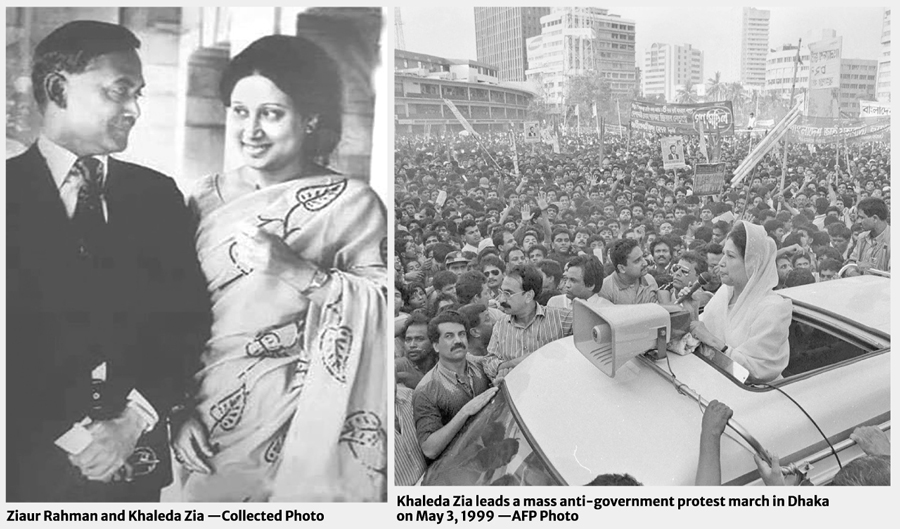
With the start of the War of Liberation in late-March 1971, Major Ziaur Rahman revolted against the Pakistan army on the night of March 25 and joined the liberation war. The Pakistani occupation forces took Khaleda Zia under their custody, and she was freed in Dhaka only after Bangladesh achieved victory on December 16 1971. Following the brutal assassination of President Ziaur Rahman on May 30 1981, the Bangladesh Nationalist Party (BNP) he founded faced serious crisis. Soon afterwards, the newly elected President of Bangladesh Justice Abdus Sattar was ousted through a military coup by the then army chief General Hussein Muhammad Ershad, who proclaimed martial law on March 24 1982.
At that time, many BNP leaders left the party and joined the military government. At this critical juncture, Khaleda Zia became the vice-president of BNP, and on May 10 1984, she was elected its chairperson. Under the leadership of Khaleda Zia, BNP formed the 7-party alliance in 1983 and launched a relentless movement against the autocratic regime of General Ershad. During the 9-year long struggle against Ershad, Khaleda Zia did not compromise with his dictatorial and illegitimate regime. The Ershad-government restricted her movements through application of prohibitive laws andshe was detained several times. But undaunted, Khaleda Zia continued to provide leadership in the movement for ousting Ershad.
In the face of a mass upsurge spearheaded by the alliances led by Khaleda Zia and Sheikh Hasina, Ershad finally handed over power to a neutral caretaker government led by Justice Shahabuddin Ahmed on December 6 1990. In the parliamentary elections held under this government on February 27 1991, Bangladesh Nationalist Party emerged victorious as the single-majority party. Khaleda Zia contested from five constituencies in three consecutive parliamentary elections including this one, and won in all the seats.
On March 20 1991, Khaleda Zia was sworn-in as the first female prime minister of Bangladesh. She piloted the historic 12th constitutional amendment bill that was passed in the Jatiya Sangsad on August 6 1991 to reintroduce the parliamentary form of government in place of the presidential one. Khaleda took oath as the prime minister under the new system on September 19 1991.
While in power during 1991-96, Khaleda Zia's government achieved commendable progress in the education sector, including introduction of free and compulsory primary education, tuition-free education for girls up to class ten, stipend for female students, and the Food for Education program. Tree plantation became a nationwide social movement during her tenure. The physical construction of the Jamuna Multipurpose Bridge wasalso started. Khaleda Zia played a commendable role in revitalising the South Asian Association for Regional Cooperation (SAARC) by hosting its summit in Dhaka in 1993. Her rule, however, was seriously disrupted by the violent opposition movement for a caretaker government for holding parliamentary polls, which was launched by the major opposition political parties including the Awami League (AL), Jatiya Party, and the Jamaat-e- Islami in 1994.
Khaleda Zia became the prime minister for a second consecutive term after BNP emerged victorious in the general election for the 6th Jatiya Sangsad (JS) held on February 15 1996. Most major parties, however, boycotted the polls. Their demand was to enact constitutional amendment for installing a neutral caretaker government during parliamentary elections. To meet this demand, the 6th JS passed the 13th Amendment to the Constitution, after which it was dissolved and Khaleda Zia handed over power to a caretaker regime on March 30 1996. In the polls that followed under the caretaker government headed by Justice Muhammad Habibur Rahman on June 12 1996, BNP was narrowly defeated by the Awami Leauge despite machinations by pro-AL Janatar Mancha bureaucrats.
During the 1996-2001 tenure of the AL-led government, Khaleda Zia played the role of Leader of the Opposition in the Jatiya Sangsad. In the next parliamentary elections held under a neutral caretaker government headed by Justice Latifur Rahman on October 1 2001, the BNP-led four-party alliance won over two-thirds of seats in the JS. On October 10 2001, Khaleda Zia was sworn-in as the country's prime minister for the third time.
Khaleda Zia's third tenure in office was marked by a steep rise in export earnings and remittances sent by expatriate Bangladeshi workers, a healthy growth in the industrial and telecommunication sector, gradual rise in foreign direct investments, formation of Rapid Action Battalion for improving the law-and-order situation, and massive crackdown against Islamic fundamentalist outfits including the JMB and HUJI. She left office on October 28 2006, but her party could manage only 30 seats in the subtly manipulated Ninth JS Election held on December 29 2008 under the caretaker regime of Dr Fakhruddin Ahmed. During the caretaker rule of 2007-8, a number of corruption cases were filed against Khaleda Zia and she was kept confined for almost one year. Subsequently, she became the Leader of the Opposition in the Ninth Jatiya Sangsad.
The BNP led by Khaleda Zia faced constant harassment and persecution by the AL regime during 2009-2014 both inside and outside the parliament; Khaleda Zia was even evicted from her officially sanctioned cantonment residence on November 13 2010. The party was powerless in preventing the 15th Amendment of Bangladesh Constitution in 2011 that repealed the provision of caretaker government for holding parliamentary elections. However, her party stuck to its stand of not participating in the Tenth JS Polls without a caretaker dispensation, which was ultimately held by the AL regime on January 5 2014. The election was boycotted by the masses as well as all opposition political parties except the Jatiya Party of HM Ershad; and astonishingly, as many as 153 parliament members out of 300 were elected unopposed. The relentless movement that the BNP and its allies waged for thwarting that election, however, did not bear any fruit. Rather, her party-men had to bear the brunt of an all-out crackdown launched by the mafialike fascist AL-regime before and after the polls. Even more appallingpatterns of fraudulence and electoral malpractices were observed during the Eleventh JSPolls held on 30 December 2018 and the Twelfth JS Election held on 7 January 2024, but the BNP and its allies were powerless to do anything about it in the face of relentless repression.
Meanwhile, Khaleda Zia was falsely implicated and sentenced to five years' imprisonment in the highly duplicitous and clearly cooked-up Zia Orphanage Trust Case by the Dhaka district judge's court on 8 February 2018, and the jail-term was subsequently raised without any justification to ten years by the Hasina-controlled High Court on October 31 2018. She was also convicted in a similarly fraudulent and cooked-up 'Zia Charitable Trust Case' on October 30 2018 and sentenced to 7 years' imprisonment by the AL-backed judges. Begum Zia was admitted to the BSMMU Hospital from jail on April 1 2019 for medical treatment, and then released from prison on March 25 2020 on condition that she would stay at home, not indulge in politics, and not leave the country, through an executive order issued under Section-401(1) of the Code of Criminal Procedure. This permission was renewed till August 2024 at intervals of six months following petitions submitted to the government by family-members. The false cases were withdrawn and the sentences commuted following the mass upsurge that ousted the fascist and autocratic regime of Sheikh Hasina on August 5 2024. Subsequently, the Appellate Division of Bangladesh Supreme Court overturned the High Court verdicts against Khaleda Zia after finding all allegations in the two cases as false and fabricated.
The icon of democratic tolerance and spirit of political accommodation in Bangladesh Begum Khaleda Zia passed away on December 30 2025 after suffering prolonged illnesses that originated from maltreatment and lack of medical care during months of incarceration under Hasina's fascist regime. May the Almighty grant her eternal peace and salvation.
Dr Helal Uddin Ahmed is a retired Additional Secretary and former Deputy Press Secretary to Prime Minister Begum Khaleda Zia. hahmed1960@gmail.com
© 2026 - All Rights with The Financial Express

