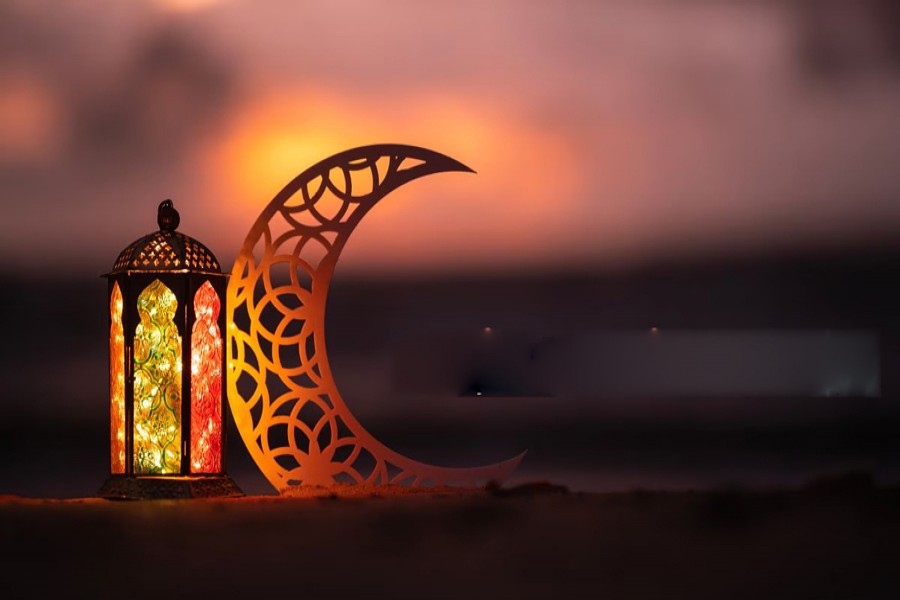
Eid al-Azha, also referred to by many as ?'Feast of Sacrifice' is the second of the two main festivals in Islam, alongside Eid al-Fitr. It falls on the 10th of Dhu'l-Hijja, the twelfth and final month of the Islamic calendar. Celebrations and observances are generally carried forward to the three following days, known as the Days of Tashreeq.
As with Eid al-Fitr, the Eid prayer is performed on the morning of Eid al-Azha, after which the udhiyah or the ritual sacrifice of a livestock animal is performed. In Islamic tradition, it honours the willingness of Ibrahim to sacrifice his son as an act of obedience to God's command. Depending on the narrative, either Ismail or Isaac is referred to with the honorific title "Sacrifice of God". Pilgrims performing the Hajj typically perform the tawaf and saee of Hajj on Eid al-Adha, along with the ritual stoning of the Devil on the Eid day and the following days.
The Arabic word 'Id' means 'festival', 'celebration', 'feast day', or 'holiday'. The word Id has a trilateral root, with associated root meanings of "to go back, to rescind, to accrue, to be accustomed, to repeat, to be experienced; appointed time or place, anniversary, or feast day". Arthur Jeffery contested this etymology, and believed the term to have been borrowed into Arabic from Syriac, or less likely Targumic Aramaic.
The holiday is called (Eid-al-Azha) or (Eid-al-Kabir) in Arabic. The words (a???) and (qurb?n) are synonymous in meaning-- 'sacrifice' (animal sacrifice) and 'offering'.
The first word comes from the trilateral root (?a???) with the associated meanings "immolate; offer up; sacrifice; victimise". No occurrence of this root with a meaning related to sacrifice occurs in the Qur'an but only in the Hadith literature. Assyrians and other Middle Eastern Christians also use the term to mean the Eucharistic host. The second word derives from the root?? (qaraba) with associated meanings of "closeness, proximity, to seek water sources or sacrifice". Arthur Jeffery recognises the same semitic root, but believes the sense of the term to have entered Arabic through Aramaic.
Eid al-Adha is pronounced Eid al-Azha primarily in Iran and influenced by the Persian language, in the Indian subcontinent. In Turkish-speaking countries, it is called "Kurban Bayram?".
According to Islamic tradition, one of the main trials of Abraham's life was to receive and obey the command of God to sacrifice his eldest son, Ishmael (both known as Ibrahim and Ismail in Arabic). Muslims overwhelmingly reject the Biblical claim that Isaaq, Abraham's second son, was supposed to have been the designated victim. According to the Qur'an, Ibrahim kept having dreams in which he killed his son. He interpreted this as a command from God. The prophet told his son-- "O my dear son! I have seen in a dream that I ?must? sacrifice you. So tell me what you think." He replied, "O my dear father! Do as you are commanded. Allah willing, you will find me steadfast." -?Surah As-Saffat 37:102
Ibrahim prepared to submit to the will of God and to slaughter his son as an act of faith and obedience to God. During the preparation, Satan tried to dissuade Ibrahim and his family from carrying out God's commandment, so Ibrahim drove Satan away by throwing pebbles at him. In commemoration of their rejection of the devil, pilgrims to Mecca throw stones at pillars that mark the place where Satan tried to tempt Ibrahim.
Acknowledging that Ibrahim was willing to sacrifice what was dear to him, God honoured both Ibrahim and his son. The Angel Gabriel (Jibreel) proclaimed, "O Ibrahim, you have fulfilled the revelations," and a ram from heaven was offered by Angel Gabriel to Prophet Ibrahim to slaughter instead of his son. When Muslims celebrate Eid al-Adha, they commemorate both Ibrahim's willingness to afflict his family and his son Ismail's willingness to die for God.
This story is known as the Akedah in Judaism (Binding of Isaac) and originates in the Torah, in the first book of Moses (Genesis, Ch. 22). The Akedah is referred to in the Quran in its 37th Surah, As-Saffat. The word "Eid" appears once in Al-Ma'ida, the fifth surah of the Quran, with the meaning "a festival or a feast".
During the Eid and Tashreeq days, Muslims recite the takbir. Like on Eid al-Fitr, the Eid prayer is performed on Eid al-Adha any time after sunrise and before the Zuhr prayer.
In the event of a force majeure, the prayer may be delayed to the day after or the second day after Eid. The Eid prayer is followed by a khutbah (sermon). At the conclusion of the prayers and sermon, Muslims embrace and exchange gifts and greet one another saying Eid Mubarak. Many Muslims also take this opportunity to invite their friends, neighbours and colleagues to the festivities to better acquaint them about Islam and Muslim culture.
The tradition for Eid al-Adha involves slaughtering an animal and sharing the meat in three equal parts - for family, for relatives and friends, and for poor people. The goal is to make sure every Muslim gets to eat meat. However, there is a dissent among Muslim scholars regarding the obligatory nature of this sacrifice. While some scholars, such as Al-Kasani, categorise the sacrifice as obligatory (w??ib), others regard it only as an "established custom" (Sunnah mu'akkadah). Alternatives such as charitable donations or fasting have been suggested to be permissible by several fuqaha.
Muslims are expected to dress in their finest clothing to perform Eid prayer in a large congregation in an open field called Eidgah or mosque.
In Bangladesh Eid Ul Azha is commonly known as Qurbani Eid among Bengalis, which means the festival of Qurbani (sacrifice). Bangladesh sacrifices most animals per year during Eid Al Azha. Estimates indicate that nearly 7 million animals are sacrificed each year.
Starting from the first day of Dhul-Hijjah, temporary cattle markets, known as haat, begin to appear across Bangladesh. The animals are traditionally decorated with garlands. Many working people in Dhaka go back to their hometowns to celebrate. Traditional Bengali meat dishes like Kala bhuna, Chui Jhal, Khasir Rezala and Qorma are eaten with pulao or rotis, traditionally made of rice flours, or pithas like chitoi and soi pitha. In Sylhet, Nunor Bora and Handesh are traditionally served as snacks during tea times or addas.
While Eid al-Azha is always on the same day of the Islamic calendar, the date on the Gregorian calendar varies from year to year as the Islamic calendar is a lunar calendar and the Gregorian calendar is a solar calendar. The lunar calendar is approximately eleven days shorter than the solar calendar.
Each year, Eid al-Adha (like other Islamic holidays) falls on one of about two to four Gregorian dates in parts of the world, because the boundary of crescent visibility is different from the International Date Line. The official dates of Eid al-Azha for Saudi Arabia are announced by the Supreme Judicial Council. Future dates are estimated according to the Umm al-Qura calendar of Saudi Arabia. The Umm al-Qura calendar acts as a guide for planning purposes and is not the absolute determinant or fixer of dates. Confirmations of actual dates by moon sighting are applied on the 29th day of the lunar month prior to Dhul-Hijjah to announce the specific dates for both Hajj rituals and the subsequent Eid festival. The three days after the listed date are also part of the festival.
The three days after the listed date are also part of the festival. The time before the listed date the pilgrims visit Mount Arafat and descend from it after sunrise of the listed day.
In many countries, the start of any lunar Hijri month varies based on the observation of the new moon by local religious authorities, so the exact day of celebration varies by locality.
Animals offered for sacrifice are required to be free from defects like- blindness or broken legs. The time of sacrifice begins following the Namaz of Eid ul Azha and continues up to the sunset of the next two/three days. A cow or buffalo can be sacrificed in the names of seven persons, while a lamb or a goat can be in the name of one person only.
Two Ayats (verses) from the Holy Quran - Ayats 80 and 163 of Surah An'am are read at the time of Jabah. This is done with the face looking upwards towards Allah. Then the Jabah is done by uttering "Bismillahi Allahu Akbar". The Holy Quran also mentions clearly in (22:37) -"the blood of the sacrificed animal does not reach Allah, neither its meat- what reaches Him is only your "takwa".
The hide of the sacrificed animal can be donated by the owner to others or sold and the money received given to the poor or orphanages.
Like all other Muslims in the world, Muslims of Bangladesh celebrate Eid ul Azha with religious passion and dedication. A few days are declared as government holidays and the Eid congregational prayer is held in large mosques and open fields. The radio and television also broadcast and telecast special programmes and newspapers publish special features highlighting the significance of the occasion.
One needs to conclude by recalling that Bengali literature was significantly influenced by Eid ul Azha and the most prominent evidence of this was the "Qurbani", the classic poem by our National Poet Kazi Nazrul Islam.
Muhammad Zamir, a former Ambassador is an analyst specialised in foreign affairs, right to information and good governance. muhammadzamir0@gmail.com
© 2026 - All Rights with The Financial Express

