The International Court of Justice (ICJ) has recently pointed out that climate change is beginning to become an existential threat for humanity. In this context environmentalist Cecilia Russel has drawn the attention of the world to some observations made recently by the ICJ Judge Yuji Iwasawa. pertaining to a case he had come across.
This case was not simply a "legal problem" but "concerned an existential problem of planetary proportions that imperils all forms of life and the very health of our planet," Iwasawa said. It was noted that "A complete solution to this daunting and self-inflicted problem requires the contribution of all fields of human knowledge, whether law, science, economics or any other; above all, a lasting and satisfactory solution requires human will and wisdom at the individual social and political levels to change our habits, comforts, and current way of life to secure a future for ourselves and those who are yet to come."
The opinion was welcomed by Ralph Regenvanu, Minister of Climate Change Adaptation, of Vanuatu. It was observed that "The ruling is a landmark opinion that confirms that vulnerable nations have legal obligations to protect their environment and act on climate change and that these are guaranteed by international law and by human rights law."
Margaretha Wewerinke-Singh, legal counsel for Vanuatu's ICJ case and international lawyer at Blue Ocean Law, has also welcomed the opinion, saying it even included the United States, which has recently withdrawn from the Paris Agreement, contrary to moral obligation that includes all States within the United Nations.
The detailed advisory opinion dealt with obligations of States under various climate conventions and treaties and humanitarian law. The Court concluded that in terms of the climate agreements, State parties to the United Nations Framework Convention on Climate Change - (a) have an obligation to adopt measures with a view to contributing to the mitigation of greenhouse gas emissions and adapting to climate change, (b) have additional obligations to take the lead in combating climate change by limiting their greenhouse gas emissions and enhancing their greenhouse gas sinks and reservoirs, (c) also have a duty to cooperate with each other in order to achieve the underlying objective of the Convention and must comply with applicable provisions of the Kyoto Protocol, (d) consistent with the Paris Agreement they have an obligation to act with due diligence in taking measures in accordance with their common but differentiated responsibilities and respective capabilities of making an adequate contribution to achieving the temperature goal set out in the agreement, (e) they also have a responsibility to prepare, communicate and maintain successive and progressive, nationally determined contributions, which, when taken together, are capable of achieving the goal of limiting global warming to 1.5 degrees celsius above pre-industrial levels.
In addition, the Court was of the opinion that customary international law sets forth obligations for states to ensure the protection of the climate system and other parts of the environment from anthropogenic greenhouse gas emissions. These obligations include the following:
-States have a duty to prevent significant harm to the environment by acting with due diligence and to use all means at their disposal to prevent activities carried out within their jurisdiction or control from causing significant harm to the climate system and other parts of the environment in accordance with their common but differentiated responsibilities and respective capabilities,
-States have a duty to cooperate with each other in good faith to prevent significant harm to the climate system and other parts of the environment, which requires sustained and continuous forms of cooperation by states when taking measures to prevent such harm,
-State parties to the Vienna Convention for the Protection of the ozone layer and to the Montreal Protocol on Substances that Deplete ozone layer and its Kigali amendment, the Convention on Biological Diversity, and the United Nations Convention to Combat Desertification in those countries experiencing serious drought and/or desertification, particularly in Africa, have obligations under these treaties to ensure the protection of the climate system and other parts of the environment from anthropogenic greenhouse gas emissions,
-State parties to the United Nations Convention on the Law of the Sea have an obligation to adopt measures to protect and preserve the marine environment, including from the adverse effects of climate change, and to cooperate in good faith.
Interestingly, the Court did not end there. It was of the opinion that States also have obligations under international human rights law and are required to take "measures to protect the climate system and other parts of the environment."
Environmentalists have also observed that the global destruction of wetlands, which support fisheries, agriculture and flood control, may mean the loss of US Dollar 39 trillion in economic benefits by 2050, according to a report by the Convention on Wetlands released recently. Some 22 per cent of wetlands, both freshwater systems such as peat lands, rivers and lakes, and coastal marine systems including mangroves and coral reefs, have disappeared since 1970. Pressures, including land-use change, pollution, agricultural expansion, invasive species, and the impacts of climate change -- such as rising sea levels and drought -- are driving the declines.
"The scale of loss and degradation is beyond what we can afford to ignore," has been observed by Hugh Robertson, the lead author of the Report. The Report has also called for annual investments of US Dollar 275 billion to US Dollar 550 billion to reverse the threats to the remaining wetlands, and has noted that the current spending was a "substantial under-investment" without giving figures. The Report has also referred to the fact that it needs to be realised that the world has lost 411 million hectares of wetlands and a quarter of the remaining wetlands are now classified as in a state of degradation. The Report has also indicated that wetland deterioration is particularly acute in Africa, Latin America, and the Caribbean, but is worsening in Europe and North America.
It may be noted at this point that rehabilitation projects are, however, underway in some countries including Zambia, Cambodia and China.
At this juncture, one needs to also refer to climate adaptation. It is the process of adjusting to the effects of climate change, both current and anticipated. Adaptation aims to moderate or avoid harm for people, and is usually done alongside climate change mitigation. It also aims to exploit opportunities. Adaptation can involve interventions to help natural systems cope with changes.
Adaptation can also help manage impacts and risks to people and nature. The four types of adaptation actions are infrastructural, institutional, behavioural and nature-based options.? Some examples are building seawalls or inland flood defences, providing new insurance schemes, changing crop planting times or varieties, and installing green roofs or green spaces. Adaptation can be reactive (responding to climate impacts as they happen) or proactive (taking steps in anticipation of future climate change).
The need for adaptation varies from place to place. Adaptation measures vary by region and community, depending on specific climate impacts and vulnerabilities. Worldwide, people living in rural areas are more exposed to food insecurity owing to limited access to food and financial resources. Adaptation needs are high for food, water and other sectors important for economic output, jobs and incomes. One of the challenges is to prioritise the needs of communities, including the poorest, to help ensure they are not disproportionately affected by climate change.
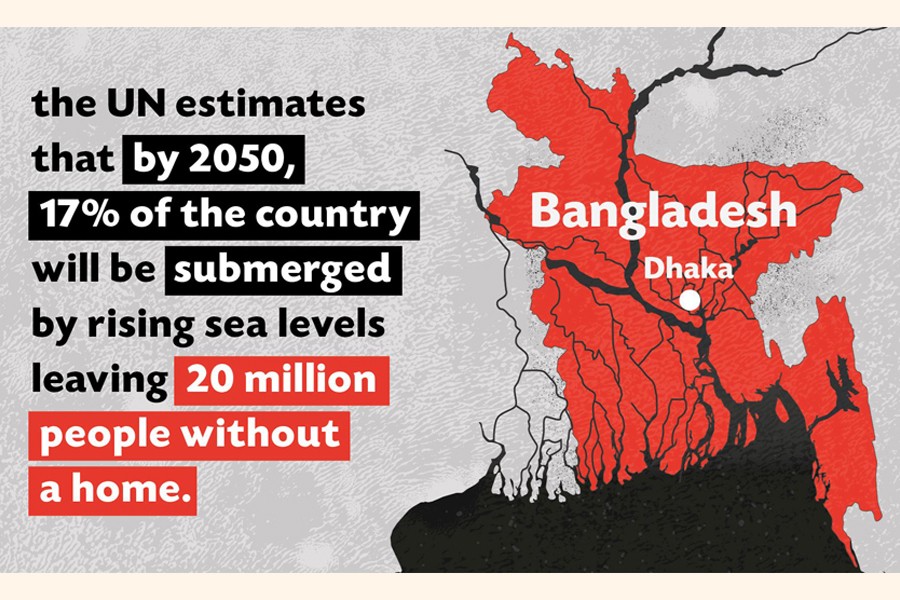
Regarding climate adaptation and impact investment issues, CARE Bangladesh has highlighted the limitations of conventional grant-based humanitarian assistance. Bangladesh, it has been pointed out seeks sustainable finance as climate impacts deepen. With rising sea levels, frequent cyclones, riverbank erosion, and unpredictable rainfall threatening millions of livelihoods, experts are now emphasising that the country can no longer rely solely on traditional humanitarian aid.
Apparently, according to the World Bank, Bangladesh loses an estimated 1.5-2 per cent of its GDP annually due to climate-related disasters. The Intergovernmental Panel on Climate Change (IPCC) has repeatedly identified South Asia, particularly Bangladesh, as a climate hotspot, with coastal and low-lying regions facing some of the most severe impacts.
Recent discussions by CARE-Bangladesh have highlighted the limitations of conventional grant-based humanitarian assistance. Kaiser Rejve, Director of CARE's Humanitarian & Resilient Futures Programme has in this context observed that "Traditional aid is often reactive, fragmented, and unsustainable. Communities need solutions that can generate revenue, sustain livelihoods, and scale locally-owned adaptation practices." Oxfam Bangladesh has also highlighted this sentiment. In a policy brief, the organisation pointed out that while emergency aid remains critical, long-term resilience depends on market-driven approaches linking environmental sustainability with income-generating activities. Impact investment can play a transformative role if it is designed around community needs and guided by local knowledge."
A representative from BRAC has also noted that: "impact investment is meaningful only if communities are at the centre of the process. They are the ones experiencing the consequences of climate change first-hand. Solutions must be tailored to their realities."
Md Shamsuddoha, of the Centre for Participatory Research and Development (CPRD) has, however, raised concerns about relying too heavily on private capital for climate adaptation. He has cautioned that adaptation cannot be viewed solely through a profit-driven lens: "Private finance is profit-driven, and many adaptation activities may not generate profits, particularly those related to human welfare and well-being. We can mobilise private finance for techno-physical solutions such as strengthening embankments to protect coastal communities. However, extended and residual impacts-like displacement, migration, or health crises-should not be addressed through private or loan-based financing."
In Bangladesh, we need to carefully move forward in finding solutions to the different dimensions related to required steps.
Muhammad Zamir, a former Ambassador is an analyst specialised in foreign affairs, right to information and good governance.
muhammadzamir0@gmail.com
© 2026 - All Rights with The Financial Express

