 As he emerged from a meeting with the King at Buckingham Palace in the 1930s, Gandhi was asked if the monarch had commented on his threadbare clothes, meaning his dhoti. Gandhi quipped, 'No, he was wearing enough for the both of us.'
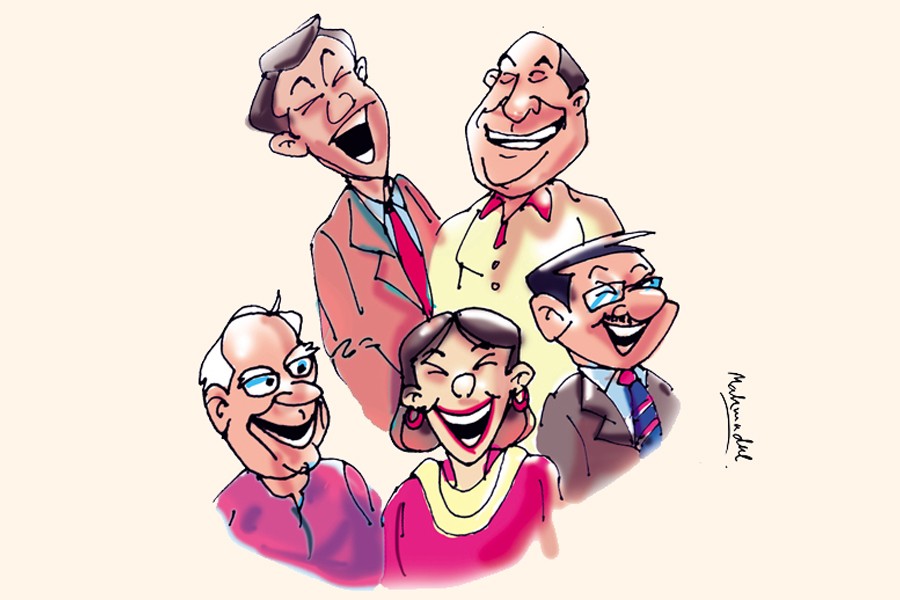
Time was when humour often enlivened politics. Not so any more. In these difficult times we inhabit, politicians are often combative, sometimes insulting toward one another. Political comments come with a heavy coating of the abrasive.
In the mid-1960s, French President Charles de Gaulle was asked for his views on China, whose communist leadership at the time had largely not been recognised in the West. China for much of the West was yet Red China. De Gaulle's response was facetious: "China is a big country and many Chinese live in it." His audience burst into laughter.
Today one is quite appalled at the absence of humour which once characterised politics around the globe. In our subcontinent, there was a time when politicians engaged in repartee without malice despite their disagreement on policies. Atal Behari Vajpayee was a past master at it.
In the early days of Pakistan, a West Pakistani politician thought of tripping up Shere Bangla AK Fazlul Huq in a friendly manner: "Huq saab, how is it that in West Pakistan people are so tall but by the time we get to East Pakistan we find the people there so short?" Shere Bangla's response was an instance of ready humour: "That may be so, but first you tell me how it is that in East Pakistan people's brains are so huge but by the time we go to West Pakistan, we find brains there rather small?"
Wit has often led to an unlocking of tension and given politicians some much needed space for relief from stress. The rather corpulent Indian politician Piloo Mody comes to mind. On one occasion, clearly unable to agree with a statement a minister happened to be making in the Lok Sabha, Mody rose from his seat, provocatively turned his back to the minister and just as quickly sat down. The act did not escape the notice of the minister, who swiftly drew the attention of the Speaker to the offensive behaviour. The Speaker asked Mody if he had indeed shown his back to the honourable minister. Mody responded thus: "Mr. Speaker Sir, please take a good look at me. I have no front, no back and no flanks. I am round all over. So how could I have shown the honourable minister my back?" The House erupted in loud laughter.
John F. Kennedy's wit was spontaneous. On a state visit to France in 1961, he was asked for his comments on the trip. He made everyone break into laughter with his response: "Let's just say I was the man who accompanied Jacqueline Kennedy to Paris." Abraham Lincoln's preoccupation with matters of state did not affect his sense of humour. Observe his natural humour: "After 40, every man gets the face he deserves." Once, while arguing a political point, he had this analogy to offer: "How many legs does a dog have if you call the tail a leg? Four. Calling a tail a leg doesn't make it a leg."
Sometimes, there is gallows humour. On the night Indian Prime Minister Lal Bahadur Shastri died in Tashkent in January 1966, Pakistan's foreign secretary Aziz Ahmed woke up his boss, Foreign Minister Bhutto, to tell him: "Sir, the bastard is dead." Bhutto's response: "Which one?" You see, at that point of time, Shastri and Pakistan's President Mohammad Ayub Khan were equally evil in Bhutto's eyes, for they had in Bhutto's opinion committed the sin of initialling an agreement he could not agree with. Hence that remark.
Winston Churchill was noted for his barbs. Gandhi was, to him, a half-naked fakir. And his view of Clement Attlee? "An empty cab drew up outside Downing Street and out of it stepped Clement Attlee." In his youth, campaigning for his first election to the House of Commons, he approached a young man who refused to extend his hand to him. The young man told him, "I'd rather vote for the Devil than vote for you." Churchill calmly responded: "I understand, but supposing your friend decides not to run, can I count on your vote?" Imagine the confusion that young man must have been thrown into.
Charles de Gaulle, asked how it felt being president of France, replied thus: "How can you govern a nation which produces 247 different kinds of cheese?" His opinion of Belgium certainly did not endear him to the people of that country: "Belgium: a country invented by the British to annoy the French." Campaigning against a hapless Jimmy Carter in 1980, Ronald Reagan told Americans: "Recession is when your neighbour loses his job. Depression is when you lose yours. And recovery is when Jimmy Carter loses his." And there was always more, as in the following dig at pro-abortion groups: "I've noticed that everyone who is for abortion has already been born." How does one respond to that?
Humour came naturally to Benjamin Disraeli. In the House of Commons, a member noted that the prime minister, which Disraeli was at the time, had repeatedly been using two words, 'misfortune' and 'calamity' in the course of his speech. When he wished to know the difference between the two terms, Disraeli, with a gleam in his eyes, pointed to William Gladstone on the opposition benches and said: "Now see Mr. Gladstone there? If he fell into the Thames, it would be a misfortune. But if we picked him out of it, it would be a calamity." The statement brought the House down.
Soviet leader Nikita Khrushchev had this to say about politicians: "Politicians are the same all over. They promise to build bridges even when there are no rivers." India's Jawaharlal Nehru was a serious man, but even he sometimes gave vent to wit which came out as aphorisms. An instance: "Great causes and little men go ill together." Gandhi once said: "If I had no sense of humour, I would long ago have committed suicide." Disraeli once declaimed: "There are three kinds of lies: lies, damned lies and statistics."
Churchill was once asked what he thought of pigs. His response remains a model of educative humour. This is what he said: "I like pigs. Dogs look up to us. Cats look down on us. Pigs treat us as equals." And Abraham Lincoln's witty take on writers? Here is how he looked at the issue: "Those who write clearly have readers. Those who write obscurely have commentators."
The last word in humour is of course Bishop Desmond Tutu's. Commenting on the arrival of Christian missionaries in his native land, he said: "When the missionaries came, they had the Bible and we had the land. They asked us to pray. We closed our eyes and prayed. When we opened our eyes, they had the land and we had the Bible."
ahsan.syedbadrul@gmail.com
© 2026 - All Rights with The Financial Express

