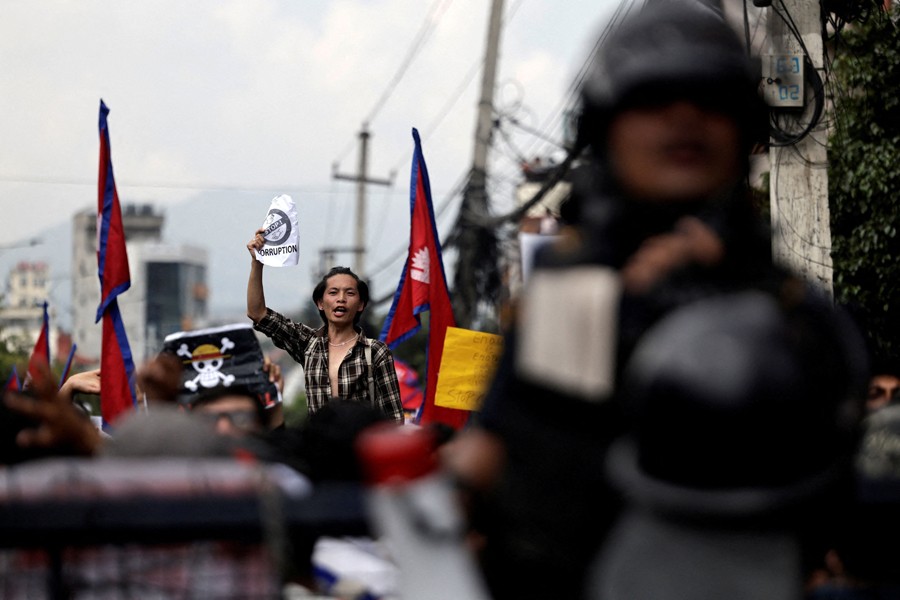
 A demonstrator shouts slogans during a protest against corruption in Kathmandu, Nepal on September 8, 2025 —Agency Photo
 Nepal emerged from a brutal decade-long Maoist insurgency in 2006 and also marked the end of the country's 240-year-old Hindu monarchy in 2008. However, the transformation into a federal state was marred by political infighting, and successive governments dragged their feet on bringing perpetrators of abuses committed during the civil war to justice.
Between 1996 and 2006, the Communist Party of Nepal (Maoist) waged a rebel-led war aimed at toppling the monarchy for democratic rule. The conflict killed more than 10,000 people. In 2006, protests involving political parties, civil society and students forced the monarch, King Gyanendra, to cede power. The movement paved the way for the abolition of the monarchy and, in 2008, the declaration of Nepal as a democratic republic. Since then, eight men from the three main parties - the Communist Party of Nepal (Unified Marxist-Leninist) (CPN-UML), the Communist Party of Nepal (Maoist Centre) (CPN-MC) and the Nepali Congress (NC) - have led the country 14 times. Oli, who resigned on September 9, was serving his fourth term.
More than 30 people were killed in the recent clashes with police during the week-long mass protests sparked by a ban on social media platforms in Nepal.
The protests were triggered by the government's decision to ban 26 social media platforms, including WhatsApp, Instagram and Facebook, but they soon widened to embody much deeper discontent with Nepal's political elite. In the weeks before the ban, apparently, a "nepo kid" campaign, spotlighting the lavish lifestyles of politicians' children and allegations of corruption, had taken off on social media.
Nepal's first woman Supreme Court Chief Justice Sushila Karki -- now the country's new Prime Minister -- is known for her insistence on integrity and the need for an independent judiciary.
Sushila Karki is Nepal's first woman Prime Minister, but is not its first woman leader. Bidya Devi Bhandari held the largely ceremonial role of President for two terms from 2015 to 2023.
Karki, who took the oath of office on September 12 from President Ram Chandra Paudel, will lead the political transition in the geo-strategic Himalayan nation after deadly anti-corruption protests. The 73-year-old emerged as the leading candidate of many representatives of "Gen Z" -- the loose umbrella title of the protest movement -- who selected her via online platform "Discord".
She has told the Nepali media that the Gen Z protesters had told her that "they believe in me" to lead for "a short time for the purpose of doing elections". "She is a credible choice to lead the interim government," Anil Kumar Sinha, a former Justice of the Supreme Court who worked with Karki has told AFP, "Her integrity has never been in doubt, and she is not someone who can be intimidated or easily influenced. She is courageous and not swayed by pressure."
It may in this regard be recalled that in a speech broadcast on Nepali media earlier this year, Karki spoke of ingrained corruption. She had observed that "we see it everywhere but we don't speak -- now we need the youth to speak up, take the lead and stand in elections. What I have seen in the last 35 years does not work. I am 100 per cent in favour of youth coming forward."
It needs to be mentioned that her tenure as Chief Justice, from 2016 to 2017, was brief but significant -- challenging gender stereotypes and facing down politicians over corruption. She did so in a society where women rarely entered the legal profession. Born in 1952 in Biratnagar, an industrial town in eastern Nepal, she earned degrees in political science in India and in law in Kathmandu. She began her career as a lawyer in 1979, and quickly gained a reputation as a fearless advocate, often taking up cases others avoided.
Following the taking of oath of a new Prime Minister, the Kathmandu District Security Committee has lifted the curfew and prohibitory orders that had been enforced in Kathmandu in recent days. Senior Superintendent of Police Bishwo Adhikari has observed that while the restrictions have been removed across most of the Valley, certain sensitive areas will still remain under prohibitory order to prevent demonstrations and unrest.
The decision came a day after President Ramchandra Paudel appointed Sushila Karki as the new Prime Minister. Karki, 73, was sworn in during a brief ceremony, becoming the first woman to lead the needy Himalayan nation after a deal was reached with the protest leaders.
This decision to have an interim Prime Minister in Nepal that had emerged after the mass movement forced former Prime Minister KP Sharma Oli to resign. An agreement was then reached between President Ram Chandra Poudel and the protest leaders after days of consultations. Legal experts were also involved. Parliament was dissolved late on September 12 and it was announced that general elections would be held on March 5, next year.
Karki is expected to appoint ministers in her cabinet within a few days. Her cabinet will face multiple challenges -- restoring law and order, reconstructing parliament and other key buildings that were attacked and severely burnt. Karki will also have to tread carefully so that her interim government can reassure the Gen Z protesters and others who want change in Nepal that they do not need to be fearful. Another key task will be to bring about proper dispensation of justice.
Karki's appointment has been the result of compromise in the talks held in Kathmandu that were brokered by Nepal's army chief. Elated Gen Z supporters are now expressing their happiness on social media and many see this as the next step in the new political course they want the country to take.
Karki has already visited the protest site in Kathmandu where 19 people were killed in clashes with police. She has also met some of the injured who were being treated in hospital.
At this juncture one needs to recall a few incidents that marked Karki's earlier life. In 2012, Karki was one of two presiding Supreme Court judges who jailed a serving government minister for corruption -- a first at the time for Nepal in its battle against a culture of graft. In 2017, the government also tried to impeach her as Chief Justice after she overturned its choice for Chief of Police. The United Nations called the impeachment "politically motivated" and the move was blocked. She stepped down from the post at her retirement. But it was under Karki's watch as Chief Justice that a court in 2017 sentenced three soldiers to 20 years in jail for the murder of a teenage girl.
It needs to be understood that what happens in Nepal matters well beyond the borders of the landlocked country that sits on the southern slopes of the Himalayas and lies between two regional giants: China to the north and India to the south, east and west.
Though historically close to India, Nepal's foreign alignments have shifted with domestic politics. Oli was widely seen as leaning towards Beijing, and his removal has prompted speculation about a recalibration of influence in Kathmandu.
Lokranjan Parajauli, a social scientist who has written extensively on social movements and politics, has suggested that the next ruler is likely to be an "independent" figure, not aligned with any party.
However, a longtime human rights activist in Kathmandu, speaking on condition of anonymity, has said that regardless of the identity of the new leader, both India and China will seek stability and a government that "respects their interests". "Neither neighbour wants to see the other exercise too much influence in Nepal," the activist told Al Jazeera. Analyst Tripathy has also emphasised Nepal's historical balancing act. He has observed that "Nepal has always had friendly ties with both its neighbours, China and India. Culturally, we are closer to India in the southern part, while the northern part has cultural similarities with China. But our motto has always been to maintain a balanced relationship between both countries, and we will continue the same notion." Ali Hassan, a South Asia specialist at UK-based Healix, a risk management company, has argued that Oli's fall could serve as a setback for Beijing in Kathmandu and a potential opening for New Delhi.
Sections of Indian Prime Minister Narendra Modi's Bharatiya Janata Party (BJP) have also been aligned with the pro-monarchist movement in Nepal, which argues that the Himalayan nation needs the Ranas back in power. The former monarch, Gyanendra, received a huge public reception in Kathmandu earlier this year, pointing to the continuing support for the former rulers among sections of Nepali society. If the pro-monarchy movement gains from the current political crisis in Nepal, that might benefit the BJP, Hassan said. However, he added that the Gen Z protesters who removed Oli do not appear to favour a return of Gyanendra.
Meanwhile, Pakistan will also be watching developments in Nepal closely, say analysts. Compared with India and China, Nepal's relations with Pakistan have historically been cordial but limited in strategic significance. Nevertheless, Nepal's rulers have used ties with Pakistan, at times, to remind India of their own regional options. More recently, at the height of India-Pakistan tensions in May, after gunmen had killed 26 civilians in Indian-administered Kashmir, Nepal hosted a delegation from Pakistan's National Defence University, leading to raised eyebrows in New Delhi, which had long viewed Oli as too close to Beijing - Pakistan's closest ally - for comfort.
The situation will require very careful handling by the Prime Minister. Karki and her interim government. There should also be transparency and accountability while determining culpability.
Muhammad Zamir, a former Ambassador is an analyst specialised in foreign affairs, right to information and good governance. muhammadzamir0@gmail.com
© 2026 - All Rights with The Financial Express

