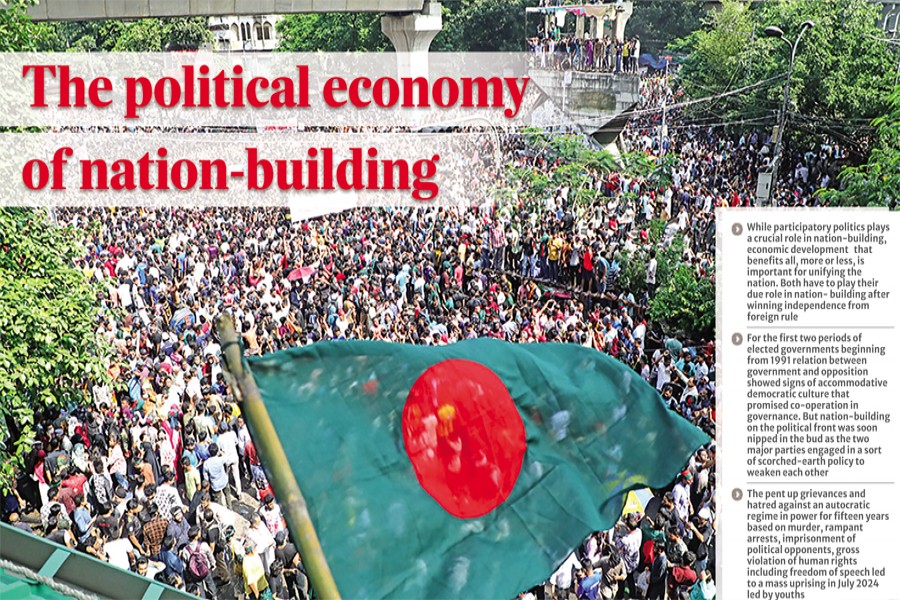
 Mass uprising in July 2024 brings a great opportunity to make a fresh start at nation-building —BSS Photo
 A textbook definition of the well-worn word ‘nation’ may denote ‘a group of people who share a common identity based on shared history, culture, tradition, custom, religion, language and a sense of unity or belonging together. Here, ‘nation’ is mostly about people and does not refer to land (territory) or state. A nation may have their own territory with a state and sovereignty (e.g. Egypt) or it may be a group of people that has a territory but not a state (e.g. Gaza). A third example of a nation may be the Jews in diaspora before the establishment of the state of Israel when they did not have a territory of their own. According to the text book definition, a nation is a community of people who feel connected because of common experiences resulting from some shared things, tangible and intangible, in the past and at present. When this feeling of unity and connectedness is roused through propaganda and preaching, nationalism is born. In other words, a nation exists if the characteristics mentioned above prevail among a group of people but nationalism may lie dormant. Nationalism is awakened by a stimulus deliberately given by somebody or an organisation (a political party) in a sustained manner to mobilise the ‘historical nation’ to say or act in unison on issues affecting them collectively. The occasion for this may emanate from actual or perceived assault by power that be (alien rulers) on the cherished beliefs, values and life style of communities and their common interests. In a summary form, these issues may simply be embodied in the demand for freedom from alien rule.
While being a nation is a historical fact for a group of people with shared tradition and experiences, feeling of nationalism is the product of a political process and activism that may either affirm belonging to the ‘historical nation’ or signal allegiance to a group of people who feel alienated from the historical nation. Such groups, propelled by nationalism, can consider themselves as ‘political nations’ which becomes in the course of time historical if they win political independence. History shows, feeling of nationalism among groups of people germinates and blossoms in circumstances of political repression and economic exploitation by alien rulers or a majority group within the historical nation. In such situations, nationalism inspires a group of people in a ‘historical nation’ to rebel against alien rule or the majority - ruling group with a view to becoming free to form a state of their own. But nationalism also has another meaning and origin that is not related to alien rule and the desire to break free from the same. In the decades of ‘30s and ‘40s in twentieth century, nationalism became strident in Italy, Germany and Japan based on national superiority and territorial expansion. The trajectory of nationalism in the former case is different from the latter. While nationalism in the former case has both positive and negative aspects, in the latter case nationalism has proved to be an unmitigated disaster. Nationalism of the second type can be analysed from case studies of the countries that experienced it to know how and why it originates but it has little relevance in the case of majority of countries. Even though Donald Trump’s brand of nationalism (Make America Great Again) comes very close to its predecessor in Mussolini’s Italy and Hitler’s Germany, it is not likely to last once the ‘changing of the guards’ takes place at the White House. Populism that has raised its ugly head in some European countries, including Trump’s hard core constituencies, is a close kin of extremist nationalism but not as sinister as nationalism in Mussolini’s Italy or Hitler’s Germany. Nationalism becomes an interesting subject of study when it is seen as the main instrument in the struggle for independence against alien rulers and subsequently, pressed into service in nation-building in an independent state. This is an ideal scenario and it should be interesting to see what has been its trajectory in selected case studies.
Asia and Africa: Many nations in Asia and Africa became independent from colonial rule after waging struggle for freedom on the back of nationalism. After winning independence, nationalism lost its erstwhile role of galvanising the nation against a foreign ruler and waited to be transmuted into a new incarnation relevant to the post-independence phase. Some countries downplayed the role of nationalism and devoted to electoral democracy based on party politics. Both good and bad faith were at play in the conduct of political parties in the practice of democracy that followed the departure of colonial rulers. A few countries managed to keep the ideal of democracy alive in their polity while many subverted its practice giving rise to centralised democratic autocracy. Democracy had setbacks in the latter group of countries not least because of the fractured nature of nation, creating political instability and popular unrest. The failure to transform nationalism into a new channel to mobilise and unify the nation proved to be very costly in terms political stability to backstop economic development. Nation-building in countries having diverse groups in terms of ideas, interests and aspirations was, by and large, taken for granted. In the worst instances, it was steamrolled, with different groups constituting the ‘political nation’ subjected to regimentation. While participatory politics plays a crucial role in nation-building, economic development that benefits all, more or less, is important for unifying the nation. Both have to play their due role in nation- building after winning independence from foreign rule. Failure to carry out adequate nation-building leads to fracturing of nation which for lack of unity fails to move forward in a sustained manner. This hypothesis is examined bellow, using Bangladesh as a test case.
Nationalism and nation-building — Pre-Bangladesh case: After independence from British colonial rule in 1947, Bengalis in East Pakistan had almost all the characteristics of a nation sharing a common past and culture. But they did not consider themselves as a ‘political nation’ separate from West Pakistanis at the time. Pan-Islamism that propelled the Pakistan movement still acted as the catalyst for nationalism for majority of East Pakistani Bengalis. It was only after the language movement in 1952 that Bengali nationalism had its first awakening. As the exploitative rule and repression by the west Pakistani rulers continued and magnified, the feeling of nationalism grew in strength and enlarged its remit. Disenchantment with Pakistani nationalism had its roots in two areas of national life: (a) Unequal participation in the politics and administration of the country; and (b) Inequitable distribution of benefits from economic development under state sponsorship. In short, both politically and economically, Bengalis in East Pakistan felt discriminated. Lagging in education and lacking home-grown entrepreneurs were given as explanation for the backwardness of East Pakistani Bengalis but these could not be excuses for not taking affirmative action to ensure egalitarian development of the two groups of people, advanced West Pakistanis and backward East Pakistanis. The disparity in political and economic life of the Pakistani nation inevitably bred the idea of ‘two nation theory’ in respect of economic development. Resistance and later half-hearted response by West Pakistani policy makers to the demand for redressing the economic imbalance underlying the two-nation theory led to the formulation of six-point charter that combined both political and economic measures to address disparity. Unwillingness to agree on this meant the West Pakistani policy makers failed to see this charter as an attempt at nation-building. Their refusal fuelled Bengali nationalism to a fever-pitch, ultimately leading to the emergence of independent Bangladesh.
Nation- buliding in Bangladesh: In independent Bangladesh the importance of nationalism was recognised and it was enshrined in the constitution of the new state. But in the process its different role before and after independence was ignored and it was simply recognised as a political force, similar to its original incarnation. Because of this error its role in nation-building was neglected. Not only that, it divided the nation into Bengali and other ethnic groups. The policymakers who drafted and finalised the constitution should have realised that whereas in the struggle for independence all ethnic groups could accept Bengali nationalism as a unifying force, in post-independent Bangladesh ‘nationalism’ without qualification or elaboration meant for the minority ethnic groups cultural hegemony by the majority Bengalis. A prominent representative of adivasis protested against this verbal hegemony but it did not lead either to the deletion of the term in the constitution or to its modification or elaboration. Faced with the opposition from the minority ethnic groups, the policymakers could either drop the term in the greater interest of nation-building (unifying all ethnic groups) or give it a new makeover, relevant to changed circumstances. Neither of these options were adopted.
Nationalism before independence acted as the catalyst to forge unity among all Bangladeshis to win over the adversaries and as such was a weapon of war. After becoming independent the nation of Bangladesh did not have the same need for nationalism. If at all it had to be retained, a new meaning and purpose should have been assigned to it, like nationalism denoting participatory politics and inclusionary development. Like the proverbial cannon turned into ploughshare, nationalism could be transformed from a war cry into a strategy for inclusive and participatory nation-building.
It was not only in respect of the indiscreet use of the term nationalism that an opportunity for nation-building was missed. A greater mistake was made by dividing the nation into Muktijoddhas and Rajakars. Instead of taking legal action against those who had committed crimes during the war of liberation, Rajakar was used as a permanent label, tagging those having a different ideology. Instead of uniting the nation, it was divided at the very dawn of independence, creating two classes of people: those who supported Muktijoddho (Liberation War) and those who did not. Instead of a divisive policy what was needed was a policy of truth and reconciliation, as in South Africa. Unless cognizable offences were committed, no Bangladeshi citizen should have been denied of political and economic rights equal to those of other Bangladeshis. This was a failure of nation-building from which the country is still reeling.
The second chance at nation-building was missed when the first government in independent Bangladesh was formed with members from one political party only. If, instead of a party-based government, a national government was constituted not only governance would have been easier, a historic step would have been taken towards nation-building. After all, the war of liberation was fought by all political parties except Purba Pakistan Communist Party (Huq group). Later, it was disappointing to see that no candidate from opposition parties won any seat in the first parliamentary election held in 1973. The almost one party rule that began in December 1971 was consolidated with the abolition of all parties and promulgation of BAKSAL in 1975. Nation-building through inclusionary and participatory politics and election was buried six feet under to put it figuratively. The only redeeming feature of governance till the middle of 1975 was the public ownership of all the means of production except land. It produced economic equality by default, though mismanagement and corruption by administrators of nationalised industries and businesses greatly undermined the equality-enhancing economic policy. Beyond the public sphere, a large number of NGOs undertook relief and rehabilitation works in different parts of the country which, even if uncoordinated, contributed to nation-building through mobilisation of people at grassroots level.
After 1975: After the change of government in August 1975, all political parties were allowed to take part in politics and election. Introduction of inclusionary politics by the new regime was conducive for nation-building but harassment of politicians of the party that was in power before the change-over somewhat undermined this policy. To the credit of this regime, it should be mentioned that nation-building was sought to be promoted through a novel project – canal digging with mass participation. It brought government to grassroots level in a dramatic fashion. But requirement of donating labour for excavation of canals did not help the poor labourers and the project tapered out before long. Properly planned and executed with a pragmatic approach that provided wages in kind to labourers and combined voluntary labour by students during holidays, this could be a project that built a network of canals for storage of water and at the same time contribute to nation-building in a visible manner. More significantly, nationalism could be brought to bear on this programme using the nationalist spirit for mobilisation of masses at grassroots level and students from urban areas. Unfortunately, this remained unplanned and ended like a nine days wonder. On the economic side during this period, opening up market economy with private ownership of industries and business firms under the ‘Washington consensus’ gave rise to economic inequality. So, on balance, nation-building after mid-1975 till early ‘80s has been better than before but not as robust as ideal.
The declaration of second martial law in early ‘80s saw the same political turmoil as during the first which was a setback for democratic transition and in turn for nation-building. Again, a new political party was floated by the martial law administrator-cum president, marginalising the existing parties. On the economic side, corruption reached new heights during the tenure of this regime. Rampant kleptocracy made short shrift of nation-building, sequestering resources for the privileged few. The only silver lining during this dark period was the establishment of Grameen Bank by Prof Yunus who organised the landless and near landless, giving them hope of a better future. It soon became a model of nation- building from below by integrating the poor into the development network. On the political side, disgusted with serial martial law, one after another, the political parties joined together and launched a movement against autocracy. At the end of a prolonged movement the combined opposition parties succeeded in toppling the authoritarian regime ushering in a new lease of life for participatory democracy. In launching the movement against authoritarianism the opposition political parties forged collective alliance at different levels which had repercussions for nation- building in so far as it united their field level workers. For the first two periods of elected governments beginning from 1991 relation between government and opposition showed signs of accommodative democratic culture that promised co-operation in governance. But nation-building on the political front was soon nipped in the bud as the two major parties engaged in a sort of scorched-earth policy to weaken each other. The mutual animosity became so bitter and the rift between them so widened that another non-political government was installed by the army in 2006. The party that won the election after two years in 2008 burnt the bridges for not only reconciliation with the other major party but took all measures, administrative, legal and political , to remain in power in perpetuity.
The pent up grievances and hatred against an autocratic regime in power for fifteen years based on murder, rampant arrests, imprisonment of political opponents, gross violation of human rights including freedom of speech led to a mass uprising in July 2024 led by youths. Failing to quell the revolution – like upheaval through brutal killings and indiscriminate arrests, the tyrant-ruler fled the country to the relief of the oppressed populace.
In a departure from the past, the interim government headed by Prof Yunus did not go for election right away but undertook onerous task of carrying out wide-ranging reforms, covering all sectors. The idea behind this ambitious undertaking was to prevent the emergence of autocracy and ensure rule of law that guarantees fundamental human rights. Though the reform programmes undertaken take care of the political side of nation-building, ensuring participatory democracy (the exclusion of one party, however, detracts from the inclusionary ideal), the economic side of inclusive development has not received due priority. Perhaps one can expect this to follow after the new political order has been put in place. The vision of a reformed polity, independent state organs and accountable government is so vibrant and people-oriented that it can be said to be shared by the population at large. When the nation is waiting a new dawn in democratic governance it is somewhat disturbing to see that instead of implementing party agenda after the reforms are in place and verdict is given in a general election some groups are trying to upend the process of national regeneration and let their agenda prevail. With election only six weeks away, the emergence of a new Bangladesh promised by reforms cannot be thwarted under any pretext. Bangladeshi nationalism is now at full play just as it was in 1971 when the nation fought for independence. Let this spirit of nationalism make a fresh start at nation-building.
hasnat.hye5@gmail.com
© 2026 - All Rights with The Financial Express

