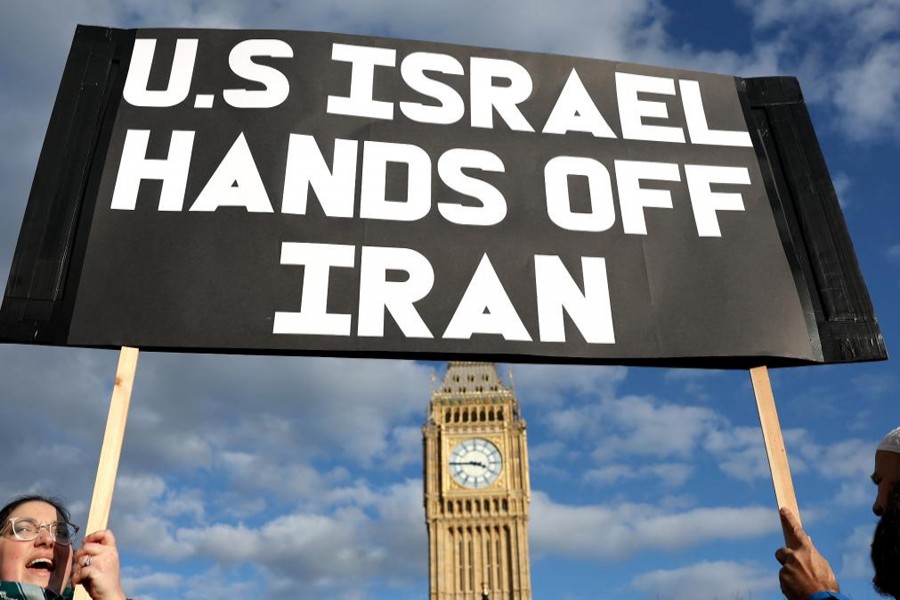
 People hold a placard during a protest against U.S.-Israeli attacks on Iran, at the Parliament Square in central London, Britain, on February 28, 2026 —Xinhua Photo
 The war against Iran had been on the anvil for Benjamin Netanyahu over 40 years which saw him in different political roles in Israel during that period. In his grand geo-political design for the Middle- East the Bibical 'promised land' for the tribe of Israelites was resurrected in conformity with the Zionist view to which he subscribed like many rightwing politicians. He was shrewd enough not to make his private dream public, at least not to the outside world, lest it raised suspicion about his expansionist strategy. To fulfil his dream he had to eliminate rival powers in the Middle-East and countries nearby. First, he planned to destroy nuclear power plants under construction in countries hostile to Israel to maintain Israel's monopoly over nuclear weapons. This saw the surprise attack and destruction of nuclear power plants under construction in Iraq and Syria. Libya was disarmed of its nuclear potential under pressure from Israel's allies in the West. That left only the Islamic Republic of Iran standing firm with its nuclear potential. Iran was not unscathed, having been militarily and economically damaged by the eight-year war waged by Iraq, a war critics say was instigated by America. But to the dismay of Israel, the country recovered quickly from the ravages of war, like the mythical Sphinx. The Israeli lobby in America was no less concerned at the rise of Israel's nemesis militarily. The nexus between the Zionist lobby in America and Benjamin Netanyahu continued to exert influence American foreign policy with a view to keeping Iran in the cross-hairs of American defence establishment. Benjamin Netanyahu tried his level best to show Iran as a threat to both American and Israeli security interests and to forge a common strategy to dismantle the regime there, through pre-emptive attacks. From president Bush Jr to Biden through Clinton, no American president agreed with him on launching a military campaign against Iran. This particularly became a hard sale after the Iraq war launched by America had disastrous moral and political fallout. It was widely believed that Israel provided much of the ballast to American defence establishment for the war against Iraq from behind the scene.
The destruction of Saddam regime removed a formidable enemy of Israel in the Middle-East. But the main adversary, the regime in Iran, not only survived the eight-year war, it continued to produce ballistic missiles and develop uranium enrichment under its civilian nuclear programme. To Benjamin Netanyahu's horror, the American administration under president Obama concluded a treaty ( JCPOA) in 2015 with five other major powers that allowed Iran to develop nuclear power for civilian purposes subject to inspection by International Atomic Energy Agency (IAEA). Inspire of IAEA's regular monitoring about Iran's uranium enrichment being within permissible limits, Netanyahu tried his best to convince the signatory powers, particularly America, that Iran was secretly building nuclear weapons based on its stockpile of weapons grade uranium. His scare-mongering tactics finally received sympathetic attention from American administration after Donald Trump was elected president in 2016. In 2018 the Trump administration walked out of the 2015 JCPOA and reinstituted imposition of economic sanctions. In response, Iran refused comprehensive inspection by IAEA and reportedly accelerated enrichment of uranium above the level permitted under JCPOA.
Emboldened by president Trump's unilateral stand against JCPOA and by implication against Iran, Israel went ahead with its plan to launch pre-emptive attack on Iran and its nuclear facilities. During the June, 2025 pre-emptive attack Netanyahu's government assassinated leading Iranian nuclear scientists along with top military commanders. The pre-emptive attack took place in the midst of negotiation between America and Iran on nuclear issues, raising suspicions about America's complicity or at least green lighting the attack. But the vicious Israeli bombing left the Fardo nuclear facility intact because it was deep under a mountain inaccessible to Israeli bombs. America was keeping quiet giving the impression that it was left in the dark by Israel. But Fardo nuclear facility left secure deep under mountain called for American intervention with bunker-busting bombs that could only be dropped by B-52 stealth bombers. After a surprise covert bombing of Fardo nuclear facility president Trump broke his silence and gloated that Iranian nuclear potential had been obliterated. This announcement together with effusive praise for Israel's 'efficient' use of American arms and ammunition in the pre-emptive attack left no doubt that from the beginning the bombings on Iranian targets by Israel was a co-ordinated campaign between America and Israel. Everything about this pre-emptive attack was kept so secret that even America's close allies were in the dark about America's role in the June war. But this secrecy did not make all of America's allies unhappy, as seen from the remark by the German Chancellor who said 'Israel was doing their dirty job'. This remark and the silence of European leaders on the unprovoked war against Iran indicated the moral by support given to Israel's aggression by them. The June war was brought to a halt by an announcement of ceasefire by president Trump removing any doubt that his administration was behind the war from the very beginning. According to observers, president Trump was surprised to see the resilience of Iranian armed forces even after sustaining severe loss in the surprise attack by Israel and the precision of ballistic missiles launched by Iran. Depletion of anti- ballistic defence interceptors of Israel was also a major factor behind president Trump's decision to halt the war in June, 2025. In public he gloated that the war was won by Israel which appeared to astute observers as a face saving posture. The role of Trump administration, from negotiation with Iran on nuclear issues and the surreptitious co- ordination with Israel over the pre-emptive attack, subsequent bombing of Fardo and finally calling a halt to the war reveal president Trump as a dark conspirator and operator in the American underworld tradition. No American president had conducted matters of war and peace so unabashedly and abominably before.
Even though president Trump declared publicly that Iranian nuclear facilities had been obliterated and America's top intelligence official corroborated by saying that Iran's capability to develop nuclear weapons had been delayed by decades, there were lingering doubts about that as a ground reality. Of greater interest and even concern to America and Israel was the whereabouts of the 450 kilogram of enriched uranium. This and the need for extracting a commitment from Iran not to build a nuclear weapon in future led America to re- start negotiation in 2026 with Oman as mediator this time. From the Iranian side the willingness to negotiate with the Americans was based on their interests to get waiver on sanctions and access to their assets frozen in Qatar and banks in America. After two meetings in Switzerland the Omani mediator announced in the third week of February this year that a 'breakthrough' had been reached in negotiation, opening the path to a permanent deal. No sooner had he said that than came a joint surprise attack by America and Israel against Iran on February 28. Not only no inkling was given by America that an attack was on the table, the targets of the attack included political assassinations of the head of Iranian regime, his family members and close associates which were political assassination of the most abominable kind. In a diabolical and macabre mood of the worst kind president Trump publicly announced that Iranian leadership had been decapitated while they complacently sat for breakfast. Such blatant bravado over what amounted to a war crime came as a shock to many. The public gloating was followed by repeated exhortation by president Trump to the Iranian people to overthrow the regime, saying ' the country is for yours to take'. Such an open call to the population of a country by the head of state of a super power is unprecedented.
Selection of targets for bombings that included political leaders and subsequent call for popular uprising clearly indicated that the goal of the joint American-Israeli attack was regime change. Achievement of this goal satisfied the plan for Israel to destroy the only militarily strong country in the Middle-East which stood in the way of establishing greater Israel. For the Trump administration regime change also had geo-political interests but different from that of Israel. Regime change in Iran would give America control over its oil reserves and deny China from a foothold in the Middle-East.
There were plenty of indications in plain sight that America was going to launch a military attack on Iran. Bombers and fighter jets were being redeployed preceding the attack on February 28 to make American bases in Arab countries and in Israel combat ready. In addition, almost all the aircraft carriers were ordered to converge in waters around Iran. This was not for the sake of a show of force to unnerve Iran. President Trump was not worried about Iran's nuclear potential because the 4,000-plus stockpile of nuclear bombs at the disposal of America made even a pre-emptive nuclear attack by any country impossibility. President Trump drummed up the threat of Iranian nuclear bomb as a camouflage to hide his greater and more important goal of regime change in Iran to stop China from having a reliable ally with vast oil reserves. It was because of this convergence of interests over regime change that president Trump joined Netanyahu in launching pre-emptive attack that saw Iran's top leadership decapitated.
But the expectation that decapitation of top leaders would lead to surrender by Iran's military and a simultaneous popular uprising did not materialise. There was no street demonstrations by jubilant public and instead of surrender Iran's army under IRGC (Iranian Revolutionary Guard Command) responded with bursts of drone and ballistic attacks on American bases in the Gulf countries and in Iraq, Jordan and Saudi Arabia, as was warned by IRGC before the attack. In addition to American bases, IRGC attacked oil facilities in the Gulf countries and took control of the Strait of Hormuz as part of its asymmetric war strategy. While the first wreaked havoc to American military assets in bases in the Middle- East, the latter gave a sudden shock to the oil and stock markets, pushing price of Brent crude from $ 70 per barrel to $ 100 within days of the war. In the stock markets even gilt-edged shares took a southward dive. Unnerved at the strong response by IRGC and the absence of a popular uprising, president Trump called a ceasefire on June 17, announcing that he was ready for a deal for peace. Unhappy at this turn of American policy Netanyahu opened a new front in Lebanon to make negotiated settlement with Iran difficult. In the memorandum of understanding signed by America and Iran, stoppage of Israeli aggression in Lebanon has been included as a clause at the insistence of Iran.
The American- Israeli war against Iran begun on February 28 has 60 days to reach a final peace agreement within the framework of the Memorandum of Understanding that was reached on June 17. After the first high-level meeting in Switzerland attended by American Vice President Vance and Iranian Foreign Minister Araghchi, negotiations on technical matters are taking place. Mutual agreements reached to de-link the nuclear issue from issues like safe and open passage through Hormuz, lifting of American naval blockade, resumption of Iran's oil exports, release of frozen Iranian assets and cessation of Israeli hostilities in Lebanon clearly indicate Iran has not only withstood the joint attack by America and Israel but has already vindicated its position on several crucial issues of its national interests and obligations. In exchange for waiver of total sanctions it may even agree to hand over the 450 kg of enriched uranium to a third country. In another area of victory, Iran has succeeded to keep ban on ballistic missile development and help to proxies off from the agenda of negotiation. The recent war has shown that with its vast stockpile of advanced ballistic missiles Iran does not need nuclear bombs to defend itself. Even president Trump has conceded that when other countries have ballistic missiles Iran cannot be denied of this weapon. Of course he would be singing a different tune if there was a regime change after the February 28 pre-emptive attack. Not only all nuclear facilities would be closed down for good, ballistic missiles production would also come to an end. A defeated Iran would be demilitarised and politically depilated placing it at the mercy of America and reduced to a whipping horse of Israel.
Even now, in the midst of negotiation after ceasefire president Trump keeps on threatening to bomb Iran to oblivion. But this is no more than whistling in the dark, trying to assure others that he is the winner in the confrontation with Iran. [US forces started to strike Iran on Wednesday after Trump had suddenly announced that the ceasefire was over.]
President Trump made his greatest miscalculation that he would be able to pull off another Venezuelan rope trick of his own in Iran or to be more relevant to the context, a flying carpet operation by his 'beautiful' commandos. His blabber mouthing about victory and threats of unleashing apocalypse on Iran sound pathetic in the face of facts on the ground. If the funeral of the slain Khomeini shows anything starkly it is the solidarity of the Iranian people united against foreign aggression and domination. Of course, there are some dissidents but they are a minority voice. The war imposed on Iran by America and Israel has made the country stronger and not weaker. Benjamin Netanyahu should take note and behave himself to avoid making Israel a permanent international pariah. It should be a warning to him that even Israel's closes ally, America has become disenchanted with his policy of 'killing out of problems'.
hasnat.hye5@gmail.com
© 2026 - All Rights with The Financial Express

