Dr Muhammad Umer Chapra’s passing in late June marked the end of an era in modern economics, however for many people studying the subject, it also raised a difficult issue. A towering figure in Islamic finance, Chapra spent nearly six decades arguing that a financial system based upon interest rates would ultimately fail the communities it claimed to support. I am confident in saying that Chapra was a careful economist who happened to believe that the lack of ethical considerations in finance, essentially turns finance into a vehicle to transfer wealth upwards.
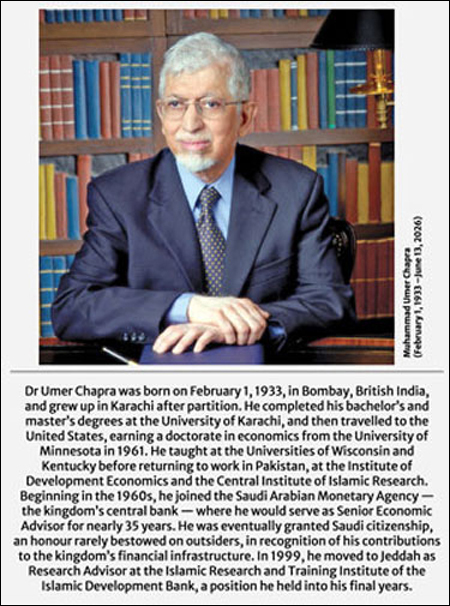 This year, looking at Bangladesh’s banking data, it is difficult to avoid the conclusion that Chapra was describing this scenario with such precision. Consider the numbers. The country’s non-performing loans (NPL) in the banking sector rose to a record high of 35.73 per cent of all disbursed credit in the first quarter of FY26, the highest ratio in the world and the highest in Bangladesh in twenty-five years. The figures have declined somewhat to around 30 per cent later, yet this decrease came not from recovering loans; instead it came from a rescheduling program that allowed defaulters to clear a loan by paying down 2 per cent. The cash inflow into the banks did not increase. We simply relabeled the boxes. One Managing Director told an English newspaper that the real picture will not come out until 2027, when grace periods expire and payments are scheduled to resume.
In his book Towards a Just Monetary System (1985), Chapra articulated his central thesis relative to this point. While his central premise is generally considered theological, it is actually structural. Under an interest-based system, financiers are assured of a positive return regardless of whether the debtor’s business venture succeeds or fails. Consequently, financiers have no incentive to critically review a debtor’s proposed business activity. Instead, financing decisions rely on collateral, political influence, and the debtor’s reputation rather than the merits of a proposed venture. Risk is privatized when business ventures fail and socialized when banks are bailed out. By contrast, Chapra argues that profit and loss sharing reverses this structure: when a bank’s return is tied to the success of a specific venture, the bank must “search for talent, innovation and potential” rather than just relying on collateral, and must carefully assess borrowers.
Now consider how our largest defaults occurred. The governor of Bangladesh Bank has stated that approximately Tk 500 billion may have been removed from a single bank by a single family. Five Shariah-compliant banks — Social Islami Bank Limited, First Security Islami Bank Ltd., EXIM Bank Limited, Union Bank Ltd., and Global Islami Bank Ltd. — suffered serious enough losses that they needed to be consolidated into a new state-owned commercial bank, Sammilito Islami Bank PLC. Four of these five banks were part of one conglomerate located in Chittagong. None of these were cases where the application of profit and loss sharing caused any problems. Rather, they were all instances of poor governance, related party lending and the capture of institutions by vested groups. But there is a particularly harsh irony here: Most of these failed banks were Shariah compliant and thus flew the flag for which Chapra advocated. Yet they abandoned the principles that Chapra said made that flag worth flying.
Here is where I must be honest, as Chapra always was. The collapse of these institutions does not represent any evidence against Chapra’s thesis; rather it represents evidence supporting it. Chapra never contended that simply labeling a bank as ‘Shariah Compliant’ would shield it from collapse. A significant amount of his work — and virtually all of his later career at SAMA and IRTI — focused on creating the institutional infrastructure necessary for profit-sharing: namely, a strong central bank whose primary obligation is to prevent the concentration of wealth and power among special interest groups; an Investment Audit Corporation to confirm the accounts of parties receiving bank monies; and an effective deposit insurance plan that safeguards ordinary depositor assets without guaranteeing reckless speculation. We created the contractual arrangements for Islamic finance, yet chose to ignore the architectural requirements for profit-sharing. We used the terms murabaha and mudaraba as mere labels for conventional fixed return collateral driven politically targeted lending practices, and subsequently complained when the results resembled conventional banking at its worst.
Even more specifically, Chapra had previously addressed the criticism that a profit-sharing model would be unstable. The instability currently being experienced is not associated with the uncertainty inherent in shared risk; rather it is associated with the violent consequences of accumulated unshared risk now coming due. With 55 per cent of bank liquidities presently sitting idle while businesses continue to find themselves unable to obtain funding and customers waiting in lines to withdraw only Tk two laks of their deposits from the merged banks , we are witnessing exactly the type of collapse that Chapra predicted: a system whereby small savers’ deposits flowed toward a select group of wealthy individuals and then became frozen when that select group defaulted.
Of course none of this means that the solution lies in some sort of slogan. Chapra was a gradualist. He posited that monetary reform “need not await” perfection in society but must occur incrementally — simultaneously with changes in taxation policies, capital markets regulations and governance structures. Practical implications exist clearly in Bangladesh. First, Bangladesh Bank must be completely free from direct oversight from entities it regulates — i.e., it must operate independently from borrowers; it is precisely this concentration of authority which Chapra noted as one of the central bank’s first enemies — i.e., what was able to corrupt Bangladesh Bank. Second, an active and robust auditing mechanism capable of enforcing compliance would have exposed the hollowing out of several of the newly merged banks far prior to requiring a massive Tk 35 billion public bailout. Third, genuine asset-backed/risk-sharing finance models — not merely superficial imitations thereof — would cause banks to begin pricing ventures rather than merely assessing names.
I have argued elsewhere with colleagues that mechanisms like kafalah-based deposit insurance, and incorporating Zakat into fiscal planning would enhance resilience within systems such as described above. These mechanisms are neither symbolic nor nostalgic gestures; rather they constitute the dull institutional heavy-lifting that Chapra recognised as providing substance to his vision — long after the empty sloganeering ceased.
Chapra’s greatest legacy was his refusal to differentiate between efficiency and justice or markets and morals. Chapra believed that economies should be evaluated not solely by their ability to produce wealth but by their ability to reduce poverty and preserve dignity. At base, Bangladesh’s banking crisis arises from separating these concepts — i.e., a banking system designed to create paper profits for a select few while transferring losses onto seventy-five million depositors and taxpayers. It is not enough to simply lament his passing; we can honor his memory in the best possible way by finally bringing to life the institutional framework he spent a lifetime designing.
Professor M. Kabir Hassan is the Moffett Chair in Finance, Professor of Finance at the University of New Orleans, recipient of the 2016 IDB Prize in Islamic Banking & Finance, member of the AAOIFI Ethics and Governance Board, and chair of the board’s education committee. mhassan@uno.edu
© 2026 - All Rights with The Financial Express

