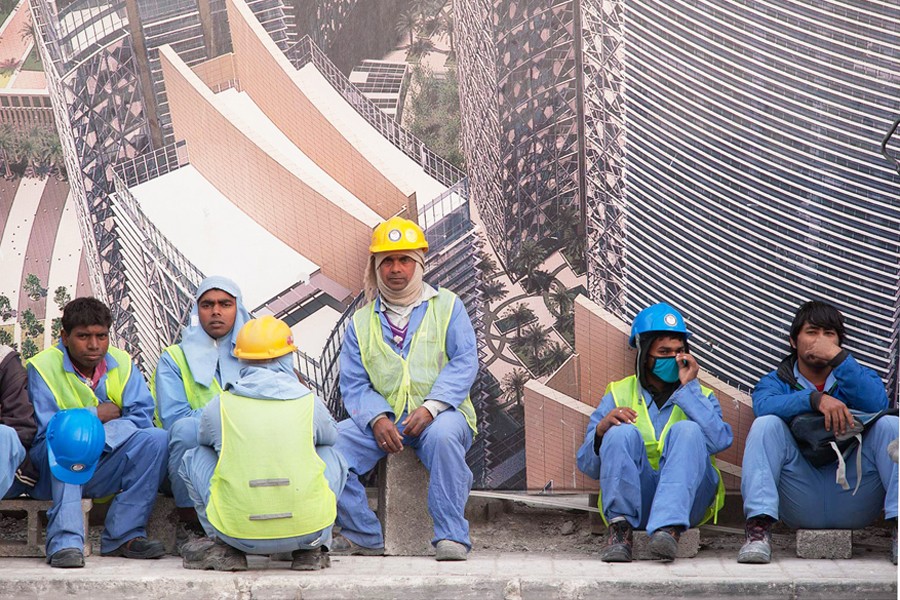
 Migrant workers from different countries including Bangladesh very often to face various troubles in the Gulf countries —Agency Photo
 Labour migration has become one of Bangladesh's most celebrated development narratives. Over the decades, millions of Bangladeshis have travelled to the Gulf, Southeast Asia, Europe, and beyond, sending home remittances that sustain households and stabilise the national economy. These flows of money are hailed as lifelines, contributing to foreign reserves, funding rural development, and supporting education, health, and housing for families across the country. Yet, beneath the triumphal story of remittance-led growth lies a quieter, more fragile reality-one that unfolds within the private corners of family life. The emotional costs of being a transnational family are easily overshadowed by the visible economic gains, but they lie at the heart of the migration experience and shape the social fabric of the country in profound ways.
Labour migration in Bangladesh is not just an economic decision; it is an emotional and cultural undertaking. Families frequently treat migration as an investment in their collective future, believing that a few years of hardship abroad will secure long-term stability at home. This belief is deeply tied to socio-cultural norms around sacrifice and duty. For low-income families, especially in rural areas, migration is embraced as a path to upward mobility. The migrant worker becomes a heroic figure, one whose physical absence is morally validated by the financial support he provides. Yet this narrative often masks the emotional toll that separation imposes on both the migrant and the family members left behind.
Transnational families operate under a unique form of emotional geography. Physically separated across borders, they must reconstruct intimacy through digital means. Mobile phones, messaging apps, and video calls create the illusion of constant connection, but the emotional experience of distance remains fundamentally unchanged. A father watching his child's birthday through a screen, a mother crying quietly after a dropped call, a spouse waiting anxiously for a message during a storm in the Gulf-these are moments rarely captured in economic reports but central to understanding the lived reality of transnational life.
In these families, emotional labour becomes an everyday necessity. Wives left behind assume expanded roles as caregivers, financial managers, and social navigators. They must maintain emotional stability for their children, manage household economies, and cope with loneliness and social scrutiny. In many rural communities, a migrant's wife becomes subject to increased surveillance-subtle and overt-shaped by patriarchal norms that question women's autonomy in the absence of their husbands. She must embody patience, loyalty, and discipline, often suppressing her own emotional needs for the sake of family harmony.
Children who grow up in transnational families develop complex emotional landscapes marked by gratitude, resentment, longing, and confusion. While remittances may provide better schools, healthier food, or a more secure home, children frequently internalise the absence of a parent as a form of emotional loss. The promise of a better future does not erase the present reality of growing up without daily affection. Children may develop behavioural challenges, feelings of abandonment, or uncertainties about their relationship with the absent parent. Sociologically, this reflects the phenomenon of "ambivalent love," where financial provision coexists with emotional distance.
For migrants themselves, the emotional burden is often heavy and unspoken. Long working hours, harsh labour conditions, crowded living environments, and limited social support mark their daily lives. They usually suppress their own emotional struggles, believing that expressing sadness or loneliness would create additional burdens for their families. Instead, they present a carefully managed image of strength during phone calls, concealing exhaustion or homesickness. This emotional suppression is not merely personal but structural, shaped by the economic necessity of maintaining productivity in foreign labour markets.
The emotional geography of migration also intersects with the risks and vulnerabilities that workers face abroad. When migrants experience wage theft, abuse, or legal difficulties, their families back home are engulfed in waves of fear and helplessness. A sudden loss of communication fuels anxiety. The uncertainty stretches across borders, leaving families emotionally paralysed. Tragedies-such as workplace deaths, accidents, or the repatriation of bodies-bring into sharp focus the hidden costs of a remittance-dependent development model. These stories rarely reach the public sphere with the same force as remittance statistics, yet they represent the human face of global labour markets.
Even when migration is economically prosperous, the emotional consequences linger. Many migrants return home after years abroad to find that their families have grown in their absence. Children have become adolescents or adults; spouses have forged independent routines; elderly parents have aged without their support. The returning migrant must negotiate a new place within the family, often experiencing a sense of displacement in the very home he left to support. Reintegration becomes psychologically challenging, as the migrant grapples with the haunting feeling that time has moved forward without him.
The fabric of rural Bangladeshi society has been reshaped by decades of labour migration. Villages with high rates of migration experience subtle changes in gender relations, community dynamics, and social expectations. The absence of large numbers of men influences leadership patterns, decision-making structures, and the symbolic ordering of family life. Migrant households often become symbols of prestige, inspiring others to pursue migration even when the financial risks are high. This social pressure reinforces migration as a collective aspiration, usually ignoring its emotional costs.
Moreover, the rise of remittance-based lifestyles can create new forms of social inequality. Families benefiting from remittances gain access to improved housing, education, and social status, while non-migrant families may struggle to keep up. This creates a "remittance hierarchy," shaping how communities perceive success and belonging. Yet even among migrant families, financial prosperity does not erase emotional vulnerability. A polished two-storey house built with Gulf earnings may conceal a decade of loneliness, anxiety, and unarticulated grief.
The notion of "development with emotional displacement" becomes central to understanding Bangladesh's remittance economy. While the country celebrates record-high remittance inflows, the emotional void experienced by transnational families remains invisible, mainly in policy discussions. Policymakers focus on recruitment processes, skill development, and safe migration frameworks, all of which are vital, but the emotional well-being of families receives little institutional attention. There is limited provision for counselling services, psychosocial support, or community networks dedicated to migrant households. As a result, emotional burdens are absorbed within families, particularly by women and children.
Rethinking the remittance economy requires acknowledging that national development cannot rely indefinitely on the emotional sacrifice of millions of citizens. Bangladesh must consider strategies that address both economic and emotional well-being. This includes investing in pre-departure counselling for migrants, mental health services for families, school-based support for children of migrant parents, and structured reintegration programmes to help returnees rebuild family bonds. Moreover, long-term development planning should focus on reducing the necessity of migration by expanding dignified employment and skill-based industries within the country.
Labour migration will continue to be a vital component of Bangladesh's growth. Still, it must be understood not only as an economic transaction but as a profound social and emotional process. Every remittance sent home reflects a life marked by separation, longing, and resilience. Acknowledging the emotional cost does not diminish the economic significance of migration; rather, it enriches our understanding of its human depth. It allows the nation to honour migrant workers not only as financial contributors but as individuals navigating complex emotional terrains for the sake of their families.
The strength of a nation lies not just in its foreign reserves but in the well-being of its people. If Bangladesh is to build a future that is both prosperous and humane, it must confront the emotional dimensions of its remittance economy. Only by bringing these hidden costs into public conversation can the country move toward a development model that values families as much as finances, and emotional security as much as economic growth.
Dr Matiur Rahman is a researcher and development professional.
matiurrahman588@gmail.com
© 2026 - All Rights with The Financial Express

