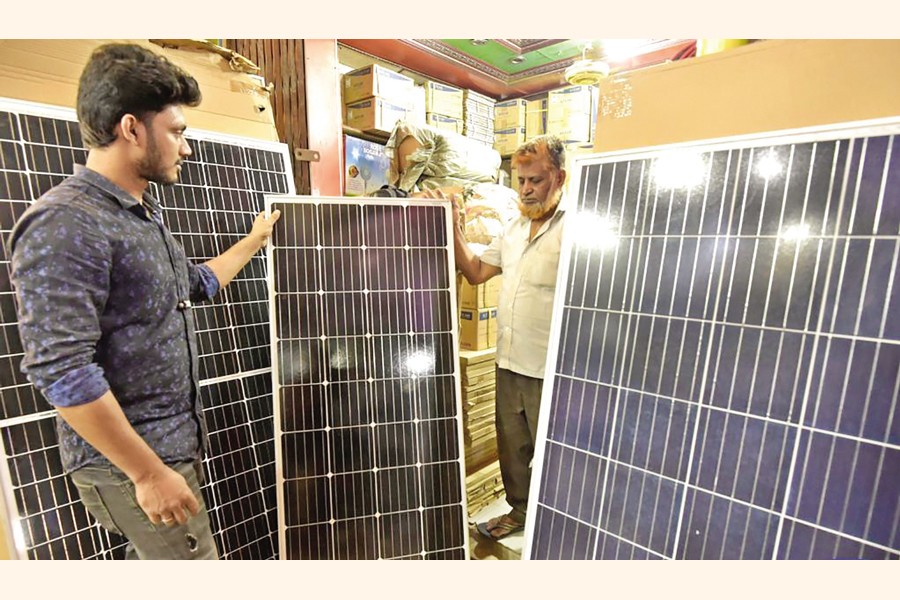
 A customer looks at energy efficient solar panels at a store in a wholesale market in Dhaka, Bangladesh on November 24, 2021— Xinhua Photo
 Renewable energy has overtaken coal as the world's leading source of electricity in the first half of this year -- a historic first, according to new data from the global energy think tank 'Ember'.
Electricity demand, as we all know, is growing around the world but the growth in solar and wind has apparently been so strong, it has met 100 per cent of the extra electricity demand in some areas -- even driving a slight decline in coal and gas use. However, 'Ember' has also indicated that the headlines mask a mixed global picture.
Developing countries, especially China, lead the clean energy charge but richer nations including the US and EU rely more than before on planet-warming fossil fuels for electricity generation. Coal, a major contributor to global warming, was still the world's largest source of energy generation in 2024, a position it has held for more than 50 years, according to the International Energy Agency.
In this scenario, China remains way ahead in clean energy growth, adding more solar and wind capacity than the rest of the world combined. This has enabled the growth in renewable generation in China to not only outpace rising electricity demand but has also helped reduce its fossil fuel generation by 2 per cent. India experienced slower electricity demand growth and also added significant new solar and wind capacity, meaning it too cut back on coal and gas.
China's overwhelming dominance in clean tech industries remains unchallenged, other new data from Ember show. In August 2025, its clean tech exports hit a record $20bn, driven by surging sales of electric vehicles (up 26 per cent) and batteries (up 23 per cent). Together, China's electric vehicles and batteries are now worth more than twice the value of its solar panel exports. This obviously is interesting.
In contrast, developed nations like the US, and also the EU, has demonstrated the opposite trend. In the US, electricity demand has grown faster than clean energy output, thereby increasing reliance on fossil fuels, while in the EU, months of weak wind and hydropower performance have led to a rise in coal and gas generation.
'Ember' has described the present moment as a "crucial turning point" and Ember senior analyst Malgorzata Wiatros-Motyka has observed that it "marks the beginning of a shift where clean power is keeping pace with demand growth".
In some areas of the world solar power is delivering the lion's share of growth by meeting 83 per cent of the increase in electricity demand. Most solar generation (58 per cent) is now in lower-income countries, many of which have seen high growth in recent years.
Pakistan, for example, imported solar panels capable of generating 17 gigawatts (GW) of solar power in 2024; double the previous year and the equivalent of roughly a third of the country's current electricity generation capacity. Africa is also experiencing a solar boom with panel imports up 60% year on year. Coal-heavy South Africa has led the way, while Nigeria has overtaken Egypt into second place with 1.7GW of solar generating capacity - which, according to analysts is enough to meet the electricity demand of roughly 1.8 million homes in Europe.
However, in some countries the growth of solar has been so rapid, it is creating unexpected challenges. For example, in Afghanistan, widespread use of solar-powered water pumps is lowering the water table, threatening long-term access to groundwater. This has led environmentalist Dr. David Mansfield to note that satellite data from Alcis indicate that such extraction of water could lead to some regions running dry within five to ten years, endangering millions of livelihoods.
Adair Turner, Chair of the UK's Energy Transitions Commission has made another interesting observation. The analyst has noted that countries in the global "Sun Belt" and "Wind Belt" face very different energy challenges. Sun Belt nations -- including much of Asia, Africa, and Latin America -- need large amounts of electricity for daytime air conditioning. These countries can significantly reduce energy costs almost immediately by adopting solar-based systems, supported by increasingly affordable batteries that store energy from day to night.
Wind Belt countries like the UK, however, face tougher obstacles. Wind turbine costs have not come down like those of solar panels -- down just a third or so in the last decade. Higher interest rates have also added to borrowing costs and raised the overall price of installing wind farms significantly in the last few years. Balancing supply is harder too: winter wind lulls can last for weeks, requiring backup power sources that batteries alone cannot provide - making the system more expensive to build and run.
Renewable energy also called green energy is energy made from renewable natural resources that are replenished on a human timescale. The most widely used renewable energy types are solar energy, wind power and hydropower. Bio-energy and geothermal power are also significant in some countries. Some also consider nuclear power a renewable power source, although this is controversial, as nuclear energy requires mining uranium, a nonrenewable resource. Renewable energy installations can be large or small and are suited for both urban and rural areas. Renewable energy is often deployed together with further electrification. This has several benefits: electricity can move heat and vehicles efficiently and is clean at the point of consumption. Variable renewable energy sources are those that have a fluctuating nature, such as wind power and solar power. In contrast, controllable renewable energy sources include dammed hydroelectricity, bioenergy ot geothermal power.
Renewable energy systems have rapidly become more efficient and cheaper over the past 30 years. A large majority of worldwide newly installed electricity capacity is now renewable. Renewable energy sources, such as solar and wind power, have seen significant cost reductions over the past decade, making them more competitive with traditional fossil fuels.
Solar power, also known as solar electricity, is the conversion of energy from sunlight into electricity, either directly using photovoltaics (PV) or indirectly using concentrated solar power. Solar panels use the photovoltaic effect to convert light into an electric current. Concentrated solar power systems use lenses or mirrors and solar tracking systems to focus a large area of sunlight to a hot spot, often to drive a steam turbine.
Photovoltaics (PV) were initially solely used as a source of electricity for small and medium-sized applications, from the calculator powered by a single solar cell to remote homes powered by an off-grid rooftop PV system. Commercial concentrated solar power plants were first developed in the 1980s. Since then, as the cost of solar panels has fallen, grid- connected solar PV systems' capacity and production has doubled about every three years. Three-quarters of new generation capacity is now solar, with both millions of rooftop installations and gigawatts-scale photovoltaic power stations continuing to be built.
In 2024, renewables accounted for over 30 per cent of global electricity generation and are projected to reach over 45 per cent by 2030. Many countries already have renewables contributing more than 20 per cent of their total energy supply, with some generating over half or even all their electricity from renewable sources.
The main motivation to use renewable energy instead of fossil fuels is to slow and eventually stop climate change, which is mostly caused by their greenhouse gas emissions. In general, renewable energy sources pollute much less than fossil fuels. The International Energy Agency estimates that to achieve net zero emissions by 2050, 90 per cent of global electricity will need to be generated by renewables. Renewables also cause much less air pollution than fossil fuels- thereby, improving public health.
However, deployment of renewable energy still faces obstacles, especially fossil fuel subsidies, due to lobbying by incumbent power providers, and local opposition to the use of land for renewable installations. Like all mining, the extraction of minerals required for many renewable energy technologies also results in environmental damage. In addition, although most renewable energy sources are sustainable, some are not.
Although almost all forms of renewable energy cause much fewer carbon emissions than fossil fuels, the term is not synonymous with low-carbon energy. Some non-renewable sources of energy, such as nuclear power, generate almost no emissions, while some renewable energy sources can be very carbon-intensive, such as the burning of biomass if it is not offset by planting new plants.
Renewable energy is also distinct from sustainable energy-- a more abstract concept that seeks to group energy sources based on their overall permanent impact on future generations of humans. For example, biomass is often associated with unsustainable deforestation.
As part of the global effort to limit climate change, most countries have committed to net zero greenhouse gas emissions. In practice, this means phasing out fossil fuels and replacing them with low-emissions energy sources. This much needed process, coined as "low-carbon substitutions" in contrast to other transition processes including energy additions, needs to be accelerated multiple times in order to successfully mitigate climate change.
At the 2023 United Nations Climate Change Conference, around three-quarters of the world's countries set a goal of tripling renewable energy capacity by 2030. The European Union aims to generate 40 per cent of its electricity from renewables by the same year.
The two most important forms of renewable energy, solar and wind are intermittent energy sources: they are not available constantly, resulting in lower capacity factors. In contrast, fossil fuel power plants, nuclear power plants and hydropower are usually able to produce precisely the amount of energy an electricity grid requires at a given time.
There are, however, two dimensions which must not be forgotten. Solar energy can only be captured during the day, and ideally in cloudless conditions. Wind power generation can vary significantly not only day-to-day, but even month-to-month. This poses a challenge when transitioning away from fossil fuels: energy demand will often be higher or lower than what renewables can provide.
Muhammad Zamir, a former Ambassador, is an analyst specialised in foreign affairs, right to information and good governance.
muhammadzamir0@gmail.com
© 2026 - All Rights with The Financial Express

