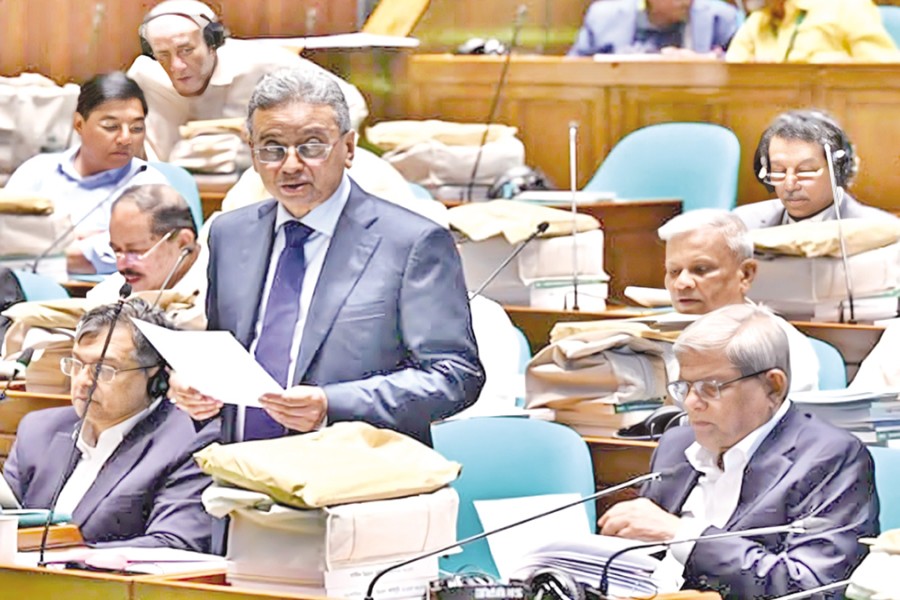
 Finance Minister Amir Khosru Mahmud Chowdhury Thursday last placed the national budget worth Tk9.38 trillion for FY27— Agency Photo
 A national budget is not only a statement of income and expenditure. It is also a signal. It tells citizens, investors, businesses, banks, and development partners how the government understands the economy. It shows where the state wants to spend, how much it wants to borrow, and how realistic its priorities are.
For the banking industry, the national budget is especially important. Banks do not operate outside the fiscal system. They are directly affected by government borrowing, inflation, interest rates, public investment, tax policy, and business confidence. When the budget is realistic, banks get a better operating environment. When it is unrealistic, banks face more pressure.
This relationship is now very important for Bangladesh. The proposed FY2026-27 national budget has been placed in parliament at a difficult time. Growth is under pressure. Inflation remains high. Private investment is weak. Revenue collection is still below the required level. Most importantly, the banking sector is already in serious trouble.
The central question is therefore simple. Can this budget support recovery in the banking sector, or will it add new pressure to an already fragile system?
The proposed budget has a large expenditure target. It also has ambitious revenue goals. The deficit is projected at 3.6 per cent of gross domestic product (GDP). The government has proposed to finance part of this deficit through domestic borrowing, including Tk 112,000 crore from the banking system. This is lower than the revised figure of the outgoing fiscal year. That is a positive signal. But the risk has not disappeared.
Bangladesh’s banks are already carrying a heavy burden. Non-performing loans have reached a dangerous level. Many banks are facing capital weakness. Some banks are also facing liquidity stress. Depositor confidence has been affected. In such a situation, even moderate government borrowing from banks can create pressure if private-sector credit demand recovers.
This is the first major challenge of the budget. It tries to support recovery through public spending. But if that spending is financed in a way that absorbs bank liquidity, the private sector may suffer. Banks may prefer lending to the government because it is safer. Then businesses, especially SMEs, may find it harder to get loans. This can weaken investment, production, and employment.
The second challenge is interest rate pressure. When the government borrows heavily from the domestic market, interest rates may remain high. High interest rates can protect depositors and help control inflation. But they also raise the cost of borrowing for businesses. For firms already struggling with weak sales, import costs, exchange-rate pressure, and energy costs, higher interest payments can increase default risk. This may produce new bad loans.
The third challenge is the quality of credit. A troubled banking sector cannot support growth only by expanding loans. It must lend better. Bangladesh’s experience shows that bad lending is not only an economic problem. It is also a governance problem. Politically influenced loans, weak appraisal, connected lending, repeated rescheduling, and poor recovery have damaged banks. If these practices continue, fresh credit will only create fresh NPLs. That would be like pouring clean water into a leaking bucket and calling it irrigation.
The proposed budget recognises this problem. It speaks about reducing non-performing loans, strengthening transparency in loan approval and rescheduling, improving bank governance, introducing risk-based supervision, and strengthening the central bank. These are necessary steps. But the main issue is implementation. Bangladesh has heard many reforms promises before. It needs enforceable action.
The fourth challenge is bank recapitalisation. The budget speech notes that large public resources are being used for bank recapitalisation. In some cases, recapitalisation may be unavoidable. Weak banks need capital to protect depositors and maintain financial stability. But recapitalisation without accountability is dangerous. It transfers the cost of bad governance to taxpayers. Public money should not rescue those who took loans with no intention to repay.
Therefore, recapitalisation should be conditional. It should be linked to asset quality review, management change, board accountability, recovery targets, and restrictions on future lending to connected parties. Weak banks should not receive capital simply to continue old habits. That would be reform theatre, and Bangladesh has already bought too many tickets.
The fifth challenge is inflation. For banks, inflation affects deposit behaviour, loan repayment, and credit demand. High inflation reduces real income. Households then draw down savings. Businesses face higher input costs. Borrowers find repayment harder. If inflation continues, banks may face more stress from both deposit and loan sides.
The sixth challenge is revenue mobilisation. If revenue targets are too ambitious and actual collection falls short, the government may again turn more heavily to borrowing. This can increase pressure on banks during the fiscal year. So, the credibility of the budget depends not only on the deficit number, but also on the realism of the revenue target. A budget gap created by weak revenue performance can quietly become a banking-sector problem.
The seventh challenge is the weak capital market. Bangladesh still depends heavily on banks for long-term financing. This is unhealthy. Banks collect mostly short- and medium-term deposits. But they are often asked to finance long-term industrial and infrastructure projects. This creates maturity mismatch and increases risk. The proposed budget mentions corporate bonds, municipal bonds, Sukuk, mutual funds, green bonds, infrastructure funds, and other long-term instruments. This is important. If developed properly, these instruments can reduce pressure on banks.
But capital-market development needs trust. Investors will not return only because new products are announced. They need disclosure, governance, credible ratings, proper regulation, and protection from manipulation. Without these, alternative financing will remain a slogan.
The budget also has opportunities for banks. If public spending is directed toward productive infrastructure, agriculture, health, education, and technology, it can improve long-term growth. If targeted refinancing supports SMEs, women entrepreneurs, agriculture, and export-linked sectors, banks can expand inclusive lending. If digital finance is strengthened, transaction costs can fall and financial inclusion can improve. These are positive possibilities.
But the budget needs to avoid three mistakes. First, it should not use banks as an easy source of deficit financing. Second, it should not protect wilful defaulters in the name of business support. Third, it should not treat banking reform as a technical matter only. Banking reform is also political reform, legal reform, and governance reform.
The parliamentary discussion on the budget should therefore focus strongly on banking-sector implications. There areseveral key questions. How will bank borrowing be managed if revenue falls short? What conditions will be attached to bank recapitalisation? How will wilful defaulters be separated from genuine distressed borrowers? What timeline will be followed for asset quality review? What steps will restore depositor confidence?
It is obvious that the proposed national budget contains some positive signals for the banking industry. It reduces planned borrowing from banks, recognises financial-sector weaknesses, and promises reforms in banking governance and capital-market development. But the risks remain large. High NPLs, weak capital, inflation, revenue uncertainty, and low private-sector credit can limit the budget’s impact.
The real test will not be the size of the budget. It will be the quality of implementation. Bangladesh needs a budget that restores confidence, protects depositors, supports productive borrowers, and punishes wilful default. Without that, the banking sector will remain weak, and the budget will become another polished document standing bravely in front of unpleasant facts.
The writer is Professor, Bangladesh Institute of
Bank Management (BIBM) and Chairman, Dnet (finbislesh.com). ahsan@bibm.org.bd
© 2026 - All Rights with The Financial Express

