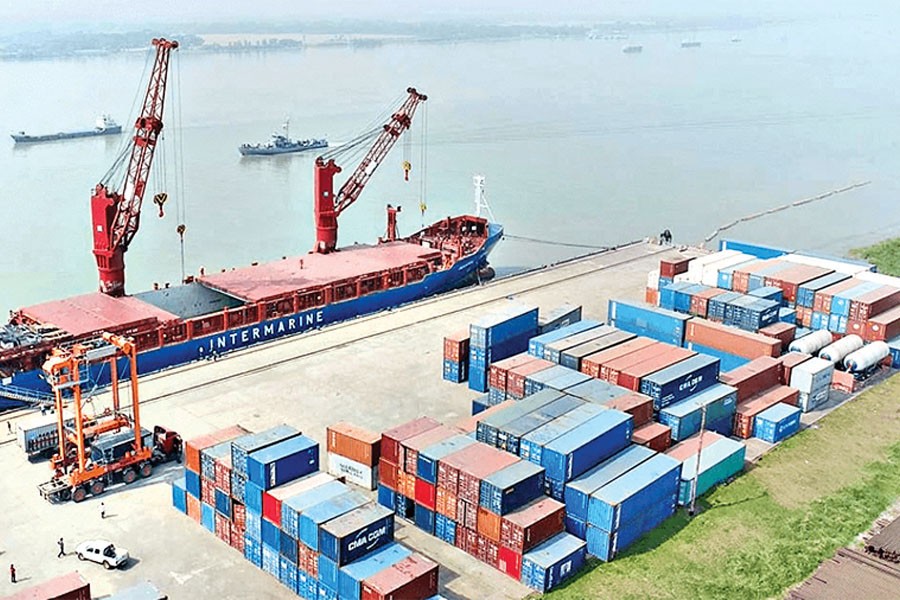
 A view of Mongla Port, Khulna— Collected Photo
 When operations at Mongla Port slow to a near standstill because vessels cannot access fuel, it is tempting to view the disruption as a temporary inconvenience. The reality is far more serious. What has unfolded is not an isolated breakdown—it is a signal of a deeper systemic vulnerability at the intersection of energy, logistics, and national economic resilience.
Reports of lighter vessels remaining idle, cargo unloading being disrupted, and importers incurring mounting costs are not just operational setbacks. They reveal how tightly Bangladesh’s economy is bound to a fragile chain of dependencies. When fuel supply falters, even briefly, the effects ripple quickly through ports, inland transport, and into factories and markets. The system does not absorb the shock; it transmits it.
What began at Mongla has now revealed a broader systemic strain, with fuel shortages slowing cargo movement across Bangladesh’s maritime gateways. This is no longer a localised issue. It is a national logistics concern with direct economic consequences.
Industry data suggest that Bangladesh’s lighter vessel system—responsible for transporting cargo from outer anchorages to inland destinations—is facing a severe fuel gap. While daily operations require roughly 250,000 litres of diesel, current supply has fallen to less than one-third. As a result, vessel movement is constrained, cargo clearance is slowing, and costs are rising across the supply chain.
This exposes a critical but often overlooked reality: Bangladesh’s maritime logistics does not end at the port. It depends heavily on lighter vessels that connect seaports to inland markets through river systems. When this is disrupted, the entire supply chain stalls—even if ships continue to arrive. Ports may remain operational, but the economy they serve begins to slow.
This matters because Bangladesh’s economic structure leaves little room for disruption. A vast majority of its fuel is imported, and nearly all of it enters through maritime gateways. From there, it must be distributed efficiently across rivers, roads, and storage facilities. Any interruption in this chain can delay cargo, raise costs, and disrupt production cycles.
The structural features behind this disruption—heavy reliance on imported fuel, limited reserves, fragmented coordination, and dependence on inland transport—are not anomalies. They define Bangladesh’s logistics architecture. The difference between ports lies in scale, not structure.
The implications are profound. If constraints intensify at the country’s primary maritime gateway, the consequences would extend far beyond port operations. Export timelines would be affected, industrial supply chains would face uncertainty, and pressure on foreign exchange reserves would increase. What is now a strain could quickly evolve into a systemic shock.
This is why the situation should be understood not merely as a fuel shortage, but as a logistics failure with energy consequences. Bangladesh has invested heavily in power generation capacity over the past decade, but far less attention has been paid to the resilience of the supply chains that feed that system. Energy does not begin at the power plant; it begins at the port and moves through a network before reaching consumers.
Countries that have managed similar vulnerabilities have done so by treating energy and logistics as an integrated system. China has built resilience through diversified sources, reserves, and strong logistics infrastructure. India has also expanded storage, improved port efficiency, and aligned energy planning with infrastructure. These measures do not eliminate shocks, but they prevent disruptions from escalating into crises.
Bangladesh’s response remains largely reactive. When shortages occur, the system turns to demand-control measures—shortened working hours, reduced industrial operations, and conservation directives. These may provide temporary relief, but they do not address the underlying fragility.
The consequences are now reaching deep into the rural economy. Transport disruptions linked to fuel shortages are preventing perishable agricultural products from reaching major urban markets. Watermelon farmers, in particular, are facing acute distress as their produce cannot be transported to Dhaka in time. Unlike industrial goods, these are time-sensitive commodities; delays translate directly into losses. What begins as a disruption in fuel supply thus cascades into income shocks for farmers and growing uncertainty across the agricultural sector.
The situation has also revealed a behavioural dimension that amplifies system stress. Reports of panic buying and illegal fuel hoarding suggest that supply uncertainty is not only a logistical issue but also a governance challenge. Authorities have recovered significant quantities of stockpiled fuel. While such practices worsen shortages, they emerge when supply chains are perceived as unreliable. Hoarding is therefore not the cause, but a symptom of deeper structural fragility.
What is needed now is a shift in perspective. Energy security must be approached as a system-level challenge that spans procurement, storage, transport, and distribution. Ports must be recognised as central to this system.
This requires practical steps. Fuel storage capacity near ports needs to be expanded so that short-term disruptions do not translate into shutdowns. Allocation mechanisms must ensure that critical logistics operations, particularly lighter vessels, receive priority access to fuel. Bangladesh should consider designating marine fuel supply for such operations as a critical logistics service.
There is also a case for diversifying logistics pathways. Overdependence on a narrow set of transport modes increases exposure to disruption. Strengthening rail connectivity, improving inland waterway management, and enhancing multimodal integration can provide flexibility when one part of the system comes under stress.
At the same time, Bangladesh should accelerate efforts to reduce its dependence on imported fuel. Renewable energy, particularly through large-scale rooftop installations in ports, inland container depots, and logistics facilities, offers a practical pathway. These sites already possess vast, underutilised rooftop spaces that can support on-grid solar systems with net metering, reducing pressure on the grid while strengthening resilience.
Ultimately, the lesson is not about one port or one episode of fuel shortage. It is about how Bangladesh has organised its energy and logistics systems. The current disruption exposes a gap that remained less visible in stable times.
If this moment is treated merely as a temporary disruption, the opportunity will be lost. But if it is understood as a systemic warning, it can become a turning point.
Energy security is not determined only by how much fuel a country can import. It is determined by how reliably that fuel can move through the system. And today, that system is under strain.
The question is not whether Bangladesh can respond, but whether it will fix the structure that caused this crisis.
Ahamedul Karim Chowdhury—maritime, logistics and supply chain analyst. Adjunct faculty, Bangladesh Maritime University.
akccpa@gmail.com
© 2026 - All Rights with The Financial Express

