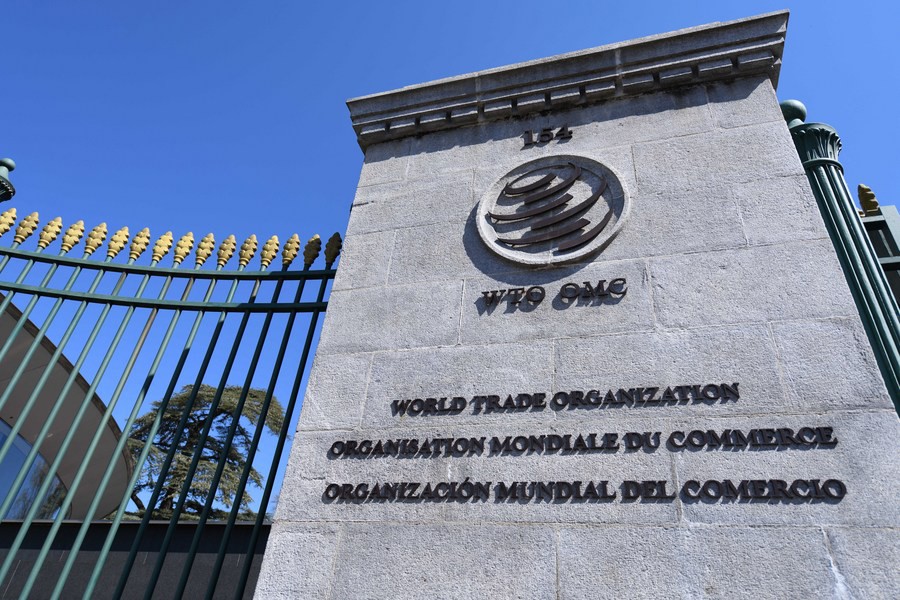
 A logo of the World Trade Organization (WTO) is seen in Geneva, Switzerland, on April 5, 2023 —Xinhua Photo
 Bangladesh's economic success story is inseparable from global trade. Over the past three decades, our garment industry has become the backbone of the economy, employing millions and accounting for more than 80 percent of export earnings. The international rules-based trading system, anchored in the World Trade Organization (WTO), gave Bangladesh the space to thrivewith predictable market access, equal treatment, and protection from arbitrary discrimination.
But today that system is crumbling. Michael Froman, former United States Trade Representative (USTR) and now President of the Council on Foreign Relations, recently declared in an article in Foreign Policy that the WTO has "ceased to function." The institution no longer negotiates new agreements, resolves disputes, or even upholds its founding principle of "most favored nation" treatment. For Bangladesh, a small, open economy dependent on global markets, this is not a distant problem-it is a clear and present danger.
THE BLAME GAME - WASHINGTON VS BEIJING: In Washington, the collapse of the WTO is often laid at China's door. The US officials argue that Beijing's subsidies, sprawling state-owned enterprises, and industrial overcapacity overwhelmed world markets and broke the system. This narrative, though convenient, is dangerously incomplete.
The US itself bears a heavy responsibility. For decades, Washington was the architect of globalisation. It launched the General Agreement on Tariffs and Trade (GATT), midwifed the WTO in 1995, and championed multilateral rules. Yet once American workers soured on globalisation, the US leaders turned against the very system they had built.
The unravelling began under President Obama, whose administration quietly blocked the reappointment of WTO appellate judges it accused of "judicial overreach" --the idea that the Appellate Body has interpreted WTO agreements in a manner that exceeds its mandate and undermines the US sovereignty and trade interests. President Trump then drove the system into paralysis by refusing to appoint judges, withdrawing from the Trans-Pacific Partnership, and imposing tariffs on allies and adversaries alike. President Biden, while more diplomatic in tone, doubled down on industrial subsidies and "reshoring" policies. Trump's second term has gone even further, with tariffs of 25-50 percent slapped on dozens of countries.
THE ECONOMICS OF PROTECTIONISM: These policies may deliver short-term political gains, but their economic arithmetic is punishing. Steel tariffs saved a few thousand American jobs while destroying tens of thousands more in downstream industries dependent on cheap inputs. Chinese retaliation hammered U.S. farmers, forcing Washington to spend billions in subsidies to keep them afloat. The politics of protectionism may feel good; the economics are grim.
Nor is China the singular villain it is often made out to be. Yes, Beijing subsidises industries-but so does Washington, as the US$280 billion CHIPS Act makes clear. Yes, China has state-owned enterprises, but so do many European countries. Yes, it demanded technology transfers, but Western firms such as Apple and Tesla entered joint ventures willingly, trading know-how for access to the world's largest consumer market.
In truth, China has been one of the greatest beneficiaries and engines of globalisation. Since joining the WTO in 2001, it has slashed tariffs, opened its markets, and lifted more than 800 million people out of poverty. It is widely recognized that its cheap, manufactured goods helped suppress global inflation, raising living standards across the world-including in Bangladesh.
THE DEEPER MALAISE: What truly doomed the WTO was no single country but a mismatch between a slow-moving multilateral system and a rapidly changing global economy. Consensus rules gave every member a veto, making reform painfully slow-sometimes impossible. Meanwhile, new issues such as digital trade, artificial intelligence, and supply chain security emerged far faster than the WTO could adapt.
At the same time, the US politics grew hostile to globalisation, reflecting its uneven distribution of gains. The benefits-cheaper goods, wider markets, higher corporate profits-were diffuse. The costs-lost factory jobs, shuttered towns-were concentrated and visible. The result was a political backlash that undermined support for the system itself.
COMPETING VISIONS FOR THE FUTURE: If the WTO cannot be revived in its old form, what comes next? Froman argues for "open Plurilateralism": coalitions of the willing-which would mean mostly advanced economies-forming clubs to write new rules on trade, technology, and supply chains. This approach is agile and pragmatic, bypassing the WTO's paralysing consensus rules. But it is also exclusionary. Developing countries like Bangladesh, which may struggle to meet high regulatory thresholds, risk being left outside the new clubs. In practice, this would likely evolve into a club of like-minded, mostly advanced economies, setting new standards on technology, supply chains, or fair-trade practices. A variant of this approach is found in the advocacy of a new trade order with "concentric circles": onner circle of deep integration with close allies; middle circle of predictable rules with most other countries; and outer circle of "de-risked" but still limited trade with adversaries like China
By contrast, Singapore's Prime Minister Lee Hsien Loong has suggested a more inclusive path: a "world minus one." In his view, if the United States opts out, the rest of the world should continue using the WTO framework. Agreements such as the CPTPP and RCEP reflect this spirit of adaptation: imperfect but still anchored in inclusivity. It is suggested that the multilateralists' middle powers, which have the economic and political wherewithal, need to take the leadership to promote the cause of multilateralism for smaller economies; this model is far preferable to being shut out of elite clubs dominated by rich nations.
WHAT IT MEANS FOR BANGLADESH: For Bangladesh, the stakes could not be higher. Our prosperity rests on export markets, yet the erosion of WTO principles has already eroded predictability. If rich-country coalitions impose new labour, environmental, or digital trade rules without including us, our competitive edge could be blunted.
We must not remain passive bystanders. Dhaka should work actively with other developing nations to safeguard inclusivity in global trade governance. At the same time, Bangladesh must strengthen its domestic foundations: diversify exports beyond garments, move up the value chain, and invest heavily in human capital to prepare for the disruptions of automation and artificial intelligence (AI).
Trade shocks may be painful, but they will pale in comparison to the looming shock of AI and robotics, which could displace millions of jobs worldwide. Without strong domestic policies-lifelong learning, reskilling, place-based investment, even the most open trade regime will not deliver sustainable gains.
THE PATH AHEAD: The WTO as we knew it will not return. The challenge now is not to try to glue Humpty Dumpty back together but to build something new: rules that are flexible enough to adapt, fair enough to be trusted, and inclusive enough to give all nations a seat at the table.
For Bangladesh, the choice is stark. We can help shape the next trading order, or we can risk being shut out of it. As a nation whose destiny is tied to trade, we cannot afford complacency. Our future prosperity will depend on how boldly we engage in this global debate-and how wisely we prepare at home.
Dr MG Quibria is an economist and former Senior Advisor at the Asian Development Bank Institute. His academic career spans institutions across three continents. mgquibria.morgan@gmail.com
© 2026 - All Rights with The Financial Express

