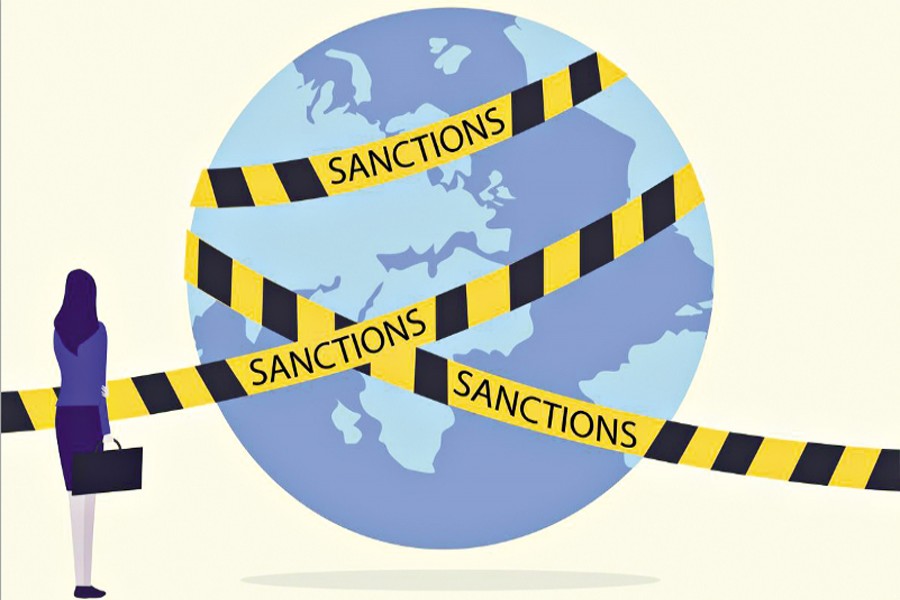
For decades, economic sanctions have been among the most powerful instruments of global influence. By controlling access to finance, markets, and technology, the United States has used its dominance over the dollar-based system to project power worldwide.
But that power is no longer absolute. As sanctions have expanded in scale and frequency, they have produced an unintended consequence: a gradual redesign of the global system itself. Countries seeking to circumvent or minimise the impact of sanctions have resorted to adaptive mechanism. Power, when overused, invites adaptation. And when such adaptation becomes systemic, it begins to transform the very structure of power itself.
In the ongoing tensions between the United States, Iran, and China, Washington has imposed sanctions on Chinese entities accused of helping Iran evade U.S. restrictions. China is not confronting these sanctions through dramatic defiance or outright rupture. It is doing something far more consequential: quietly redesigning the pathways through which sanctions operate. This is not merely a story of resistance; it is a story of transformation-one that can only be fully understood through the lens of geopoliticonomy, the fusion of geopolitics, geoeconomics, and global power.
Sanctions function through control over key nodes of the global system: payment networks, reserve currencies, trade financing, and technological ecosystems. The post-Bretton Woods order ensured that most of these nodes converged around the U.S. dollar, making sanctions highly effective. Exclusion from the system often meant isolation from the global economy.
In recent years, the United States has imposed sanctions on hundreds of Chinese firms-more than 700 entities across various restriction list-reflecting both the scale and intensity of economic confrontation. Yet the significance of this number lies not merely in its size, but in what it has triggered.
These entities are strategically clustered. This is not a broad embargo, but targeted pressure on the nodes that define the future: semiconductors, quantum computing, and artificial intelligence. In a geopoliticonomic system, however, targeting critical nodes does not simply isolate firms; it triggers systemic counter-responses. In one of its first major corporate enforcement actions, China invoked its Anti-Foreign Sanctions Law against firms complying with foreign restrictions. Adopted in June 2021, the law creates a domestic legal buffer, placing multinational companies under competing obligations and transforming sanctions from absolute prohibitions into negotiated constraints.
China's response, therefore, has not been to attack the system directly, but to fortify itself and reduce its vulnerability to sanctions. It has expanded alternative payment infrastructures, encouraged bilateral trade in local currencies, deepened ties with sanctioned economies, and created legal buffers to shield firms from external pressure. Taken individually, these moves appear incremental. Collectively, they represent structural change.
One visible consequence is the fragmentation of the global financial system, as countries develop alternative payment mechanisms, diversify reserves, and restructure trade settlements to reduce exposure to sanctioning authorities. These measures are gradually eroding the singular dominance of the dollar while creating space for other currencies, including the yuan, to play larger international roles.
A measurable signal of this shift is visible in global reserve composition. Data from the International Monetary Fund's COFER database show that the U.S. dollar's share of allocated foreign exchange reserves has declined from roughly 70 per cent at the turn of the century to below 60 per cent in recent years. This does not imply imminent displacement, but it does reflect a system in transition-one in which diversification itself becomes a strategic response to geopolitical risk.
What emerges is a world no longer defined by a single financial axis, but by multiple, overlapping circuits of exchange. In such a system, sanctions do not disappear-they diffuse. Their force is no longer concentrated at a single point, but dispersed across a network that is increasingly difficult for any one country to control.
Here, the logic of physics offers insight. In a system of sympathetic resonance, a disturbance in one component induces vibrations in others, altering the behaviour of the whole. A sanction imposed in Washington reverberates through supply chains in Asia, energy markets in the Middle East, and financial systems in Europe. These vibrations do not merely transmit-they transform.
The original signal weakens through this resonance. When one node is restricted, the disturbance travels through global financial circuitry, inducing adaptive responses. This is evident in the development of alternative payment systems. While dominant networks remain central, repeated sanction shocks have encouraged countries to create parallel channels as safeguards. This is not resistance alone; it is the emergence of redundant architecture-ensuring that the system continues to function even when the primary dollar channel is disrupted.
Over time, the system retunes itself. The signal does not vanish-it loses dominance. The analogy extends further. In an entangled system, actions are never isolated. A policy decision in one country triggers immediate adjustments elsewhere, regardless of distance. This is the essence of geopoliticonomy: a world in which economic and political actions are inseparable, and power is exercised not only through control, but through connectivity.
Surface narratives often describe the present moment as "decoupling." Geopoliticonomy reveals a more complex reality: entanglement. A restriction on a supplier in one country triggers adjustments across manufacturing networks, financial hubs, and global commodity flows. Because economic and political systems are deeply intertwined, true decoupling becomes structurally difficult. What we are witnessing instead is a rerouting of connectivity, as linkages are redirected through local-currency settlements and alternative financial circuits.
China has understood this dynamic with remarkable clarity. Rather than dismantling the existing order, it is embedding itself within it while simultaneously building alternatives. This dual strategy-participation and parallelism-allows it to benefit from the current system while preparing for a future in which that system is no longer singular.
The implications are profound.
Sanctions, once a tool of near-absolute leverage, are becoming increasingly context-dependent. Their effectiveness now varies across regions, sectors, and networks. They remain powerful when supported by broad international coordination, but become less effective when applied unilaterally in a fragmented global landscape.
This does not signal the end of sanctions. It signals their evolution. For policymakers, the lesson is clear: power rooted in centralisation must adapt to a world of decentralising networks. Sanctions remain potent when they function as a coordinated, multilateral chorus, but lose effectiveness when deployed as a unilateral solo.
For analysts and journalists, the narratives of "defiance" or "violation" often obscure deeper structural change. And for developing countries, the lesson is equally important. In a world increasingly shaped by competing power centers, economic and diplomatic engagement must be strategic, diversified, and carefully balanced to avoid excessive dependence on any single bloc.
The future of power lies not merely in the ability to exclude, but in the capacity to sustain connectivity across overlapping circuits of exchange. What China is doing is not simply breaking sanctions. It is changing the conditions under which sanctions work-and quietly redefining the architecture of global power.
Dr. Abdullah A. Dewan, Professor Emeritus of Economics, Eastern Michigan University (USA); former physicist and nuclear engineer, Bangladesh Atomic Energy Commission (BAEC). aadeone@gmail.com.
Dr. Firdousi Naher,Professor and Chairperson, Department of Economics, University of Dhaka. naher.firdousi@du.ac.bd
© 2026 - All Rights with The Financial Express

