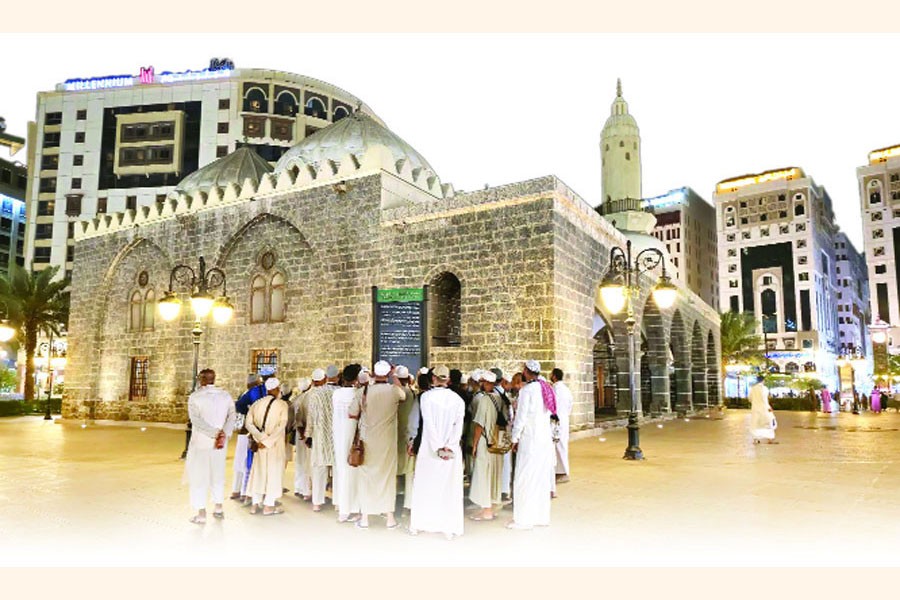
 Pilgrims are watching Al-Ghamamah Mosque in Madinha
 Like millions of pilgrims, we visited Madinah as part of our Hajj trip this year and stayed there for a week. Though visiting this historic and important city is not obligatory for the Hajj pilgrims, they customarily stay for a week or more there for various reasons. The most important of them is to visit and pray at Al-Masjid an-Nabawi, the Prophet’s Mosque which is the second-holiest site of Islam after Al Masjid Al Haram or the Grand Mosque of Makkah, which surrounds the Holy Kaaba, the Qibla, towards which Muslims pray five times daily.
 Pilgrims during their Hajj or Umrah trip take the opportunity to visit the Prophet’s Mosque where the Blessed Chamber and the Blessed Rawdah are also situated. The Chamber is actually the house of Prophet Muhammad (PBUH), where he lived with his second wife, Aisha (RA). In this room, the Prophet and his two key companions, Abu Bakr and Umar, were buried. Visitors used to pay tribute to them there. The Rawda is located at the front of the Prophet’s Mosque, and extends from the house of the Messenger of Allah (PBHU) to his pulpit.
Besides the Prophet’s Mosque, a number of historical sites are in Madinah, and by exploring them, pilgrims can feel the persistent struggles Muhammad (PBUH) and his companions went through to establish Islam and satisfy Allah. The exploration is known as ‘Zyarah’ in Arabic.
During our stay in Madinah, a scheduled group visit to Rawda was arranged. For the women, it was around midnight; for men, a few hours later. Once the women entered Rawda, we planned to walk around the Prophet’s Mosque, explore a few historical spots, and then return to Rawda.
The Rawda is not just an area within the Prophet’s Mosque; it is a highly revered place, a piece of Jannah (Paradise) on Earth. The Prophet (PBUH) said: “What is between my house and my pulpit is a garden from the gardens of Paradise.” (Sahih al-Bukhari: 1196, Sahih Muslim: 1391). Visiting Rawda and praying there is a practice which is deeply emotional with a unique spiritual vibe. The Kingdom of Saudi Arabia (KSA) has introduced an online platform, Nusuk, to book individual time slots for Rawda visit. Travel agencies handling pilgrims for Hajj and Umrah can also set group schedules. Though many of us booked individual slots, our agency, Amin Travels and Tours, arranged a group visit at night.
After the women of our group departed for Rawda, we moved west from the Prophet’s Mosque. Mawlana Md Ibrahim Khalil guided us to four historical mosques. After crossing Gate No. 330 and Quba Avenue, we saw Al-Ghamamah Mosque, built on the ground where Prophet Muhammad (PBUH) led Eid and rain-invoking prayers. This spot holds deep spiritual and historical significance. The mosque has five domes, a rectangular prayer hall, and a striking cylindrical minaret. Its contrasting black basalt and white lime-washed stonework make it unique.
Ibrahim Khalil briefly described the mosque’s history, which is also inscribed outside. Originally called ‘Al-Musalla’ (the prayer ground), it later became known as ‘Al-Ghamamah,’ meaning ‘the cloud’. According to a narration, a cloud once shaded the Prophet as he prayed here, adding to the site’s sacred aura. During his lifetime, Muhammad (PBUH) usually offered Eid and rain-invoking prayers in open desert areas around Madinah. Toward the end of his life, he chose this site, later known as Al-Ghamamah Mosque. At that time, it was an unbuilt plain on the city’s edge (www.visitsaudi.com).
The mosque was first built by Umar ibn Abdulaziz, governor of Madinah in the first Hijri century. This means no visible structure existed for almost a century after the Prophet’s death. In later centuries, it underwent several restorations. The Saudi government carried out a major renovation to preserve its architectural character. We offered two raka’at Salat in the semi-open courtyard, where the stone floor is uneven.
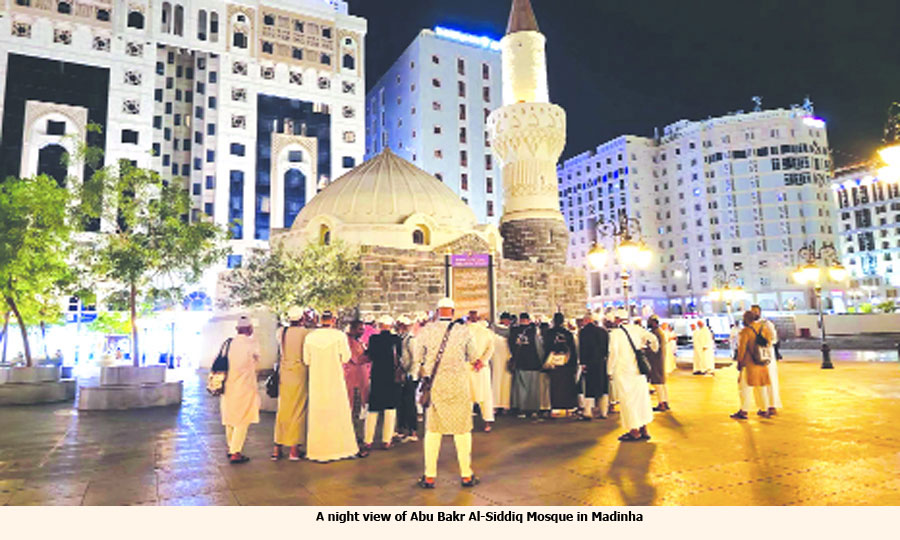
Next, we proceeded to Abu Bakr Al-Siddiq Mosque, which is only a few minutes’ walk away from the Ghamamah Mosque. The first caliph, Abu Bakr, who was also the first man to accept Islam in response to the call of Muhammad (PBUH), used to offer Eid prayers at this place during his caliphate. Again, it was Umar ibn Abdulaziz who first constructed the mosque here. After several restorations and reconstructions, the current structure of the single-domed mosque was shaped around 1254 Hijri (1838 CE).
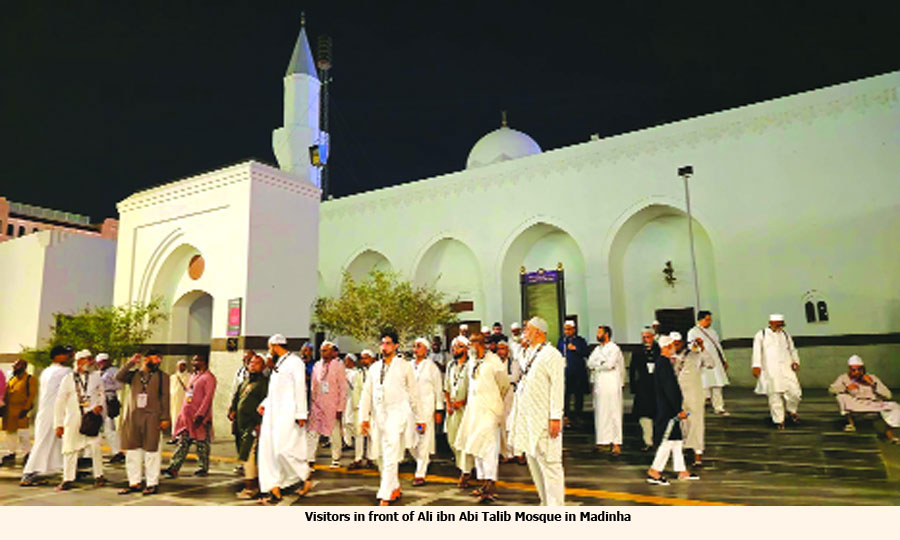
By advancing further north, we reached the point where Assalam Road towards the Prophet’s Mosque ended. At the south-west corner is situated the Ali ibn Abi Talib Mosque. Prophet Muhammad (PBUH) also led the Eid congregation in this place in the sixth Hijri century. Later, Ali led the Eid prayer at this location during the caliphate of Uthman, the third caliph.
Ibrahim Khalil also briefly described to us the last days of Uthman, who was interned at his house and finally killed by the rebels while reciting the Quran. A part of the bloodstained mushaf is still preserved at Barak-Khan Madrassah in Tashkent, the capital of Uzbekistan. On a trip in 2002, I had the opportunity to see the mushaf, the bound manuscript of the Quran compiled by Uthman.
Interestingly, the mosque was also built by Umar ibn Abdulaziz, who was the governor of Madinah (87-93 Hijri). At that time, Umar, also known as Umar the Second, initiated the identification of the Prophet’s (PBHU) prayer sites and built mosques there to preserve the memory of the Prophet (PBHU) and his closest companions. He later became the eighth Umayyad caliph, ruling for less than three years. Nevertheless, he earned a significant place in the history of Islam for his piety, austerity and justice. Unlike his predecessors, who were ruthless and fond of luxury, Umar the Second followed a simple life, abrogating luxury.
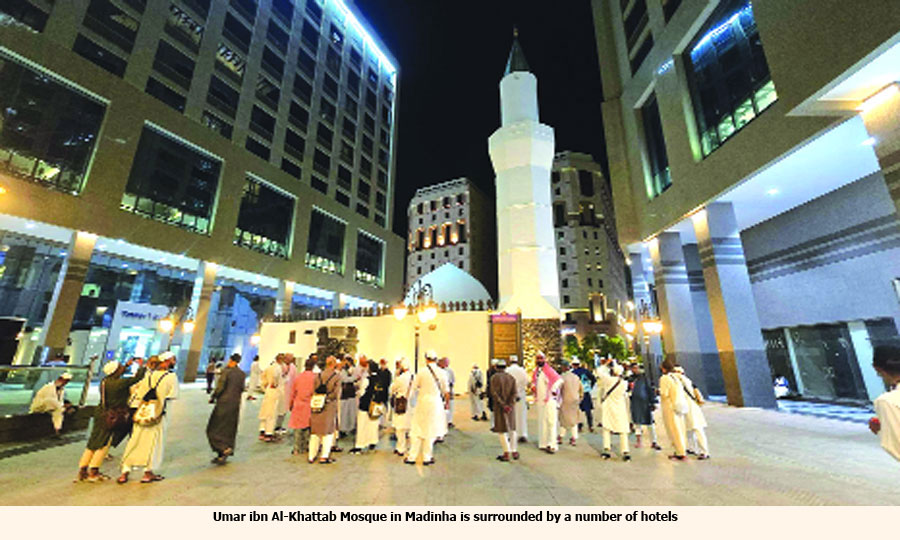
Later, we reversed the course to Umar ibn Al-Khattab Mosque, situated in the southwest corner of the Prophet’s Mosque and on the southern side of Al-Ghamamah Mosque. It is a single-domed mosque and is now surrounded by hotels on three sides. Recognised as cultural heritage, the mosque was named after Umar, the second rightly guided caliph of Islam, who used the place for Eid prayers after the Prophet (PBUH) did. Built by Shaykh Shams al-Din Muhammad ibn Ahmad al-Salawi after 850 Hijri, like nearby mosques, it has undergone various restorations. The existing structure dates back to the 13th century Hijri, though the KSA authority has carried out some preservation work. It is, however, not open for prayer. As it was midnight, we also did not get any chance to enter the other mosques.
One common characteristic of these four mosques is that they are all situated in Musalla or Al Manakha Square to the west side of the Prophet’s Mosque (www.visitsaudi.com). The Musalla Square lay between the dwellings of Banu Sa‘idah and Banu Zurayq, and was an open space free of buildings and trees. Prophet designated the area as a marketplace for the people of Madinah and also a place for performing the Eid prayers, the rain-seeking prayer (istisqa’), and the funeral prayer in absentia (salat al-gha’ib). He also supplicated for its people there. Ibrahim Khalil told us that the Prophet offered the funeral prayer in absentia for Najashi (Negus), the king of Abyssinia, at Musalla Square. The king was a Christian who later converted to Islam and helped Muslims who fled from Makkah to Abyssinia for shelter to avoid the wrath of non-believers.
As we prepared to go to Rawda, Md Obaidul Hoque and Md Ziaul Hoque, siblings and directors of Amin Travels and Tours Ltd, offered coffee. They provided full-time companions during the night-time walk and at other times. The coffee gave us a boost for our visit to Rawda. I was, however, thinking about Umar the Second. The idea of a fiction came to my mind during the walk. If time permits, I desire to write the story, with Umar bin Abdulaziz, also known as the Umayyad Saint, as the central character. I first read about him in Islamic history course at HSC level. I later also read more about him. Having deep respect for the man whose contribution to Islam is unique, the night-time walk rekindled my interest in studying more about the ‘fifth rightly-guided caliph.’
asjadulk@gmail.com
© 2026 - All Rights with The Financial Express

