 He was a voracious reader, a prolific writer, a spellbinding raconteur, a committed nationalist.
It is time to reflect on the life and career of Syed Najmuddin Hashim. This reflection becomes necessary given not only the enlightenment which underscored Hashim’s personality but also because of the requirement to have his legacy projected before the generations born and growing up in his absence. And those of us who knew Hashim are in sore need of reminding ourselves of the lessons we imbibed from him through studying his outlook on life.
For me especially, Syed Najmuddin Hashim is among the eminent people I have consistently held in the highest esteem. I have learned from them, have had my views of life, politics and culture refined through being in their company and sometimes exercising the liberty of contributing my humble views to their obviously magisterial assessments of the world. Waheedul Haque and Shawkat Osman are, with Syed Najmuddin Hashim, part of the intellectual universe through which I have sought to travel.
 When Hashim passed away in Dhaka on a July day, I watched the clouds sailing by beyond my office window in London. I travelled back to the times I had spent in his company. My very first interaction with him was at the weekly Dialogue, where his colleagues were two other eminent individuals, Mahbubul Alam and Saiful Bari, for whom my respect was unqualified. I was at the Dialogue office to submit a write-up, my first for the weekly, to Hashim.
It was a handwritten essay that I handed over to him, not sure if he would accept it or cast it into the nearby waste basket. To my surprise, he gave it to the typist, who would prepare it for that week’s issue of Dialogue. In clear trepidation, I asked him if he would not read the piece first. He put me at ease: ‘Your writing doesn’t need editing.’
That was the beginning. In subsequent years, Hashim bhai and I deepened our bonds through our participation at media seminars in Kathmandu and Delhi. My horizons were broadened when he introduced me to his peers from India and Pakistan at these seminars. Sitting in on his conversations with them, which were intensely serious and at the same time engagingly witty, I educated myself. On the concluding day of one such seminar in Kathmandu, we decided to split from the group and instead gorge ourselves on rich food at a restaurant.
Once, on our way to Delhi, we had to take a connecting flight from Calcutta. Before boarding the flight at Dum Dum airport, we could not locate our luggage on the tarmac. Both of us went round and round, worried that the flight would take off in a few minutes. At that point, a young woman at Indian Airlines, a radiant smile on her face even in that hour of twilight, told us to look at the suitcases right before us. Lo and behold! There was our luggage and we hadn’t noticed! Hashim bhai and I broke into laughter and so did the young woman.
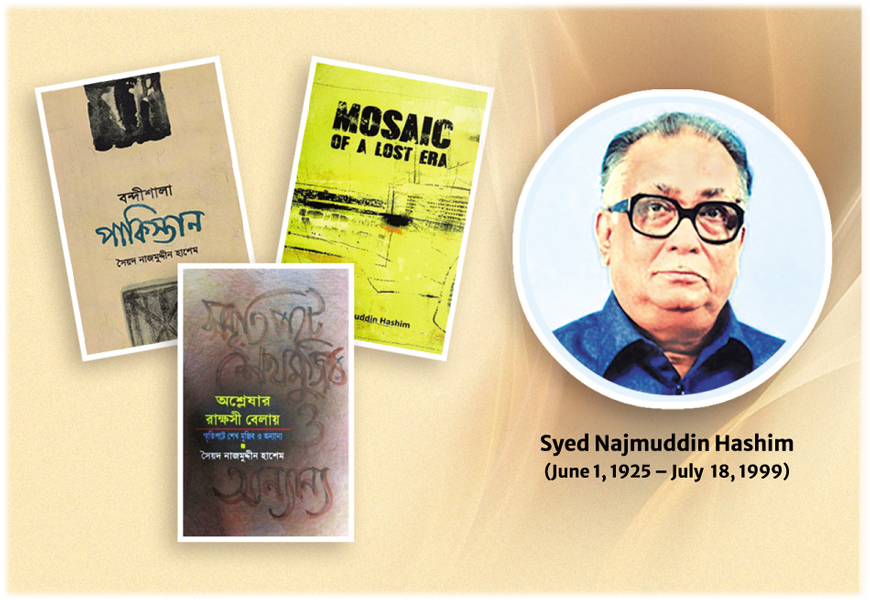
In the course of our travels, Hashim bhai and I had long conversations, particularly in relation to his experience as a civil servant in Pakistan and the difficult times he and his family spent there following the emergence of Bangladesh. Readers will be doing themselves a favour if they go through his book, Bondishala Pakistan (if copies are still to be found), for it is an enumeration of not only the captivity Bengalis were held in by the Bhutto government but also of the frustration and anger of many Bengali civil servants at the way geography in South Asia had changed.
Many of these people fulminated against their own Bangladesh, convinced that the state would not last. I asked Hashim bhai why he did not name these individuals in the book. His reply was terse and meaningful: many of those very critics of Bangladesh and Bangabandhu had, following their repatriation in 1973-74, risen to prominent positions in Dhaka. It would not be safe to incur their wrath.
In his illustrious career, Syed Najmuddin Hashim garnered experience that can only be the envy of anyone researching history in our part of the world. Having heard a multiple number of times that he had ghost-written Field Marshal Ayub Khan’s memoirs Friends Not Masters, I asked him, as we sat sipping coffee in Kathmandu, for his response to such reports. His explanation was simple and unambiguous: Altaf Gauhar, the powerful secretary of the ministry of information close to the President, had given Hashim a chapter of the manuscript to edit. Hashim bhai did a thorough editing of the chapter before giving it back to Gauhar.
Gauhar, horrified that Hashim had dared to make so many corrections and petrified about Ayub’s probable reaction, had him accompany him to the President’s House. They both stood before Ayub as he went through Hashim’s editing. At a point Ayub, focused on the chapter, asked Gauhar who had done the editing. Gauhar told him about Hashim, who was there in person. Ayub looked up and addressing Hashim for the first time, said ‘Good editing’. He asked Gauhar to give Hashim a second chapter to edit. Those two chapters were his only links, Hashim bhai told me, with Ayub’s memoirs.
Erudition was a hallmark in Hashim. I have observed him in conversation with such intellectual powerhouses as Nikhil Chakravartty of history in all its various dimensions. But Hashim was an intellectual powerhouse on his own. One need only read his Oshleshar Rakkhoshi Belae and Shamuddata Doibo Durbipaake’, works which are as much an image of the writer as they are of the heritage he writes on. His performance as a diplomat in Moscow and Yangon and as minister of information was emblematic of the sophistication he epitomised. Hashim had little time for hollow men and was brusque in his dismissals of them.
He knew how to get back at people lacking in respect for others. In Delhi, we were at a luncheon when he told me he was ignoring a former Pakistani diplomat who had refused to recognise him despite their earlier association in Islamabad. Within minutes, though, the diplomat walked over to our table and asked Hashim if they had met before. Hashim bhai’s retort was sharp: ‘You know me very well from our Islamabad days, so why do you ask me this question?’ The diplomat was embarrassed.
Syed Najmuddin Hashim and Bangabandhu Sheikh Sheikh Mujibur Rahman knew each other from their days as students in Calcutta. When Hashim bhai returned to independent Bangladesh through repatriation from Pakistan in the early 1970s, he went over to the old Ganobhaban, Bangabandhu’s office at the time. Bangabandhu was overjoyed to see him and immediately named him director general of external publicity.
Twenty-six years after his demise, Syed Najmuddin Hashim —- scholar, civil servant, diplomat, writer —- is remembered in affection, in profound respect.
ahsan.syedbadrul@gmail.com
© 2026 - All Rights with The Financial Express

