Bangladesh's idea of either merging six investment-related agencies into a single body or creating an Investment Promotion Agency (IPA) is timely and significant. The proposed consolidation of Bangladesh Investment Development Authority (BIDA), Bangladesh Economic Zones Authority (BEZA), Bangladesh Export Processing Zones Authority (BEPZA), Bangladesh Hi-Tech Park Authority (BHTPA), Public-Private Partnership Authority (PPPA) and the Bangladesh Small and Cottage Industries Corporation (BSCIC) is certainly a much-needed step to cut down on institutional fragmentation in the investment governance architecture of the country. When implemented strategically, it can enhance investor services, diminish redundancy in administration and strengthen Bangladesh's position as a competitive destination for foreign direct investment (FDI). However, the reform should not be pursued as merely an administrative merger. Bangladesh does not merely need one larger institution. It requires a systems that are more efficient, predictable and investor friendly.
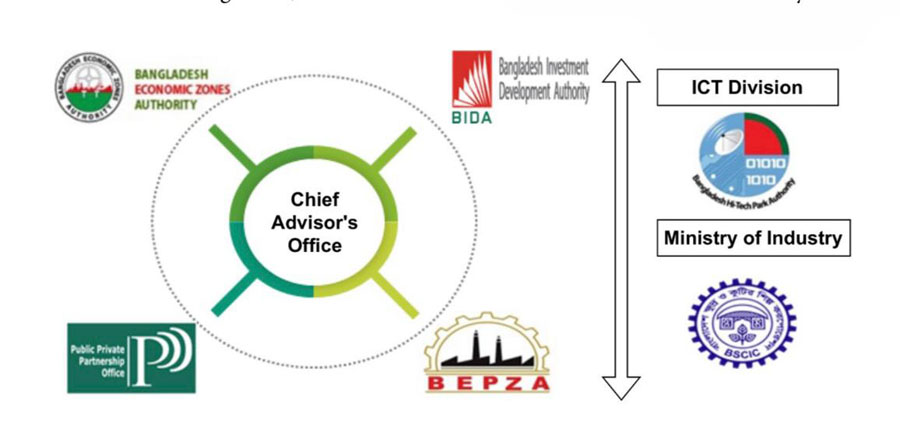
Despite being endowed with a large domestic market, reasonable labour cost, strategic location and growing infrastructure compared to some of these regional competitors, Bangladesh has failed to capture an FDI growth momentum. Over and above that institutional inefficiency is one the main reasons behind scarcity. Investors are also burdened with overlapping mandates, redundant documentation, ambiguity in who/what gets approved where, slow decision-making timeframes and weak or limited post-investment support. The costs of doing business thus go up and investor confidence is undermined.
An empirical study conducted in Bangladesh also substantiates this concern, as presented by the title of the study released recently "Streamlining Investment Promotion Agencies for attracting FDI in Bnagladesh". A mixed method study was conducted using literature review, policy document analysis, SWOT (Strengths, Weaknesses, Opportunities and Threats) analysis, PESTEL (Political Economic Socio-cultural Technological Environmental) and stakeholder analysis with a structured survey. Of the valid responses, 63 came from the officials of IPA officials alongside private investors as well as government officials and development partners. Additional 15 Key informant interviews and one focus group discussion were conducted to understand the coordination problems, procedural barriers of IPA ecosystem and reform options. The study revealed that investment facilitation remains extremely hampered by fragmented mandates, weak coordination, procedural delays and limited digital readiness. Consolidating the existing IPAs into one authority was identified by the study as the most popular reform option among stakeholders. This makes the government's current initiative highly relevant.
But, merger alone cannot be the solution. Without a change in laws, processes, digital systems and accountability mechanisms, the result may simply be a bigger bureaucracy. The objective should truly be to consolidate all investments in a single, fully empowered, and service-oriented investment authority that makes the process much easier for investors from initial enquiry through project planning to implementation and ultimately expansion.
The first priority should be harmonisation in the legal and regulatory domains. All the agencies proposed for merger were set up under distinct legislative and institutional frameworks. Their mandates are not identical. To elaborate, BEZA is responsible for economic zones, BEPZA for the export processing zone (EPZ), BHTPA is concerned with technology parks, PPPA works on public private partnership (PPP) transactions, BSCIC on industrial estates and small industries whereas BIDA has a wide investment facilitation role. Therefore, the government must carefully identify which functions should be integrated, what should be developed in coordination with each other and which distinct competencies need protection.
Second, the integration agency need a true digital one-stop service system. Digitalisation does not only mean web forms or democracy or other digital devices and data. Time-bound approvals, tracking of the application status, digital payment, inter-agency data sharing and unambiguous service standards need to be built into it. There was no need for investors to submit the same documents multiple times across different offices. A well-provided digital platform can minimise discretion, enhance transparency and accountability.
Third, investors' aftercare needs serious attention. Bangladesh enjoys a lot of hype in terms of attracting new investors but equally important are existing ones. When existing investors are given quick services, consistent assistance and prompt resolution of complaints, they have a much higher tendency to reinvest and grow. Such an agency must thus have dedicated aftercare and grievance-resolution wings.
Fourth, the new agency must be associated with national industrial policy. FDI should not be seen only as capital inflow. It needs to promote export diversification, tech transfer, local supplier development and skills upgrading and allow entry into global value chains. Countries such as Vietnam and Malaysia have been more successful in attracting investment, because the logic of investment promotion is closely linked with sectoral strategy and industrial upgrading. These examples are to be learnt for Bangladesh.
Finally, implementation should be phased and transparent. Institutional merger may create resistance, confusion and short-term disruption. It should be undertaken with the help of officials, advice from investors, pressure groups and development partners. It is to be clarified and put before the investors that the reform is meant for making services easier, not for delaying them.
This initiative should be measured by tangible outcomes-- faster approval time, no overlapping processes, improved aftercare, clearer accountability and better-quality FDI. Bangladesh is now competing in a new global investment environment influenced by supply-chain relocation, China-plus-one strategies and green industrial transformation. It is important to note that, these opportunities will not come automatically. They have to be captured by credible institutions and effective governance.
Bangladesh could be a game-changer with an integrated investment agency. However, it should also constitute a change in the reform of the investment ecosystem instead of only a switch in institutional domain. The country is not looking for another bureaucracy. It requires one effective single-system that investors will believe in.
Md. Sayful Islam, Deputy Director, Bangladesh Investment Development Authority (BIDA).
© 2026 - All Rights with The Financial Express

