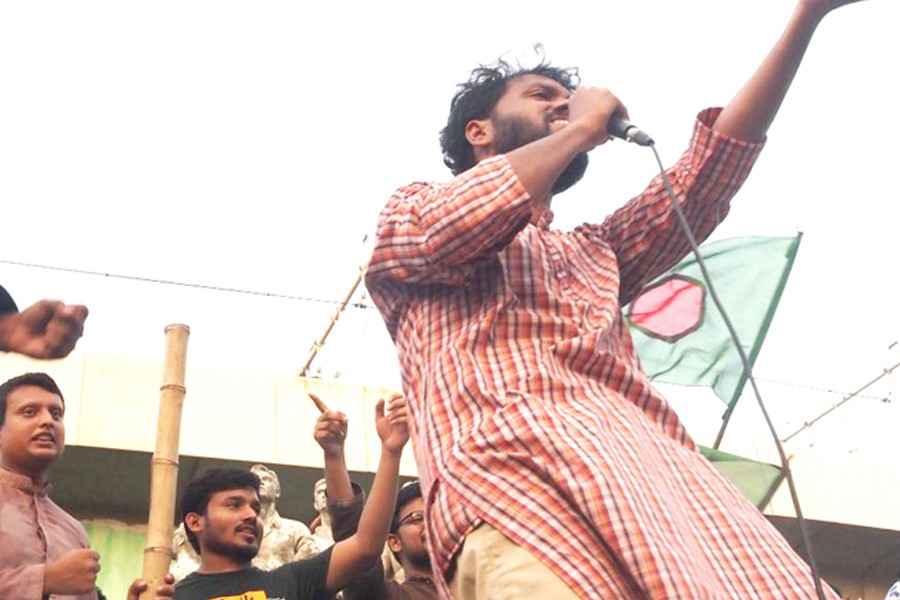
 Osman Hadi at TSC area in Dhaka University in 2024 —Photo by Shome Basu
 In the aftermath of last year’s anti-Hasina uprising in Bangladesh, several student leaders emerged from obscurity, propelled by a mix of anger and a demand for justice. Sharif Osman Hadi was one of them.
I first encountered Osman Hadi in September 2024 at the TSC junction of Dhaka University, beneath the towering Raju Bhaskar sculpture that has long served as a gathering point for dissent. Dressed in a red checked kurta and khaki trousers, and shaking his head of overgrown curls, Hadi was leading slogans from a makeshift stage. “Delhi or Dhaka…?” he asked, his voice thick with accusation. The response, “Dhaka, Dhaka”, came back in a roar.
The red sun on green, Bangladesh’s national emblem, had been repurposed as a symbol of protest. From close to the stage, I watched Hadi and his comrades train their fire on every aspect of Bangladesh’s relationship with India. “Give us Hasina,” shouted one of his associates, referring to Sheikh Hasina’s asylum in India.
As Kazi Nazrul Islam’s revolutionary song Karar oi louho kopat (‘the iron doors of the prison’) began to be sung on stage, it felt like a new revolutionary moment was beginning. Hadi had led the singing.
But the mood was volatile. From within the crowd, a group of young men noticed the identity card hanging from my neck, bearing the name of an Indian media organisation. I was jostled and accused of being an R&AW agent.
It was language that helped the situation. Then, from the stage, two young men jumped down to calm the crowd. One of them was Osman Hadi.
That brief encounter, in a post-Hasina Bangladesh, offered a window into the resentment that was animating the streets. Hadi did not appear to be a hardline Islamist. What was unmistakable in him and the young men and women gathered there was a surging anti-India sentiment. Much of it centred on anger at the Indian government for granting asylum to Sheikh Hasina.
Hadi and other students who spoke were careful to strike a qualified note. “We want good relations with India,” they said, “but the way [prime minister Narendra] Modi and [home minister Amit] Shah are behaving is unfortunate.” Shah’s description of Bangladeshis as “termites” was repeatedly cited as humiliating.
Traffic was gridlocked across the university area. Students, locals and even children filled the streets. To me, Hadi said: “Did you hear what the people want? We don’t want interference from Delhi. We know how to run our country.”
“For years,” he continued, “you manipulated our elections. We won’t allow that anymore. Do you think all these people are fools? They know how to run their homes.”
I attempted to respond, but I could also see that he was agitated. He returned to the demand that Sheikh Hasina be sent back from what he called was her “safe house” in India. As dusk settled, the crowd thinned. Children in green bandanas played around the statues. Hadi and his comrades packed away their harmonium, speakers and guitar, leaving behind a scatter of anti-India posters.
Born in Barisal, Hadi had studied at a local madrasa before coming to Dhaka University. He then became a teacher. When we parted, he and his comrades said “Allah hafiz”. A friend later remarked that groups like Inqilab Moncho, which Hadi and his associates had formed after the July revolution, were tilting to the right.
On the afternoon of December 12, the 32-year-old Hadi was shot in Dhaka’s Motijheel [actually Naya Paltan] area. CCTV footage showed his attackers fleeing on a speeding motorcycle. The area had been Hadi’s stronghold during the July 2024 uprising.
His brief career had been accelerating towards finding a platform ahead of the February 2026 elections. His opposition to the Awami League, Sheikh Hasina and India, combined with an ideological tilt towards Jamaat, the BNP, Hefazat-e-Islam, Islamic Chhatra Andolon and Nahid’s NP, appeared to be shaping that platform.
As suspicion turns towards Awami League-linked student groups, questions over law and order and the integrity of the coming polls have sharpened.
What remains undeniable is the energy Hadi brought to the streets: organising protests, assembling sound systems, and delivering impromptu speeches. He was a Young Turk but his trajectory was cut short violently before it could fully reveal where it might have led his country.
The writer is a senior Indian journalist based in New Delhi. The piece originally appeared on The Wire (www.thewire.in) and republished with permission.
© 2026 - All Rights with The Financial Express

