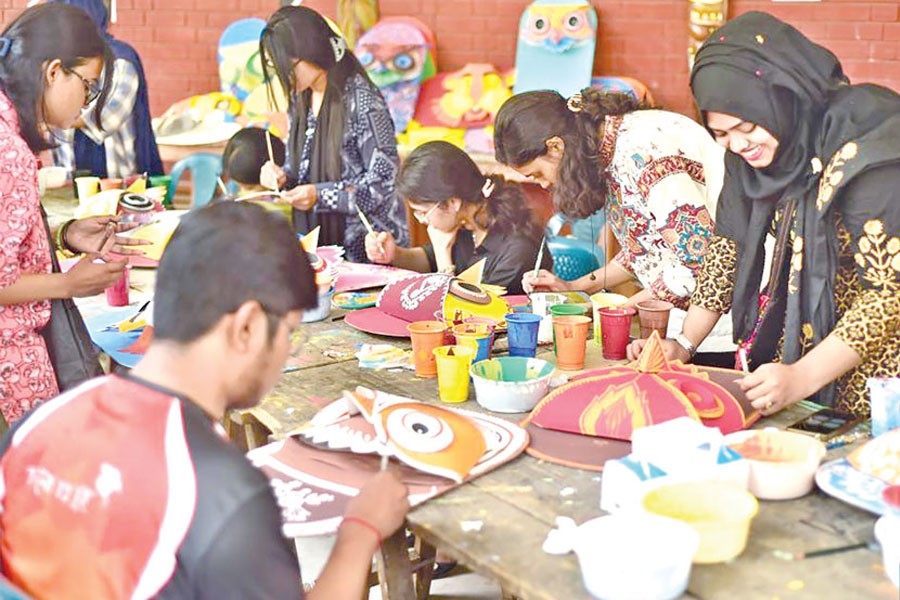
 Artists create artworks in preparation for the upcoming Bengali New Year, or Pahela Baishakh, at the Faculty of Fine Arts of University of Dhaka in Dhaka, Bangladesh on April 6, 2026— Xinhua Photo
 Although Pahela Boishakh marks the beginning of Bangla New Year, there are some variations with regard to the Bangla New Year and the Calendar followed in Bangladesh and India. The Bangla Calendar or Bangabda used in Bangladesh is primarily a solar calendar, while the version followed in the Indian states of West Bengal, Assam, Tripura, and Jharkhand is basically lunisolar in nature. These Indian states follow a version that emerged in 593-94 CE during the reign of the Hindu King Shashanka (590-625 CE). On the other hand, Bangladesh follows an amended version that was originally introduced by the Mughal Emperor Akbar in 1584 CE. The Bangla calendar adopted by the Indian states is based on the Sanskrit text ‘Surya Siddhanta’ and evolved from the Vikrami Calendar introduced by the Hindu King Vikramaditya in 57 BCE.
Calendars have been in circulation in the Indian subcontinent since the Vedic era, and are used by the Hindus across the globe, especially for setting festival dates and socio-cultural events. The complete Vedic calendars had five limbs related to time (panchanga), viz. lunar day (tithi), solar day (diwas), asterism (nakshatra), planetary joining (yoga), and astronomical period (karana). The earliest Buddhist community initially adopted the Vedic calendar, then the Vikrami version, and later local calendars that set festivals according to the lunar cycle. The traditional lunisolar Buddhist calendars of Sri Lanka, Myanmar, Thailand, and Cambodia are also based on the older version of the Hindu calendar. Similarly, the Jain community also followed the lunisolar system of the Hindu calendar. However, the Buddhists and Jains attempted to use the lifetimes of the Buddha and the Mahavira as their reference points.
Among the regional Hindu calendars of India, the most prominent are the ‘Shalivahana Shaka’ widely used in southern India, and the ‘Vikram Samvat’ or Vikrami calendar used in northern and central India as well as Nepal. Both these calendars are lunar, where the new year starts in spring. On the other hand, solar calendars are followed in states like Tamil Nadu and Kerala. The Hindu calendars are also referred to as ‘Panchangam’, which is called ‘Panjika’ in eastern India including West Bengal.
The Indian government felt the need for adopting a national calendar after becoming a republic in 1950. With this objective in mind, the central government constituted a ‘calendar reform committee’ headed by the scientist Meghnad Saha in 1957. The committee recommended a solar calendar with prescribed spans for various months: 31 days each in five months between Boishakh and Bhadra; 30 days each in seven months from Ashwin to Chaitra; Chaitra to have 31 days during leap years. The Indian government adopted this as the national calendar on March 22 1957. However, this calendar has been neglected due to the dominance of regional calendars. Another committee was constituted by the Indian government during the 1980s led by S P Pandey, which recommended April 14 as the first day of the Bangla New Year.
The proponent of the Bangla Calendar followed in Bangladesh was Fatehullah Shirazi – a famous scholar of the 16th century who adorned the court of the Sultan of Bijapur. He was commissioned by the Mughal Emperor Akbar to devise a calendar that could synchronise annual revenue collection with the harvest time of crops, so that farmers were not subjected to unnecessary hardships. At the same time, the calendar was to be acceptable to all religious communities. Fatehullah based the calendar on the Islamic one, but it took into account the fact that the lunar Islamic year was shorter than the solar year by about twelve days and therefore showed no fixed seasonal pattern. The names of the days and months were derived from the names of stars in Sanskrit, and the number of days, weeks, and months remained the same as in the solar year. This new FasliSan or Sal (Crop Year) was introduced by the Mughal Emperor Akbar on 10 or 11 March 1584, but it was counted from the day of his ascension to throne in 1556.
In East Bengal, the Bangla Calendar was subsequently modified by a committee headed by Dr Muhammad Shahidullah in 1966, which made the first five months of the Bangla Year 31 days long, and the remaining ones except Falgun 30 days long. Falgun usually has 30 days, but 31 days in case of a leap-year. This was officially adopted by Bangladesh in 1987, as a result of which the Bangla New Year (Naba Barsha) or Pahela (1st) Boishakh now falls on 14 April in the country. However, for the Bangalis of West Bengal, Tripura, Assam, and other states of India, the day falls on 13, 14, or 15 April in accordance with the Hindu calendar system. During the Pakistani era, the Bangla New Year festival became a popular means of expressing pride in Bangali culture and heritage of the people of East Bengal.
Different names are used for celebrating the indigenous New Year’s Day in different parts of India as well as in some South and Southeast Asian Countries. They include: Bwisagu and Bohag or Rangali Bihu in Assam, Buisu in Tripura, Sangken in Aurnachal Pradesh, Puthandu in Tamil Nadu, Vaishakhi in central and northern India, Mesha Sankranti in Uttarakhand, Vishu in Kerala, Vishuva or Maha Vishuva or Pana Sankranti in Odisha, and Jur Shital in Bihar. The day is also celebrated as ‘Naya Barsh’ in Nepal, ‘Aluth Avurudda’ in Sri Lanka, ‘Songkran’ in Thailand, ‘Choul Chnam Thmey’, ‘Moha Sangkran’ or ‘Sangkran’ in Cambodia, ‘Pi Mai’ or ‘Songkran’ in Laos, and ‘Thingyan’ or ‘Maha Thingyan’ in Myanmar. In the Chittagong Hill Tracts region of Bangladesh, the festival is celebrated as ‘Boisabi’ (Boishu of the Tripura community, Sangrai of Marma community, Sangkran of the Mros, and Biju of Chakma community). Consequently, Pahela Boishakh can rightly be termed as a New Year’s Day for a large part of South and Southeast Asia.
The colourful celebration of Pahela Boishakh starts in Bangladesh capital Dhaka at dawn with the rendition of the Tagore Song ‘Esho Hey Boishakh’ (Come O’ Boishakh) by the artistes of the renowned cultural organisation ‘Chhayanaut’ under the banyan tree of Ramna Park. A similar ceremony is also held at the nearby Institute of Fine Arts premises of Dhaka University. ‘Mangal Shobhajatra’ (auspicious procession, renamed ‘Ananda Shobhajatra’ last year and ‘Boishakhi Shobhajatra’ this year) is brought out by the students and teachers of this institute, which is also open to the public for participation. This event has been included in 2016 by UNESCO in the ‘Representative List of the Intangible Cultural Heritage of Humanity’.
Dr Helal Uddin Ahmed is a retired Additional Secretary and former Editor of Bangladesh Quarterly. hahmed1960@gmail.com
© 2026 - All Rights with The Financial Express

