 "She cannot leave us. She will remain forever. She is immortal," Tariqul Alam uttered these words repeatedly when she expired. He believed that his wife - singer and classical musician Ava Alam - could never die. One of the greatest female classical vocalists of the country - Ava Alam died on November 21, 1976 at the age of only 29. That sudden, premature, and sad demise was very painful to her fans, music lovers, relatives and friends. Originally hailing from Madaripur subdivision of Faridpur district, she was born on December 26, 1947 in Mymensingh. Her father Haripada Dey (died 16 days after her death) was very proud of his only daughter because of her exceptional talent in music since her childhood. She started taking music lessons when she was a child. Her music teacher Mithun Dey adored the girl for her musical talent and predicted that she would be a famous singer when she grew up. While still a teenage girl of 12 years, she started presenting songs from the Dhaka centre of Radio Pakistan in 1959. After that, she participated in musical programmes throughout East Pakistan. She demonstrated her talent in classical music by rendering raga-based songs alongside renowned musicians like Amanat Ali Khan and Fateh Ali Khan of Chattogram, and the duo from Mymensingh Salamat Ali Khan and Nazakat Ali Khan.
While a student of Muminunnisa Women's College, Mymensingh, she got married toTariqul Alam, a noted journalist, poet, lyricist, PR-man, and music-lover. That was back in 1964. They lived a happy conjugal life for long 12 years. Ava Alam and her family lived in Islamabad, Pakistan between 1966 and 1972, when Tariqul Alam was serving with the central government of Pakistan. Ava used to feature regularly in the classical music programmes of PTV-Rawalpindi at that time. She was rated very highly there and was probably one of the most sought-after classical vocalists. She also performed in musical shows at various places of West Pakistan, including Karachi, Lahore and Hyderabad. Her presentation during a music conference at Lahore was highly praised by the pundits, when she won the hearts of the audience by presenting a score in 'Puria Dhanesree' raga. She also developed close friendship with the empress of 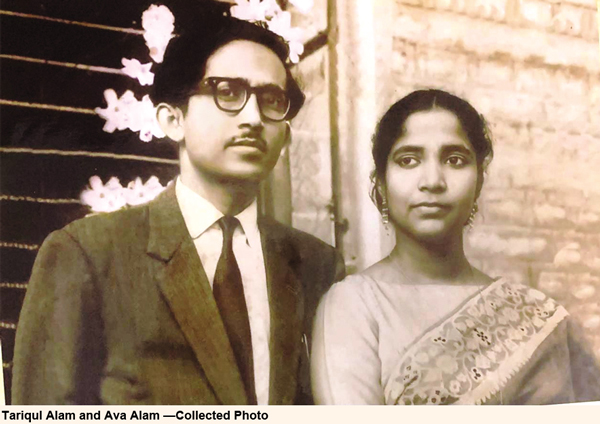 Pakistani classical music Rowshan Ara Begum. Apart from her own exploits in the field of classical songs, she was also active in teaching music. The music school she opened at the Pakistan Council centre in Islamabad had a large following, especially among the expatriate Bangalis. But leaving behind a life of prestige and luxury, she and her family returned to Dhaka at the call of her motherland in 1972. That was out of sheer patriotic zeal. In the absence of a normal travel route, they returned to Dhaka by escaping through the mountainous borders of Pakistan, and then moving on to Bangladesh via Afghanistan and India. Back in Dhaka, the family was almost penniless, and had to restart from scratches. But Ava Alam's commitment to classical music was total. Apart from re-launching her performances in the broadcast media and the stage, she soon established a school of music along with other musical luminaries in 1973; it was based at Shaheed Anwar Girls' High School of Dhaka Cantonment. Very soon, it earned fame as one of the bestamong the music schools of capitalDhaka. She was closely associated with Bangladesh Shilpakala Academy, 'Sat-sangeet Prasar Samity', Chhayanaut, Altaf Mahmud Sangeet Academy, Atiq Sangeet Academy, and other musical and cultural organisations of Dhaka till her death. She was the external examiner of Dhaka University's classical music course at the under-graduate and post-graduate levels, and also examiner of Dhaka Education Board on the same subject. But sadly, only one long-play-record of her works was brought out during her lifetime. She was posthumously awarded the 'Ekushey Padak' in 1978 - the country's highest honour in the field of culture.
At home, Ava and Tariqul led a happy and secular life, with their religions playing a unifying role rather than a divisive one. Their three children Imon, Saberi, and Ahir were all named after musical ragas, and they have all left their mark in the cultural arena of Dhaka. Imon earned reputation as a Rabindra-sangeet singer during her student life and obtained master's degree in economics from the University of Dhaka. Saberi distinguished herself as an actress - initially within the fold of group theatre movement, and later in TV plays and films. Ahir earned the appreciation of many as a young dramatist, actor, and publisher, but sadly died prematurely due to a tragic road accident in September 2001. Ava was very fond of her children and husband, and often turned down invitations to perform in musical programmes just to stay with her family-members. By 1975, Ava had succeeded in establishing herself as one of the leading female classical vocalists of the country. But just when her career seemed to be heading towards a zenith, death struck suddenly and swiftly.
The month of November 1976 proved to be very hectic for Ava - both professionallyand personally. She was busy throughout the month in connection with the wedding ceremony of her youngest brother-in-law Nazrul, which was slotted for November 21. But one morning before the event, a tired and exhausted Ava felt pain in her chest and was admitted to PG Hospital for check-up. A medical board was formed and her case was diagnosed as fatal. At noon on November 21, she repeatedly asked the attending doctor to allow her to go home. When the doctor asked her why, she replied, "I want to see my children, I haven't seen them for two days. They are busy with their school exam, and I told their Bapi not to bring them here". The physician consoled her and said that she would be able to leave by 22nd. She was asked by the doctor to take complete rest, but she could not sleep. She wanted to talk, but that was prohibited. She told her mother-in-law, "Ma, I have so many things to tell you, please let me talk". Mother-in-law asked her not to, as her doctor had forbidden. Meanwhile, her close friend Banu Panni came to visit her, and Ava exclaimed, "What a nice sari you have worn, you look superb!" Banu replied, "You like this sari? It is yours". Ava smiled happily and asked, "Can you tell me whether I shall be able to sing again"? Banu was surprised and said, "Why not? Nothing has happened to you; you will be okay very soon." Ava closed her eyes and then slept. Nobody knew she would not getup from that sleep, would never talk again. She breathed her last just before 5 pm in the afternoon. Dedicating his maiden book of poetry 'Prem Aupremer Kobita' to the memory of his late wife, Ava's devoted husband Tariqul Alam (who himself expired in March 1994) wrote in January 1994, "My love and infatuation for Ava has continued for long 32 years. Of these, 2 years were spent in preparation, 12 years in matrimonial bliss, and 18 years in solitary grief. I have written over one thousand poems on Ava; only a few of those have been included in this book". The introductory poem reads as follows: "You are the illumined rays of morning celebration,/You are the last sunrays of silent death,/You are the melody of joy -/Undaunted light on the leaves of plants,/Eternal, untouchable, infinite ray of red;/You are only mine!"
Dr Helal Uddin Ahmed is a former Editor of Bangladesh Quarterly. hahmed1960@gmail.com
© 2026 - All Rights with The Financial Express

