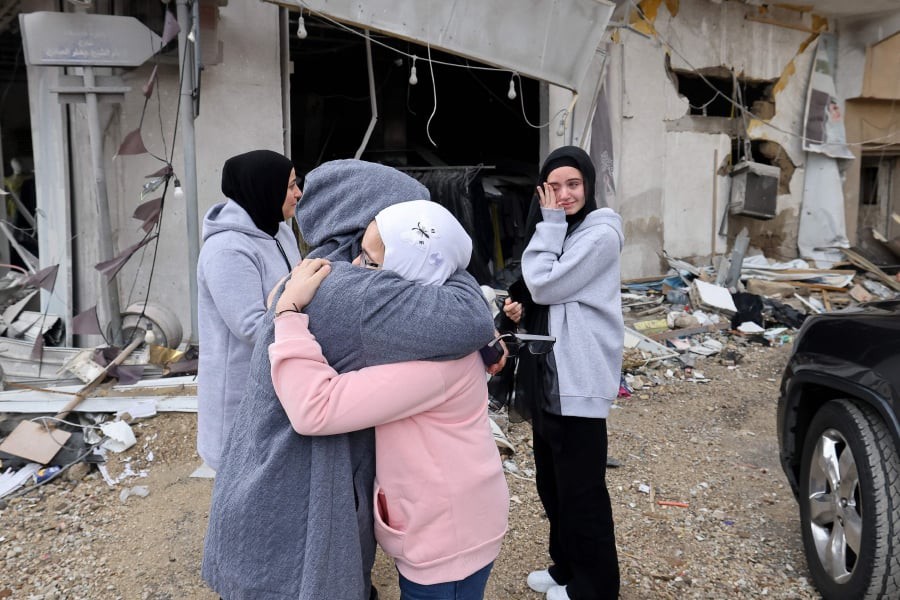
 Women greet each other as displaced people make their way back to their homes in Lebanon after a ceasefire between Israel and Hezbollah. — AFP
 NAQURA (Lebanon), Jan 24 (AFP/Reuters): All signs of life have disappeared from the bombed-out houses and empty streets of the Lebanese border town of Naqura, but despite a fragile Hezbollah-Israel ceasefire that has held since November, no one can return.
The Israeli military is still deployed in parts of Lebanon's south, days ahead of a January 26 deadline to fully implement the terms of the truce.
The deal gave the parties 60 days to withdraw -- Israel back across the border, and Hezbollah farther north -- as the Lebanese army and UN peacekeepers redeployed to the south.
The Lebanese military has asked residents of Naqura not to go back home for their own safety after Israel's army issued similar orders, but in spite of the danger, Mayor Abbas Awada returned to inspect the destruction.
"Naqura has become a disaster zone of a town... the bare necessities of life are absent here," he said in front of the damaged town hall, adding he was worried a lack of funds after years of economic crisis would hamper reconstruction.
"We need at least three years to rebuild," he continued, as a small bulldozer worked to remove rubble near the municipal offices.
Lebanese soldiers deployed in coastal Naqura after Israeli troops pulled out of the country's southwest on January 6, though they remain in the southeast.
Meanwhile, funding shortages may affect the UN's ability to maintain aid flows at target levels throughout the Gaza ceasefire deal, a UN official told Reuters.
Fifteen months of war has left more than 47,000 Palestinians dead and most of Gaza in ruins, with hundreds of thousands of people homeless and reliant on outside aid for survival.
Daily deliveries have surged tenfold since the Sunday deal, according to UN data, surpassing the 600 trucks a day target set out for the first seven weeks of the ceasefire.
Muhannad Hadi, Humanitarian Coordinator for the Occupied Palestinian Territories, told Reuters late on Thursday he was "very happy" with how the first few days had gone, but flagged funding as a concern.
"Funding is an issue. We need immediate funding to make sure that we continue providing the aid for the 42 days, but also after the 42 days, because we're hopeful that we'll go from phase one to phase two," he said, after returning from Gaza earlier this week.
He described scenes of widespread joy and relief across the enclave, with many Gazans smiling and eager to return to the remnants of their homes and find work.
© 2026 - All Rights with The Financial Express

