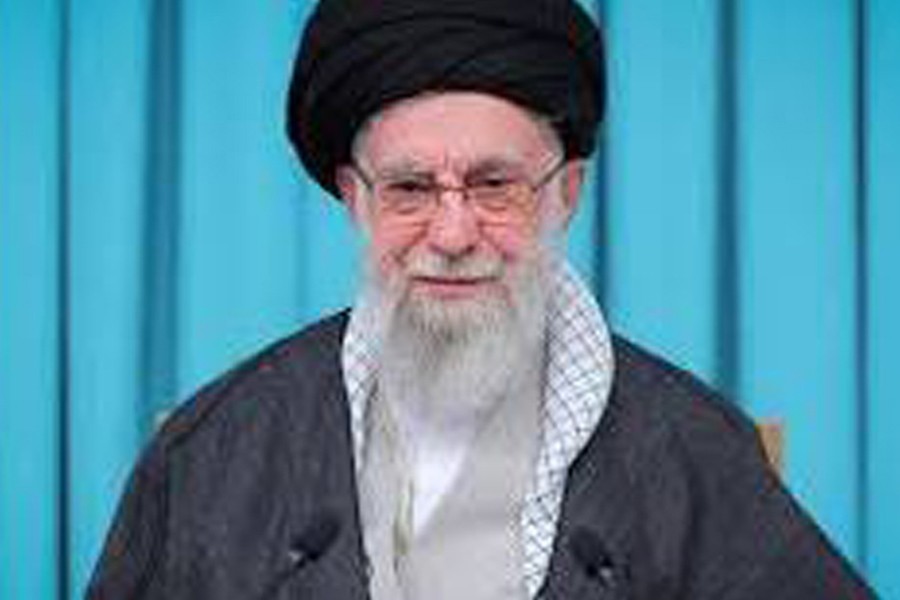
 Iran's supreme leader Ayatollah Ali Khamenei
 DUBAI, Sept 24 (AP/AFP): Iran has begun rebuilding missile-production sites targeted by Israel during its 12-day war in June, satellite images analyzed by The Associated Press show, but a key component is likely still missing - the large mixers needed to produce solid fuel for the weapons.
Reconstituting the missile program is crucial for the Islamic Republic, which believes another round of war with Israel may happen. The missiles are one of Iran's few military deterrents after the war decimated its air defense systems - something that Tehran long has insisted will never be included in negotiations with the West.
Missile experts told AP that obtaining the mixers is a goal for Tehran, particularly as it prepares for possible United Nations sanctions to be reimposed on the country later this month. The sanctions would penalize any development of the missile program, among other measures. Iranian President Masoud Pezeshkian is due to address the United Nations General Assembly on Wednesday.
Known as planetary mixers, the machines feature blades that revolve around a central point, like orbiting planets, and offer better mixing action than other types of equipment. Iran could purchase them from China, where experts and U.S. officials say they've purchased missile fuel ingredients and other components in the past.
"If they're able to reacquire some key things like planetary mixers, then that infrastructure is still there and ready to get rolling again," said Sam Lair, a research associate at the James Martin Center for Nonproliferation Studies who studied Iranian missile sites.
Iran's mission to the United Nations did not respond to questions about the country's efforts to rebuild its missile program.
Solid-fuel missiles can be fired faster than those using liquid fuel, which must be loaded just before launch. That speed can make the difference between launching a missile and having it destroyed in a launcher - something that happened during the war with Israel.
Iran has solid-fuel missile manufacturing bases at Khojir and Parchin, two sites just outside Tehran, as well as at Shahroud, some 350 kilometers (215 miles) northeast of the capital. Even before the most recent war, all of those sites came under Israeli attack in October 2024 during hostilities between the countries.
Iran's supreme leader Ayatollah Ali Khamenei on Tuesday said the Islamic republic would not give in to pressure to abandon its enrichment of uranium.
Khamenei, in a televised address, also called any talks with the United States a "dead end" that were of no benefit to his country.
His statement came as European powers seeking to reimpose tough sanctions on Iran over its nuclear programme met with the Islamic republic's top diplomat, without any signs of a compromise.
"The American side has been adamant that Iran must not have (uranium) enrichment," Khamenei said.
"We did not surrender and we will not. We did not and will not yield to pressure in this matter or any other matter," he added. The supreme leader went on to say talks with the United States would only bring harm to Iran.
Negotiating with America "not only brings no benefit, but also causes major harm under the current conditions, some of which might even be described as irreparable", he said.
"Let us not forget the experience of these past 10 years, and the other side-which is the subject of our discussion for now-is the United States," he continued, referring to the landmark 2015 nuclear deal that Washington withdrew from three years later.
© 2026 - All Rights with The Financial Express

