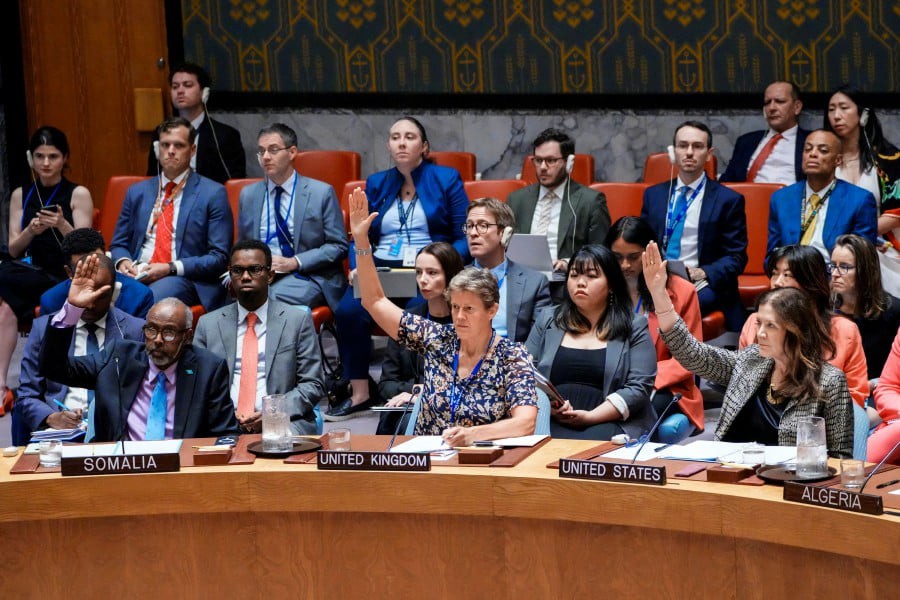
 Members of the UN Security Council vote against a resolution that would permanently lift UN sanctions on Iran at the UN headquarters in New York City. — Reuters
 UNITED NATIONS, Sept 19 (Agencies): The United Nations Security Council voted Friday to reimpose deep economic sanctions on Iran over its resurgent nuclear program after Britain, France and Germany called for action.
The three European nations are signatories to a 2015 deal known as the Joint Comprehensive Plan of Action (JCPOA) intended to stop Tehran obtaining nuclear weapons.
The trio alleged that Iran has broken its promises under the treaty.
Iranian Foreign Minister Abbas Araghchi said Friday he had put forward a "fair and balanced" proposal to European powers to prevent the return of sanctions.
"We urge (Iran) to act now," said British ambassador Barbara Woodward after casting a vote against a resolution that would have extended the current suspension of the sanctions.
She left the door open for diplomacy at the UN general assembly next week, when heads of state and government will gather in New York.
Ahead of the vote, French President Emmanuel Macron said in an Israeli television interview that he expected international sanctions to be reinstated by the end of the month. But the French ambassador to the UN said Friday that the option of a negotiated settlement was still on the table.
In a letter to the UN in mid-August, the "European Three" slammed Iran as having breached several commitments under the JCPOA, including building up a uranium stock to more than 40 times the level permitted under the deal.
Despite a flurry of diplomatic talks between the European powers and Tehran, the Western trio insisted there was no progress.
"The Council still has time to greenlight a further resolution extending the suspension of sanctions -- if Iran and the Europeans reach a last-minute bargain," Gowan said.
The hard-won 2015 deal has been left in tatters since the United States walked away from it in 2018, during Donald Trump's first presidency, and reimposed sanctions on Iran.
Western powers and Israel have long accused Tehran of seeking to acquire nuclear weapons, a claim Iran denies.
Following the US withdrawal, Tehran gradually broke away from its commitments under the agreement and began stepping up its nuclear activities, with tensions high since the 12-day war between Iran and Israel in June.
The war also derailed Tehran's nuclear negotiations with the United States and prompted Iran to suspend cooperation with the International Atomic Energy Agency (IAEA), with inspectors of the Vienna-based UN body leaving the Middle Eastern country shortly after.
Iran late Thursday withdrew a draft resolution at the IAEA that called to ban attacks against nuclear facilities after its war with Israel, citing US pressure.
In mid-June, Israel launched an unprecedented bombing campaign against Iran, starting the war that saw Israeli and also US strikes on key Iranian nuclear facilities.
During his previous term, Trump attempted to trigger the JCPOA's so-called "snapback clause" to reimpose sanctions on Iran in 2020, but failed due to his country's unilateral withdrawal from the deal two years earlier.
While European powers have for years launched repeated efforts to revive the 2015 deal through negotiations and said they have "unambiguous legal grounds" to trigger the clause, Iran does not share their view.
Iran has threatened to withdraw from the Nuclear Non-Proliferation Treaty (NPT) if the snapback is triggered.
Meanwhile, more than 140 world leaders will descend on New York next week for the annual United Nations General Assembly summit, which will be dominated this year by the future of the Palestinians and Gaza.
One world leader who will miss the gathering is Mahmud Abbas, the Palestinian president who Washington denied US visas to attend, along with his officials.
The humanitarian catastrophe ravaging the small Palestinian territory will dominate debates at the high-level event, two years after the beginning of the Israeli offensive in the Gaza Strip that was triggered by the unprecedented Hamas attack on October 7, 2023.
Saudi Arabia and France will co-chair meetings from Monday on the future of the Israeli and Palestinian two-state solution, which aims to see both sides existing alongside one another in peace.
Israeli strikes on south
Lebanon kill two
Meanwhile, Israeli strikes on southern Lebanon killed two people and wounded 11 on Friday, Lebanon's health ministry said, in the latest attacks despite a ceasefire between Israel and Hezbollah.
The ministry said that an "Israeli air strike on a vehicle" outside a public hospital in Tibnin killed one person and wounded 11, while another strike on a vehicle in Ansar killed one person.
The Israeli army did not immediately comment on the strikes.
The attack comes a day after Israel bombed five towns it told residents to evacuate.
Massive Attack join Israel
boycott campaign
British trip-hop group Massive Attack announced they are joining a new music industry initiative to block their music in Israel and have also asked for their songs to be removed from Spotify.
The Bristol natives said they had joined "No Music for Genocide", a collective of musicians modelled on the "Film Workers for Palestine" group, which has also called for a cultural boycott of Israel over the war in Gaza.
"We'd appeal to all musicians to transfer their sadness, anger and artistic contributions into a coherent, reasonable and vital action to end the unspeakable hell being visited upon the Palestinians hour after hour," the group wrote on Instagram on Thursday.
© 2026 - All Rights with The Financial Express

