Nuzhat Fatima Purnota and Md Shanawez Hossain | November 10, 2025 00:00:00
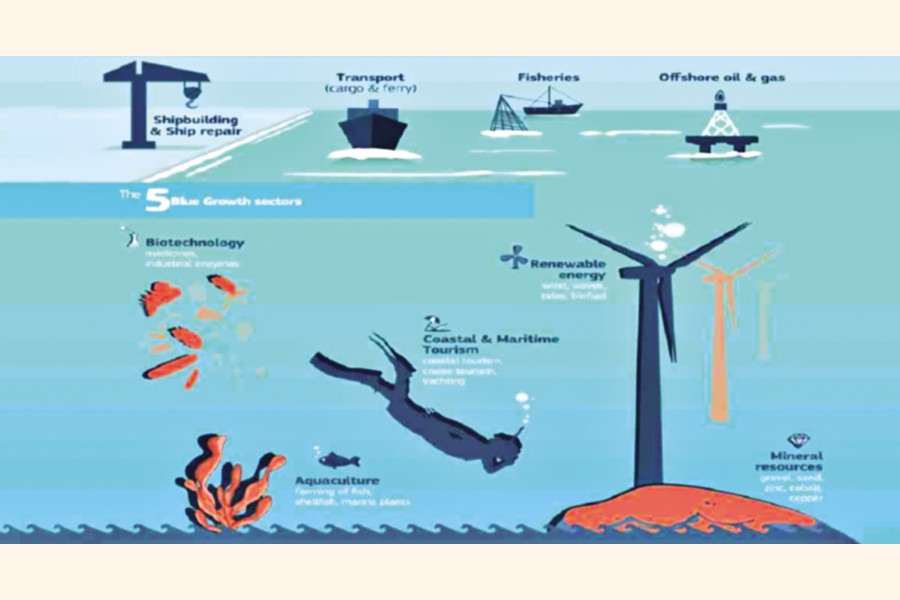
 The pride of Bengal, the Bay of Bengal, is not just a matter of global recognition for the people of Bangladesh, but also a gold mine of opportunities and regional cooperation. But how little do we do to utilise the opportunities it offers us? How well are we treating the resources that have the potential to drive economic growth to the next level if utilised sustainably? Particularly, such questions remain very pertinent to proper utilisation of fisheries and related marine resources on which life and livelihoods of millions of people depend.
Potentials and Governance Mechanisms: The Blue Economy is widely renowned for its concepts of sustainable economic development based on marine and coastal resources. The Bay of Bengal is both a curse and a blessing for Bangladesh due to its extreme climate vulnerability and the immense resources it provides. It is an opportunity for growth for us, especially with regional cooperation at play in the Indo-Pacific region. Bangladesh has been promoting the utilisation of the ocean economy since 2014, establishing a memorandum of understanding with India in 2015 in order to develop the blue economy in the Bay of Bengal. The country also launched its seventh Five-Year-Plan where the inclusion of blue economy development was ensured and identified the prospects as a potential driver of growth. The total value of ocean resources is estimated to be US$24 trillion, where the government of Bangladesh has identified approximately US$16 billion investment opportunities across its 26 blue economy sectors. The expected GDP return is estimated to be approximately 4–4.5 per cent by 2030 which includes the fisheries sector, eco-tourism, renewable energy, maritime trade, etc. Investment efforts include projects like the Matarbari deep sea port construction, which aim to open up further opportunities for the export-import scene of Bangladesh. However, threats to ocean habitats and estuarine ecosystems will remain if external factors are not considered. Only focusing on fisheries management will lead to a sustainable blue economy failure if fishing sizes and compositions are not shifted and accounted for, as a big barrier to sustainability is that the regulation of fish stocks remains uncertain and unknown.
Bangladesh has been focusing on its blue economy initiatives since 2017, by launching its “Blue Economy Initiatives”. The government bodies working on Blue Economy are the Planning Commission, Ministry of Foreign Affairs, Ministry of Finance and the Ministry of Power, Energy and Mineral Resources. The Ministry of Foreign Affairs (MoFA) has identified 26 sectors for the country’s blue economy development. The government also launched a Bangladesh Blue Economy Cell in 2016 under the Energy and Mineral Resources Division, which failed miserably due to lack of adequate resources, lack of strategic plans, implementation, and policies. Its role has been heavily criticised over the years. Several multilateral partners work in the development of the blue economy in Bangladesh, for example UNDP has assisted in developing the National Blue Economy Action Plan, led by the Ministry of Foreign Affairs. Additionally, the UNDP has also organised a national dialogue on Blue Bonds, in partnership with UNEP-PEA4SDGs and the General Economics Division, aiming to promote innovative financing mechanisms for marine-based sustainable development while addressing the estimated USD 928 billion SDG financing gap by exploring tools such as bonds in order to enhance sustainable fisheries, offshore energy and waste management all under the framework of the blue economy. Several policies, like the Hilsa ban which prohibits fishermen from catching and selling Hilsa during breeding seasons, particularly during October, and protection of smaller (Jhatka) at peak seasons, also promote sustainability. Other initiatives that proselytise the blue economy include the establishment of the Swatch of No Ground Marine Protected Area in 2014 that aims to protect marine biodiversity in the Bay of Bengal.
Thus, on the internal front, the government has taken short-term and long-term measures for sustainable development of the fisheries sector. However, on the external front, there are many disputed issues that still threaten the long term sustainability of this sector.
Regional and Global Mechanisms in Marine Resources Governance: Bangladesh’s maritime dispute with India and Myanmar had also been an issue for quite a long time, obstructing economic growth in the country’s Exclusive Economic Zone (EEZ). But despite the conflict resolution, the country faces immense exploitation of marine resources from neighbouring countries and ranks 85th among the 152 most vulnerable countries to Illegal, Unreported and Unregulated (IUU) fishing according to the IUU Fishing Index 2021. Bangladesh has also amended the Territorial Waters and Maritime Zones Act in 2021. The World Trade Organization (WTO) members adopted the Agreement on Fisheries Subsidies during their 12th Ministerial Conference in June 2022 which entered into force on September 15, 2025 with two thirds of its members formally accepting the Protocol of the Agreement on Fisheries Subsidies by depositing an “instrument of acceptance”. As a Least Developed Country, Bangladesh has been exempted from dispute settlement for continuing subsidies within its Exclusive Economic Zone (EEZ) up to 200 nautical miles. It also has access to benefits like a voluntary WTO funding mechanism for technical and capacity building assistance, extended reporting timelines and support for implementing the agreement’s disciplines. But as Bangladesh is set to graduate from LDC in 2026, the country must consider capacity building, reducing its fisheries subsidiaries and potentially seek extension from the General Council to agree on comprehensive disciplines, as required by the agreement’s Article 12, to align its fishing industry with global sustainability goals in order to fully utilise its Blue Economy potential.
CHALLENGES AND WAY FORWARD: Native fishermen are at the heart of Bangladesh’s coastal communities whose lives depend heavily on native fishing techniques and practices. Despite their lives being so intricately tied to the sea, they are often marginalised and are treated like passive beneficiaries in development efforts rather than considering or including them as key stakeholders. They often lack access to sustainable fishing practices due to inadequate training, modern equipment and market connections, making them more vulnerable to exploitation and climate shocks, especially with the presence of foreign pirates in our EEZ. Without their equitable inclusion, Bangladesh won’t be able to succeed in its blue economy efforts if institutional incapacities persist. Bangladesh has strengthened its maritime security and the presence of Navy and Bangladesh Coast Guard to ensure safety and security within its EEZ. The incapacities in question include lack of coordination between government agencies, governance challenges, lack of participatory actions, technical capacities, etc. Prioritisation of ecological conservation over economic acceleration is also a challenge for a developing country like Bangladesh that has a poverty rate of 27.93 per cent as of mid-2025, according to a study by the Power and Participation Research Centre (PPRC).
As a potential solution and way forward to the development of the fisheries sector various measures are required at national, regional and global levels. First, more research and development with extensive data is required in order to plan the utilisation of the marine and coastal resources sustainably. Funding oceanographic and marine research should be prioritised to fill in data gaps and surveillance of piracy activities. Bangladesh should invest heavily in capacity building of stakeholders - from grassroot to government levels.
Second, inclusivity of local coastal communities and their empowerment should be the core focus, building resilience and knowledge while promoting community-led conservation and co-management of resources. In addition to that, infrastructure projects should undergo rigorous Environmental Impact Assessments (EIA) in order to ensure environmental sustainability and protection of marine resources. Coastal tourism facilities and ports should be environmentally friendly and not cause destruction. Significant monitoring, evaluation and reporting are thus required for actionable solutions.
Furthermore, a comprehensive national blue economy framework should be established where all government institutions overseeing marine and coastal affairs should ensure cross-sectoral coordination in management of the associated resources. Public-Private Partnerships should also be considered for better economic development and resource management. Ensuring sustainability in every coastal and marine policy is essential for maximum utilisation of blue economy opportunities.
Finally, Bangladesh can strengthen its regional cooperation through the Indo-Pacific that has the potential to connect the South Asian countries to the Southeast Asian countries, and enhance economic development through regional bodies like Bay of Bengal Initiative for Multi-Sectoral Technical and Economic Cooperation (BIMSTEC) and Indian Ocean Rim Association (IORA). Engagement with these organisations and exchange of knowledge and learning outcomes from best practices for marine and community conservation can further develop Bangladesh’s capacity and enhance resilience within countries, facilitate joint research, promote peace and prosperity and build economic relations that benefit all the entities involved.
Bangladesh’s blue economy is not just an untapped sector but a vision for inclusive, resilient, and sustainable development. It is a bridge for the Indo-Pacific that offers a future of prosperity, resilience, and ecological harmony within neighbouring countries. But realising this vision demands a shift from extractive practices to regenerative ones, from exclusion to empowerment, and from fragmented governance to integrated actions at the national, regional and global levels. By centring local communities, investing in knowledge, capacity building and embracing regional solidarity, Bangladesh can chart a bold course toward a thriving blue economy that serves both people and the planet.
Nuzhat Fatima Purnota is a development professional working in the field of Climate Change & Disaster Management. purnota1226@gmail.com
Dr. Md Shanawez Hossain is an Associate Professor of the Department of Global Studies and Governance (GSG) at Independent University, Bangladesh (IUB). shanawez@gmail.com
© 2026 - All Rights with The Financial Express

