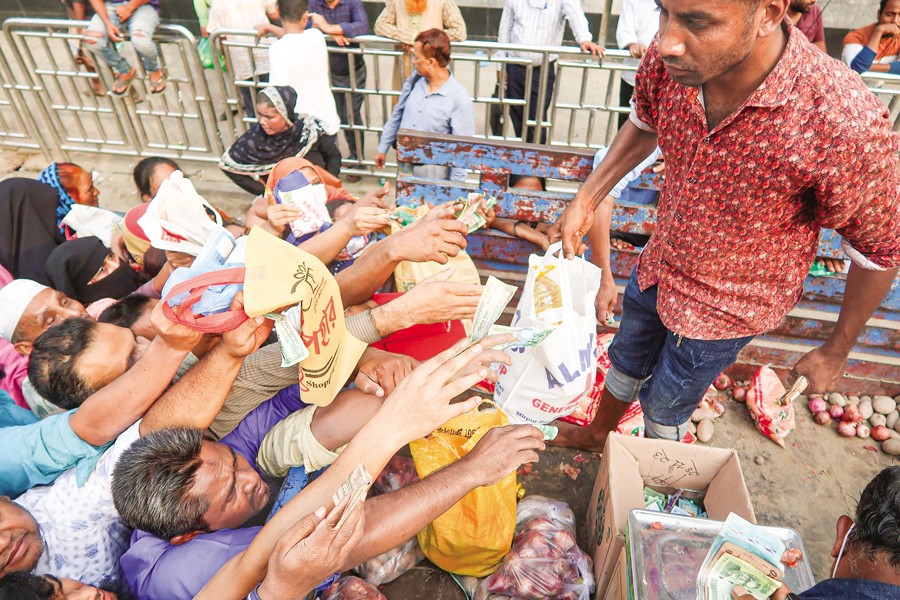
 High prices drive low-income and poor people to line up for essential items sold at subsidised rates by the TCB. — FE File Photo
  In 1972, nearly 80 per cent of the country's population was living below the poverty line. Today, however, the country has made significant progress in all areas - social, economic, education, health and culture - as reflected in its fulfillment of Millennium Development Goals (MDGs).
According to a recent Dhaka Chamber of Commerce and Industry (DCCI) study, the per capita income of a resident in Dhaka was $5,163 in fiscal year 2023-24, which is 89 per cent higher than the national average of $2,738. The estimate was based on district-wise GDP data from 2011 published by the Bangladesh Bureau of Statistics and on investment, consumption, expenditure, imports, exports, land area and population growth. The per capita income in Dhaka district is nearly twice the national average, as the district accounts for almost half of Bangladesh's gross domestic product (GDP) -- the total value of final goods and services produced in a specific period. Dhaka also accounts for 46 per cent of the country's GDP and the region, having the capital city, provides employment for more than 40 per cent of the workforce.
Considered the heart of the country's financial sector, Dhaka also hosts the headquarters of over 750 companies listed on the stock exchange. About 32 per cent of the country's urban population also lives in the District, which is home to 11.2 per cent of the total national population of over 170 million.
Such a revelation has been most interesting against the backdrop of efforts to reduce poverty in Bangladesh.
Bangladesh has managed to find ways to overcome factors that have posed socio-economic challenges. It is, however, also true that while there has been steady progress in developing the necessary infrastructure, there has also been a lack of transparency in commercial and economic transactions. This has facilitated corruption in some sub-sectors.
Nevertheless, some financial analysts have pointed out that this increase in socio-economic recovery and poverty eradication has been possible because of certain factors- (a) increase in growth in wages in the service sector, especially in public administration, education and health and (b) growth in large scale manufacturing, construction and transport.
It needs to be understood that poverty is a multifaceted concept, which includes social, economic, and political elements. Poverty may also be defined as either absolute or relative. Absolute poverty or destitution refers to the lack of means necessary to meet basic needs such as food, clothing and shelter. Relative poverty takes into consideration individual social and economic status compared to the rest of society.
Fundamentally, poverty can be described as the inability of having choices and opportunities and such a scenario can lead to violation of human dignity. It means lack of basic capacity to participate effectively in society. It also denotes not having enough to feed and clothe a family or not having a school or clinic to go to or not having the land on which to grow one's food or a job to earn one's living or not having access to credit. It means insecurity, powerlessness and exclusion of individuals, households and communities.
It also connotes susceptibility to violence, and it often implies living in marginal or fragile environments, without access to clean water or sanitation. Poverty also suggests the presence of inadequate physical security, lack of voice, and insufficient capacity and opportunity to better one's life.
Poverty may also be understood as an aspect of unequal social status and inequitable social relationships, experienced as social exclusion, dependency, and diminished capacity to participate, or to develop meaningful connections with other people in society. Such social exclusion can however be minimised through strengthened connections with the mainstream, such as through the provision of relational care to those who are experiencing poverty. Poverty can also be reduced if an improved economic policy is developed by the governing authorities to facilitate a more equitable distribution of the nation's wealth.
Bangladesh, comparatively, has undertaken several initiatives to reduce the manifestation of poverty within the country. In this context it has also addressed the issue from the point of the rural and urban divide.
The World Bank, the Asian Development Bank and the International Monetary Fund have all been carefully monitoring the economic activities of Bangladesh and have also been suggesting how to overcome existing challenges in the financial sector. Very correctly they are reiterating that Bangladesh has to be careful and bring forth accountability for reduction of poverty. It has been stressed that this will then enable Bangladesh to reach the goal of becoming a middle-income country and also be free of extreme poverty by 2030. However, to sustain economic growth, Bangladesh also needs to focus on developing energy and transport infrastructure, improving the quality of healthcare, education, and governance, and strengthening anti-corruption measures.
According to these institutions, this would improve the investment climate. It has also been reiterated that investment in people is as significant as investment in infrastructure. In this context, attention has also been drawn to the fact that Bangladesh was vulnerable to natural disasters and was also having to overcome the challenges of climate variability through adaptation and mitigation.
The news of our recent economic growth has been particularly welcome. To this can be added our upgraded OECD ranking, record remittance earnings, soaring foreign exchange reserves, success in keeping inflation relatively under control, surge in export earnings, decline in dependency ratio, and achievements in human development, along with the expansion of social protection through better education facilities, gender empowerment, and improved healthcare opportunities.
It is clear that we are moving forward.
However, our focus also needs to be on food security and lifting the quality of life of the poorest of the poor from the many Upazilas in our rural areas-Bhurungamari, Char Rajibpur, Chilmari, Phulbari, Raja hat, Ulipur, Bakerganj, Hizla, Mehendiganj, Dewanganj- to name a few from Kurigram, the Barisal, the Chandpur and the Jamalpur Districts. There should also be efforts to create a greater balance by removing growing income inequality in our urban areas- be it Dhaka or Chittagong. If we can do that, we will definitely be able to meet our 2030 goal of eradicating poverty from Bangladesh.
We need to learn from countries like Sweden and Norway. It should also be remembered that eradicating poverty from our development paradigm will enhance our prospects for achieving gender equality and creating better opportunities for our youth population.
We must not forget that better health among children, particularly those studying at the primary and secondary levels has crucial relevance in the equation for creating human capital. Education is an important determinant for economic growth and reduction of poverty. Any disruption in that process can harm the creation of physical capital.
We also need to realise that digitalisation and improvement in connectivity are not only expanding our horizons today but that technology is also helping to bring economic freedom by making financial services accessible to the poor. It is also facilitating those below the poverty line to have a safe place not only to save money but also to receive loans. This is also helping to create entrepreneurship at the grass-roots level and also contributing to poverty reduction efforts.
In Bangladesh, our authorities have been focusing on our rural hinterland because it is clear that growth in the agricultural productivity of small farmers is, on average, at least twice as effective in benefiting the poorest half of a country's population as growth generated in non-agricultural sectors. Keeping this factor in view, Bangladesh needs to improve water management as an effective way to help reduce poverty among farmers. With better water management, they can improve productivity and potentially move beyond subsistence-level farming. Our authorities, in this regard also need to seriously consider using renewable energy such as solar power to facilitate this dynamics.
Social scientists and economists agree that one method for reducing existing poverty is to encourage the creation of opportunities- be it in the form of new micro-entrepreneurship or through the potential of new employment. However, the prospect of new enterprises and foreign investment will only achieve desired objectives if there is correct use of the rule of law and less bureaucratic burdens.
Knowledge of the cost-effectiveness of healthcare interventions can be elusive but educational measures to disseminate what works and what is available for disease control can make a major difference. Effective projects like promoting hand washing is cost-effective as a health intervention measure but can cut deaths from the major childhood diseases like diarrhea and pneumonia by half. Such simple measures will be especially helpful in poverty-stricken rural areas where personal hygiene is sometimes overlooked.
Any consideration of poverty reduction in general, and in Bangladesh in particular, would be incomplete without reference to the issue of development or tied aid provided by donor countries. A major proportion of aid from these nations is 'tied', mandating that the recipient country purchase products originating only from the donor nation. In Bangladesh, we have at times observed foreign aid serving the interests of donors more than those of the recipients. Economic analysts have also pointed out that aid is often disproportionately directed towards the salaries of consultants from donor countries, and that it is sometimes poorly coordinated among donors, resulting in a plethora of disconnected projects rather than unified strategies. It is to be hoped that we will be able to overcome such challenges - particularly in the eradication of both rural and urban poverty.
The writer is a former ambassador and an analyst specialising in foreign affairs, right to information and good governance. He can be reached at muhammadzamir0@gmail.com
© 2026 - All Rights with The Financial Express

