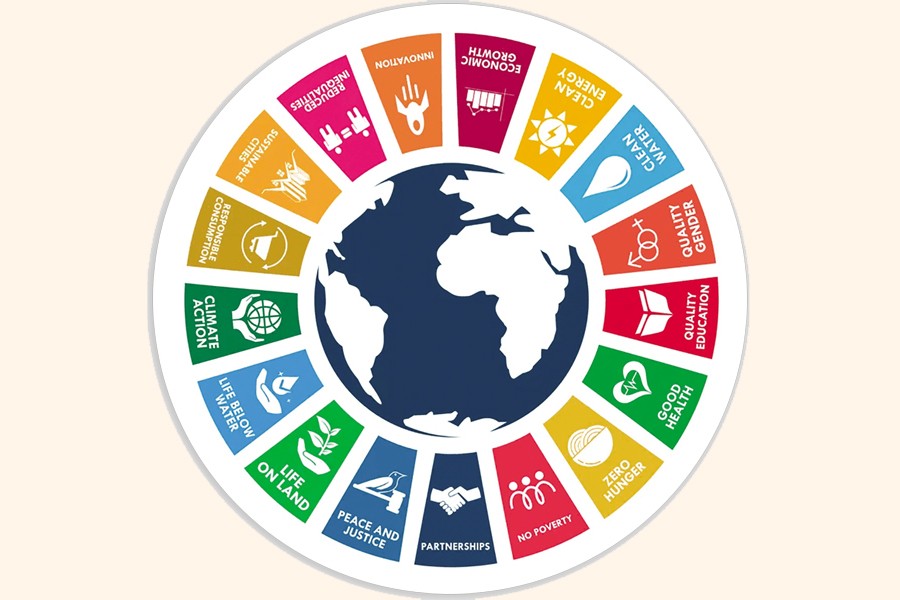
 As one of the world’s top-ten most vulnerable countries against rising ocean-water levels, Bangladesh’s secular threats, and not its material growth, may dictate the country’s 21st-century future. Bangladesh joined the 15-year SDG (sustainable development goal) crusade in 2015, but with five years left, its economic -development imperatives override its environmental obligations. If not evident in governmental policy papers and reports, every street, town or city, and in air, land, or water bodies blatantly depict how the environment needs more salvation.
Global recognition of the problem goes back to the 1992 Rio de Janeiro ‘Earth Summit’ of the United Nations Conference on Environment and Development (UNCED). The UN agency formalized, institutionalized, and empowered the United Nations Conference on Sustainable Development (UNCSD) in the 2012 ‘RIO+20’ gathering to popularize that message. All 193 members of the United Nations adopted the ‘U.N. 2030 Agenda for Sustainable Development’ in September 2015 to ‘clean’ the world by 2030. Country-specific ministries/agencies followed suit, taking responsibility and making specialized plans to deliver 17 ‘goals’, 169 ‘targets’, and 248 ‘indicators’. Hopes rose. With barely five years to go, will Bangladesh deliver? Can collective external efforts be supplemented by collective internal initiatives and engagements? Mindsets, instincts, and hands-on street-wide corrective efforts need recalibration.
Adopting any project is one key facet of policymaking, implementing is another. Whereas the former gets high-marks for framing environmental approaches, mindsets, lifestyles, and citizenry forecasts, the latter must cross other hurdles, primarily economic sustainability, to even fit environmental sustainability in any individual’s agenda, let alone deliver pieces of that puzzle.
Though both invoke differently trained professionals to drive the respective steering-wheel, as with cultivating democracy, neither can progress without public engagement. Adoption builds upon the technically-trained professionals in issue-specific domains (or ministries), before and after navigating diplomatic negotiations abroad. Yet, without mobilizing the public to ‘play ball’, implementing the SDG mission remains strapped. Benefits must not only trickle down to Main Street but also be more lucrative than routine- life demands to appeal: remaining a departmental/ministerial document or ‘accomplishment’ cannot suffice in the ‘big league’ (globally). Without collective citizen participation, collective external expectations face shortfalls, and ricochet against a feeble internal collective-mindedness deepening the malaises further.
Another bottleneck is cross-country collaboration. An idealistic Bangladesh devoid of both industrial wastes and infected rivers implies that upstream countries have also controlled waste-dumping and cross-border -collaboration functions. Reality differs starkly. On the one hand, all riparian countries neglect river cleanliness, and on the other, those rivers infect the Bay and oceans en route to infecting other coastal countries and lackadaisical regions. Reverse flows from the oceans into the Bay also ultimately enter our dinner plates and tables, compounding consequences of internally generated toxics. No matter how optimistically one views the scenario, realities trump the idyllic picture by a long shot. We feel it in the rising temperatures, see it in migrants invading safer land, and taste it in river/sea/ocean fish. In short, without connecting collective local action with global prescriptions, no crusade can win, SDG fulfillment the least of them all.
Domestic unity necessitates wishbones becoming realities, of the public delivering what ministers seek, ministries of one country ensuring their counterparts in other countries follow suit, and their global get-togethers exchanging buoyant results more than prescribing hopes.
If that idea is dismissed for being too idealistic in an excessively money-minded and pragmatically-driven neoliberal era, we must not lose sight of how humans fiddled with constructing collective organisations before seeing them proliferate. Over a century back, based upon self-determination, President Woodrow Wilson’s 14-point proposal culminated in creating the League of Nations from 1918 (even before, Tsar Nicholas II got the ‘global’ ball rolling with his1899 Hague Peace Conference initiative). Though the League was shortlived, the agency which followed and under whose rubric the SDG framework emanated, the United Nations, is still around, even expanding membership from 51 in 1945 to 193 members today. When all is said and done, collective action to prevent garrulous military war pales against the silently creeping climate-choking forthcoming wars. Born of lofty aspirations, can the SDG’s bitter pills be swallowed by the reluctant and recalcitrant public? Where, they might ask, is the comprehensible pathway?
Once addressed successfully, the next step would be to discover how might a lay person know when the SDG net effect (the score) is improving, remaining roughly the same, or worsening? Bangladesh’s storied rivers and rising temperatures illustrate this glaringly.
Two of the country’s five most polluted rivers hug its two largest cities, where industrial and public wastes find cozy and convenient river ‘homes’. Dhaka’s leather and readymade-garment factories dump detrimental wastes for which the Buriganga leads the other four rivers, just as Chattogram’s Karnaphuli does others with shipping, shipyards, and ship-related wastes (not to discount the areas’ own industrial counterpart wastes). Leather and RMG wastes exemplify, the former with heavy metals like ammonia, chromium, hydrogen sulfide, and volatile organic compounds, among others, threatening humans with asthma, cancer, and skin rashes, and RMGs with arsenic, bleach, chromium, dioxin, formaldehyde, and lead, among others, producing everything leather wastes do, but also anemia, birth defects, natural reproduction, and weakened immune systems. Changing river color and putrefying odor thwart river tourism visibly and dinner plates invisibly. No wonder Dhaka’s Buriganga has become second-most polluted river globally, behind another river in our own lore, the Ganges (loaded with India’s wastes).
The only way ‘Main Street Bangladesh’ would know of these perils is from being hospitalized for the consequences of consuming fish. That sets off a global chain since nearly a million citizens go abroad each year (half to India, the other half across Southeast Asian capitals) for medical treatment. Alerting them beforehand, for example, through school classes from as early as the kindergarten stage may go a longer way than government impositions (distinguishing the anticipatory from the reactionary).
Air pollution is similar. Lacking emission standards and all-encompassing rules , from respecting traffic-lights and rule-violating penalties to bribes, Dhaka’s air-pollution levels hit global records constantly. Judging by Air Quality Index (API), Dhaka frequently falls in the ‘unhealthy’ category (with scores between 151-200), oftentimes among the top-five global leaders. Stemming from brick kilns adjacent to Dhaka, but mostly from construction and industrial/vehicle emissions, air pollution is most aggravated by imported gas-guzzling automobiles (under 20,000 annually before the pandemic, far more after) and motorbikes (over 7% annual growth since the pandemic): they lavishly epitomize material possessions ranking far, far ahead of environmental consciousness, , (unfortunately, among the wealthier few more than the commoners).
These eventually eat away high ozone layers which protect us from the sun’s full blaze. In addition to harming our health, deep ozone losses warm the planet such that polar and mountain glaciers melt, ocean water-levels rise, coastal inhabitants must evict, and coasts erode. Losses globally were so bad in the early 1970s that the Montreal Protocol (MP) imposed strict ozone-depleting substances (ODS) rules on emissions. Fortunately, MP measures have successfully halted ozone depletion globally, so much so that in another 40-odd years, we should return to normalcy on that front. Bangladesh is a low-level emitting country, meaning what happens in other countries—mostly developed countries— have global consequences hurting such countries that are less prepared, barely aware, and least capable of rising to combat the ‘occasion’: the less-developed countries. Typically, then, how can Bangladeshi citizens take precaution for the first time? More pointedly, how can it confront its own waste-dumping practice to meet its own prescriptions?
A final example returns to water, this time seawater changes. Over the last generation (between 25-30 years in duration), the planet lost a lot of ice from the ozone depletion, some say, over 250 gigatons (gts: roughly one billion metric tons), two-thirds from the Greenland ice-capstones, under one-third
from Antarctic continental shelf, the rest from glaciers and mountain snow. The obvious consequence has been to spike ocean-water levels. Ever since Bangladesh was born, over 30 meters of water has been added to seas and oceans globally. Though some naturally evaporate and Bangladesh does not have ice, being among the top-ten countries with the lowest elevation worthwhile, the country constantly faces land-erosion and human dislocation. Yet, it adds to theses perils through greenhouse gas (GHG) consumption— from possessing refrigerators and deodorants, and releasing industrial wastes. Thus, though ozone depletion has been halted globally (by the MP intervention, a sign of how ideals can still be fulfilled), we also infect the air with GHG to contaminate cities and raise ocean water to our own peril. The end-result: we in the country suffer, and with other defaulting countries, complicate our collective fate and future.
Perils of these kinds drove the ‘Earth Summit’ in 1992, intensified the pressure through RIO+22 in 2012, and produced the SDG ‘Agenda 2030’ three years later. Does Main Street have an inkling of just a fraction of those perils?
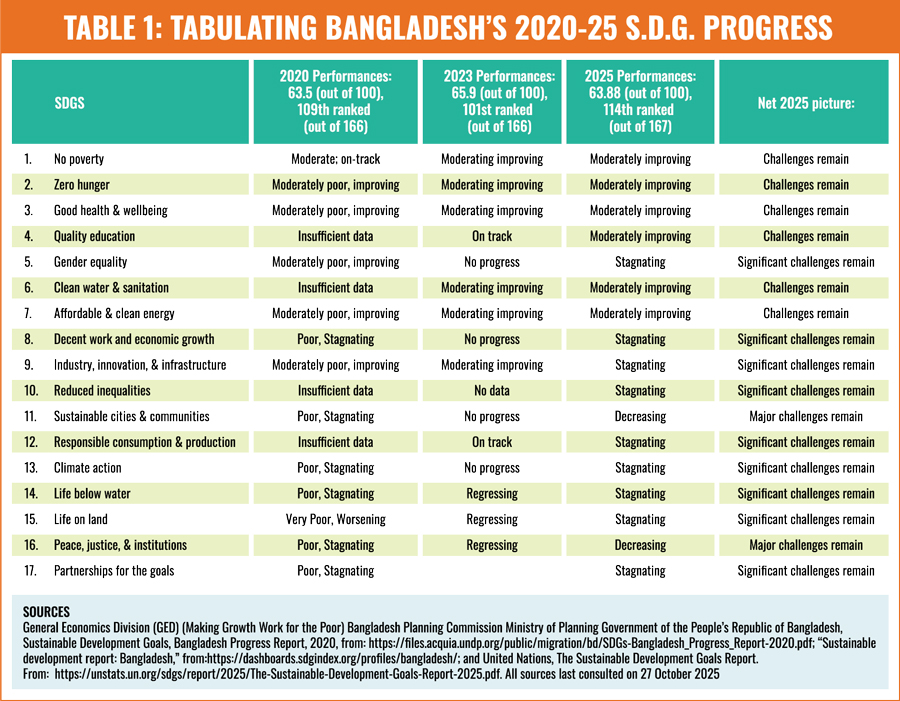
From the table we can deduce ‘Main Street Bangladesh’ neither knows of these sustainable-killing perils nor has any interest in sacrificing their material quests.
Three takeaways capture the five-year transition in the table. First, six of the 17 SDGs posed challenges, nine of them significantly so, while two reversed that ‘improvement’ mission. Second, since 2020, when “the first cycle of the 2030 Agenda” was adopted (p. 25 of the 2020 Progress Report), when extra emphasis was placed on “accelerating the implementation,” degradation resulted. Third, the widening gap between prescriptions-practice gap only widened.
Turning to the first, the most favorable reports (‘moderately improving’) address the most secular issues (‘non-environmental’ assets indirectly impacting the ‘environment’): ‘eliminating poverty’ (SDG#1), ‘hunger’ (#2), ‘enhancing health and well-being’ (#3), and ‘education’ (#4), and only one, ‘clean water and sanitation’ (#7), directly takes on the ‘environment’. Though a good start, two expose faster bureaucratic SDG upgrading on paper than street-side performances (#4 and #6): both ‘quality of education’ and ‘clean water and sanitation’ could not supply the needed data before, but now reside in the SDG ballpark. There their performances have been too deficient to be placing only on a lower-‘improvement’ rung of the ladder.
Of course, nine SDGs were at an even lower rung, ‘stagnating’, meaning they neither improving nor worsening. Included was a mixture of both four ‘non-environmental’ issues (#5 on ‘gender’, #8 on ‘decent work and economic growth’, ‘#9 on ‘industry, innovation, and infrastructure’, #10 on ‘reducing inequalities’) and five ‘environmental’ (#12 on ‘responsible consumption and production’, #13 on ‘climate action’, #14 on ‘life below water’, #15 on ‘life on land’, and #17 on ‘partnerships’).
One notices how the SDG movement encompasses human life, meaning what we see about the ‘environment’ must be backed up by inferences and interconnections. For example, ‘education’ helps curb waste disposal, in turn gives rivers a longer life leash, or if traffic flows more smoothly, metropolitan congestion could be reduced, thereby shielding the air from pollutants. Nonetheless, education reduces ozone depletion by disseminating new information, thus reducing sun-rays from melting ice or bloating oceans and causing land erosion.
Those five ‘environment’-triggered SDGs just mentioned could hold the SDG ‘veto’ power, if there is such a capacity: without corrections and improvements, they can easily erode the better -performing counterparts. Both consuming non-sustainable items (plastic-made products) and producing them (by dumping toxic wastes), face and portray Bangladesh’s twin problems: the lack of rules or enforcing extant rules; and, as if to compensate for a history of food shortages and famine, to boost open-ended consumption, from dinner-table items to filling one’s wardrobe.
Finally, both sliding items (#11 on ‘sustainable cities and communities’ and #16 on ‘peace, justice, and negotiations’) represent ‘tips of an [environmental] iceberg’. Both blatantly disregard air and water pollution: the former (#11) attracts urban migration before building infrastructures to accommodate new settlers. Yet, they also facilitate capital-building capacities towards sustainable lives. These also dramatically expose the laggardly or niggardly handling of consumers and producers in environmental prescriptions, and through them, the lackadaisical treatment of standards and regulations.
Likewise, the second takeaway merely strengthens that very summarizing comment: all nine demonstrating ‘degradation’ (‘stagnating’ on the table) do not just foretell Bangladesh’s SDG fate because patterned life diminishes with evaporating traditional society (that too, in the absence of sustainable democracy in the country’s half-century of independence). With them, norms and laws also weaken, leaving rules and regulations without the capacity to sink in or citizens with no patience to cultivate them. If just one traffic-light functions fairly sustainably in a city of over 20 million residents, something is horrendously wrong. SDG imperatives have simply not worked.
This takes the narratives to its much -expected and inevitable third bottleneck: Bangladesh’s zero-sum politics instilled a zero-sum mindedness or instincts. One consequence is to refuse to yield to new forms of behaviour even if they represent irregularities. For the first five years after independence, Bangladesh struggled to banish the ‘Bangalee-Pakistani’ instinctual duality. This was overtaken from 1975 by a ‘civilian-military’ divide for another 15 years. When democracy finally descended from 1990, two parties revived the 1970s schism through a ‘AL-BNP’ (Awami League; and Bangladesh Nationalist Party), or ‘freedom fighter-razakar’ prism. All else were subordinated under those banners (particularly jobs, for which the ‘36 July’ reformers took to the streets in 2024). For SDG prescribers, finding faithful followers became more burdensome; but for practitioners, particularly farmers in the countryside whose respect for Mother Nature has traditionally been central to producing livelihoods, thus survival, the self-help instinct of modern society disseminates collective-mindedness. Prescriptions crumble against self-help pursuits.
What do these observations mean? Even with democracy guiding the next five years, building appropriate legislations, institutions, and judiciaries may not be enough for SDG practices to sink in and become instincts in such a short time. Especially since ‘36 July reformation’, no rules nor regulations have commanded the needed reverence to survive, grow, and deepen. With internal collective-mindedness too fragile to prop up policy-making, external collective-mindedness may become a bridge too far to cross in consolidating any post-February 2026 democracy. Clearly, the 2030 SDG deadline does not look possible as prescribed. Chief Adviser Dr Md Yunus’s presence keeps international countries and their leaders praising our democratic future even as more countries have imposed more visa restrictions than ever before upon Bangladesh. Without him, we would be drowning in the proverbial ‘deluge’. To wit, without zero-sum-mindedness, our SDG exercises become a ‘once upon a time’ association that died from excess inattention and misguided interpretations.
How do we correct these? Clearly education plays a huge part, if imparted particularly from the kindergarten stage since that is when the brain is most receptive. Second, building respect for rules and laws, also as early in one’s life as possible, cementing overall education. Third, giving ‘continuity’ more of a chance, especially in politics, if only to cultivate what one must know in a fast-moving world, but mostly to institutionalize the substance (to convey importance), hoping to motivate that awareness, behavior, the culture from it, and its development instinctually. Finally, giving local governments more leeway in order to keep more constant watchdogs in proximity. Without the local (not national), nothing global seems to be working. That is the central SDG message. We still have time to repair and rebuild, but not by 2030. Yet, the later thereafter, the lesser our full-recovery chances.
Dr Imtiaz A Hussain is Professor, Department of Global Studies & Governance, Independent University, Bangladesh. imtiaz.hussain@iub.edu.bd
© 2026 - All Rights with The Financial Express

