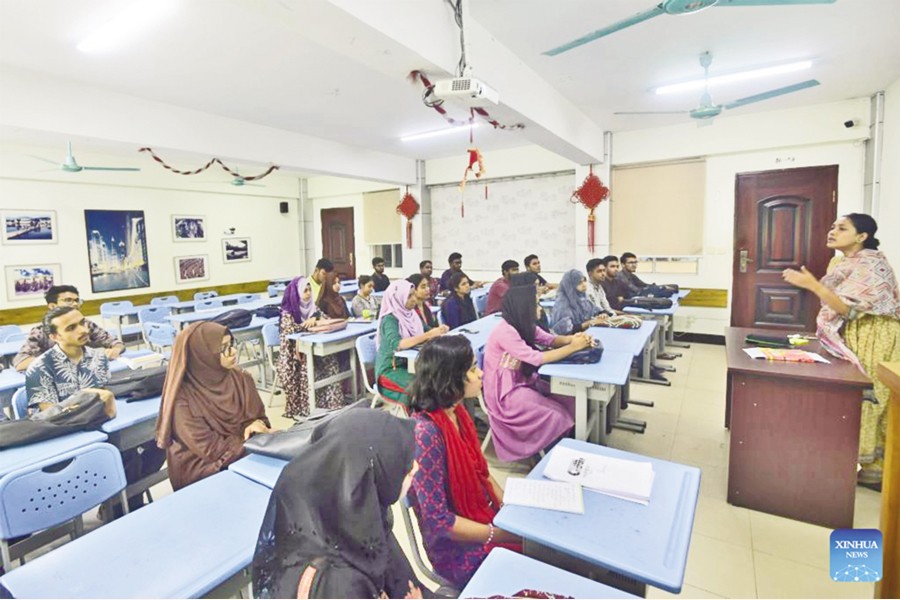
 A teacher teaches Chinese language at the Dhaka University in Dhaka, Bangladesh, August 17, 2022. — Xinhua Photo
  Bangladesh today stands at a demographic crossroads. With a substantial youth population, it holds a promise of a new generation that can lead the country into an era of creativity, innovation, and social progress. And yet, that promise remains only partly fulfilled. Thousands of young graduates are leaving universities each year without a clear sense of purpose or place in the job market. It is not solely an economic issue, but also deeply social. It speaks of the kind of learning we have prioritised in Bangladesh, and also the kind we have left out.
For decades, our education system has been designed around academic performance and examination success. We have valued memorisation over curiosity, competition over collaboration, and technical proficiency over emotional depth. Whilst some international schools have implemented advanced social and emotional learning frameworks in their teaching, the rest of the system, including national exams, is still focusing almost entirely on memorisation and recall. In such a context, education must shift its focus to not only helping young people learn subjects but also to care for themselves, for others, and for the communities. From the rising inequality to increasing social tension, the challenges in Bangladesh cannot be solved with technical skills alone, but with the ability to understand, empathise, and work with others. We have not prepared our students for the world they are inheriting. They are growing up in a time of rapid change, where unlimited information is available at their fingertips, but insight and reflexivity become harder to achieve.
This is where emotional competence comes in. Whilst these may appear to be abstract concepts, they are practical life skills - the ability to listen, to manage one's emotions, to resolve conflicts peacefully, to understand different perspectives are the keys to harmonious and resilient societies. From the recent spike in crime rates to the aggressive confrontations going viral in social media, many often wonder where we went wrong. By failing to integrate emotional learning, social awareness, and even a lasting sense of environmental responsibility into the curriculum, we have left a crucial gap in education, overlooking the very competencies that would make the citizens more respectful, tolerant, and mindful of the world they live in. For example, environmental education receives minimal attention beyond basic science textbooks. Many of the challenges we face in Dhaka city, from polluted rivers to poor urban planning, reflect decisions that might have been different if empathy and foresight were prevalent in our workforce and society.
With so many reforms in the pipeline, Bangladesh is missing a crucial opportunity to reimagine what learning should mean for a new age of information and artificial intelligence. Teaching emotional competencies does not require new textbooks or expensive reforms. Yet, these are the very skills that prepare the youth to thrive in diverse professions and coexist in an increasingly polarised world. It begins with a change in mindset. From early schooling to universities, lessons should be designed to nurture curiosity, teamwork, and communication. Globally, educators are recognising the role of emotional intelligence, and it is time we do the same in Bangladesh.
The recent drop in the HSC pass rate to 58.8 per cent highlights how sub-standard teaching and institutional conditions affect learning outcomes. Many education systems around the world demand robust preparation with mandatory training hours, collaborative lesson planning, peer observation, and reflective practices. Yet in Bangladesh, schools continue to operate with underqualified staff, minimal support for professional development, and negligible institutional time for reflection or peer learning. Many teachers enter classrooms without any mandatory training on teaching methodologies, classroom management, or how to support students' social and emotional growth. This is not because they lack potential, but because the system was built to demand so little of them. When teachers are overworked, underpaid, and undervalued, few are motivated to invest the time or creativity in designing effective lessons. Investing in teacher qualification and well-being through rigorous professional development, fair pay, manageable workloads, and supportive institutions will recognise the pressures teachers face. To truly build emotional competence in students, teachers themselves must be equipped with strong pedagogical training and operate in environments of dignity and respect. Only then can classrooms become spaces of trust, empathy, and creativity rather than fear or conformity.
Perhaps, the next great reform is not technological or structural, but ethical. Too often, our institutions mirror the very divisions they are meant to heal. When politics infiltrates campuses, when appointments and curricula are shaped by influence rather than insight, the classroom stops being a place of growth and creativity. It becomes a reflection of our fractured society. If we are to build a truly harmonious society, we must begin by restoring trust, dignity, and independence to our education system so that it can fulfil its responsibility to shape citizens who are not only skilled and employable but also thoughtful, principled, and compassionate. However, the question persists: if we all recognise the need for change, why has it remained so difficult to achieve and so ineffective in addressing our social and environmental challenges?
Sameera Zaman is a Lecturer and Research Associate at the Center for Sustainable Development, University of Liberal Arts Bangladesh. sameera.zaman@ulab.edu.bd.
© 2026 - All Rights with The Financial Express

