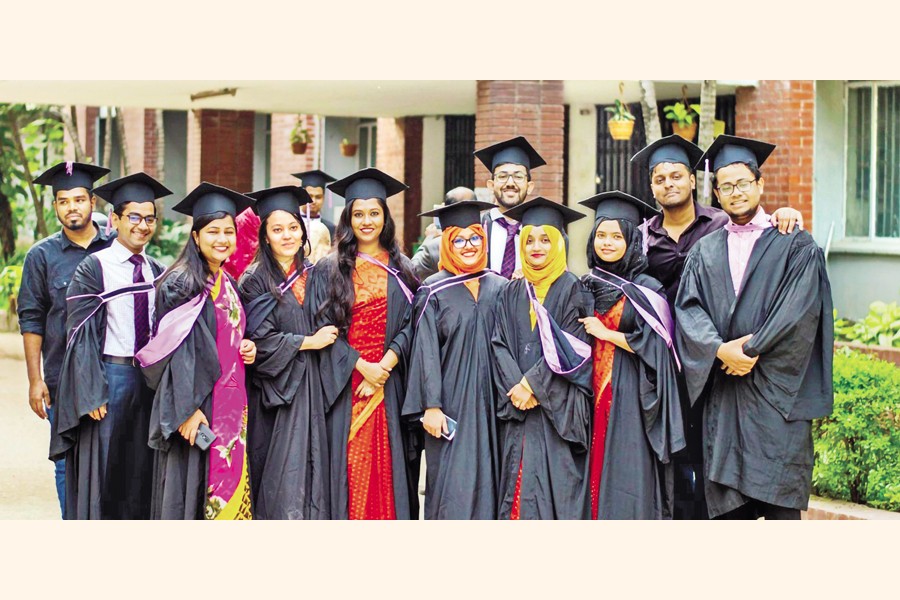
 A group of DU students celebrate their graduation moment. — DU Photo
  When the authoritarian government of Sheikh Hasina was challenged in the summer of 2024, the largest demographic that was at the forefront against it was the youth of the country. The frustration that gave rise to their heroic stand against tyranny has definite links with the lacklustre economy of the country, beset by vices like corruption, inefficiency, and weak institutions. While the rest of the world has been progressing steadily towards a strong skills-based future for labour, the declining education sector of the country, from primary to tertiary level, has failed to keep up with the challenge posed by this development in a globalised world for the future of the youth of Bangladesh.
While these assertions sound clichéd, a quick look at some troubling statistics might make the point hit closer to home!
If this is not bad enough, the status of those who do get "educated" under this underinvested and crippled sector is not much better than those who are not participating in it at all! According to the National Student Assessment 2022 for Grades 3 and 5, published in June 2023, only about 35 per cent of Class-III students could read with comprehension, and just 25 per cent could perform basic arithmetic operations. Over a 9-year period between 2013 and 2022, the top proficiency band in mathematics for Grade-V students has shrunk by 6.0 per cent, from 25 per cent of the students to 19 per cent of total students surveyed.
As per another report submitted to the United Nations Committee for Development Policy by the Government of Bangladesh, "Grade 3 students, 62 percent, did not accomplish grade-relevant competencies in Mathematics. Among grade 5 students, grade-relevant competencies were reached by only 36 percent of students in Bangla and only 24 percent of students in Mathematics. At the Grade 8 level, only 44 per cent and 35 per cent of students achieved grade-relevant competencies in English and Mathematics, respectively." (Bangladesh Annual Country Report 2022 Submitted to UN-CDP).
It is no wonder then as to why gross enrolment in tertiary-level education is so low: students with such a low level of competence simply cannot make their way up the ladder to higher studies, and this is not their fault. That the system set up to serve their educational needs has failed them miserably is a conclusion which is indisputable in the face of these facts. When the statistics published under an autocratic regime - which usually are not known for their honesty in handling data - are so bleak, one can only imagine how bad the ground reality is! On top of the relatively low expenditure-to-GDP ratio for education, the fund allotted goes mostly for "infrastructure" projects, well-known for the corruption and looting that goes on under their name at the local level by both public officials like engineers and the contractors who almost always happen to be politically connected racketeers.
To see how the teachers - the driving force in quality improvement in education - are doing in terms of their own development, from the data available from UNESCO Institute of Statistics, the percentage of primary school teachers who received the required training Bangladesh has improved from 50 per cent to 77 per cent between 2016 and 2023, but the same percentage has remained stuck between 60 per cent and 65 per cent for secondary school teachers over the same period. While the traditional 11.5 per cent for education rule in the national budget in recent years is not helping, it is not clear whether a sizable part of the meagre allocation goes to improve the quality of teaching. Available data suggest that the revenue expenditure (not part of ADP) mostly goes for paying the regular remuneration to employees under the ministry of education and not much in training (98 per cent according to a World Bank Report from 2019). Approximately 5.6 per cent of the educational allocation in the national budget for FY2024-2025 was allotted for the professional development of primary-level schoolteachers.
The purpose of summoning all these pitiful statistics is to wake us up from the slumber that has become commonplace, a resignation from responsibility and complacence engendered by a feeling of hopelessness that nothing is ever going to change or get fixed. After the momentous achievement of the youth on all of our behalf, this fatalism is nothing short of betrayal. We all owe them this one: a clean break and reset of the system. The least the current government could have done was establish some permanent reform commission or public body to highlight the issues and study the ways of improving or changing the system and pave the way for future policies. Unfortunately, they have failed to do so in the over one year they have been in power. While it is understandable that their mandate is limited due to the tricky legal nature of their formation under emergency situations, it was well within their capacity to pay the same attention to education as they have paid for the other issues which prompted the establishment of various commissions for reform.
 While much cannot be expected from the interim government at this point, the appeal to the next elected government is to quickly establish a commission to draw up a national education strategy. The purpose of the strategy will be to set the principles to guide both how much to allocate for education and how to distribute it optimally to achieve measurable goals in terms of the coverage and quality of education in Bangladesh at all levels from tertiary all the way down to the primary. The foundation of these principles should be a profound concern for launching Bangladesh into the foray for the vast potential being unlocked by the progress in artificial intelligence and computational advancements. In a globalised world such as ours, there is scant room for complacency and fatalism. The poorly educated workers from our country suffer from human -rights abuses abroad due not being able to find for themselves a room in sectors with skilled and educated labour-force requirements. Contrast this with countries like the Philippines which is famous worldwide for sending female nurses across the globe as caregivers and healthcare professionals, particularly in the Western world and the Middle East. India alone earned US$135 billion in remittances in the last fiscal year, mostly sent by skilled IT professionals who are making an impact worldwide, and more specifically in the US tech sector, which is world-leading.
Regarding the national education strategy proposed above, some suggestions can be made. The key operational goal in the short term should be improving teacher training and textbook reform. In the long haul over a period of 10-15 years, a broad-based reform agenda, agreed to by a national consensus built by all the political parties to ensure continuity, should be launched, focused primarily on integrating the education system. The current fragmented system represents the class divide that we have inherited since colonial times. The scheme goes as follows: "English medium for higher class, Bangla medium for middle class, and madrasah and NGO schools for lower class". While it seems as if it is a conspiracy to cement the class divide and create a permanent underclass with significantly different life outcomes from the privileged class, this baggage is a lamentable inheritance from the ossified feudal mentality of the elites since independence from the British rule. If Bangladesh was to truly become a "People's Republic", we must first overcome this hurdle. Otherwise, nothing else matters because we will be dead as a nation!
To delve deeper into the issues that require our attention for this strategy, madrasah education needs a significant reform because the educational achievement and economic outcomes are worse for this stream in a verified way. While this is politically tricky because of the vast network of Qawmi institutions that have sprawled across the country, the main strategy would be to identify what drives people to choose this line of education above the more mainline education system, and to work on addressing those issues to divert more parents to the mainstream education sector away from it. This is not being advocated out of malice for the institution of madrasah itself. Historically, this institution has served our community greatly and has led movements like anti-colonial resistance. The main issue is that the conservatism that sets them apart from society also keeps their leadership myopic and prevents a vision of expansion to grow in them. It is highly doubtful that purely religious motives are driving this huge level of enrolment in a sector with little participation in the broader economy, particularly (beyond self-employment) in blue-collar jobs.
Official BANBEIS-based counts put madrasah (including both Alia and Qawmi) enrolment at approximately 2.75 million students in 2023, representing roughly 25 per cent of the post-primary student population that year. In the light of such statistics, their outsized influence in the education sector deserves a reckoning by policymakers, especially since a significant number of the students coming out of this system are unlikely to find purely religious vocations as their livelihood. Regardless of how religious the country is, we cannot create 200,000 posts for Imams and religious teachers every year to employ all of them. My hypothesis is that it is not the success of the sector that is driving its growth, but the failure of its alternatives. While surveys are required to corroborate this conjecture, anecdotal evidence firmly supports this idea, as interviews reported in other news media seem to suggest that parents who are beset by poverty and who are concerned about the rising costs of education tend to favour madrasah as an alternative. Initiatives such as free stationery and textbooks, as well as free- lunch programmes might alleviate some of these concerns.
My idea of an integrated education is a K-12 (kindergarten to 12th grade) coeducational model with mandatory and free education with penalty for truancy. Beyond the 12 grades of school, various streams such as technical and madrasah education can be accommodated as tertiary levels. Arabic as an elective for students interested in future religious careers and indigenous languages in areas like the Hill Tracts can be added as a third language (in addition to English and Bengali). This K-12 model should have emphasis on language, critical thinking, and mathematical skills. Misguided and wasteful initiatives like "IT education" should be scrapped in favour of IT use integrated as part of regular coursework. Most importantly, the instrumentalist view of education as a means to earn a livelihood must be dropped. The purpose of school education should be to foster critical thinking, not to serve as trade courses for supplying "skilled workers". That job should be reserved for other types of institutions like polytechnics and professional schools at the tertiary level. When a student who is pursuing religious studies at a Madrasah after their school education with someone pursuing a medical degree, their social and mental divide will be much lower compared to what we have now. Even with the tradeoffs, it might be worth its while.
These recommendations draw from experience on both sides of education-as a former lecturer at a private university in Bangladesh and as a PhD student in Economics at a US public university. From the teaching perspective, students' disappointment in their preparation for higher education and the resulting challenges have been evident. From the student perspective within a cohort of Bangladeshi aspirants for higher education abroad, the consequences of insufficient attention to global competitiveness in higher education have become apparent. Both perspectives confirm a growing hunger for change.
The heroic post-uprising environment was supposed to be the perfect launching pad for paradigm shifts in education, which has failed to materialise. But all hopes are not lost, there still exist major scopes for improvement in the presence of a populace which has been animated by the upheaval and poised to demand better from their leaders after realising the power they have in their hands to determine the future through definitive action. The people who are hoping to lead this populace would do better to listen before leading.
The writer is a former Senior Lecturer at East West University, currently pursuing PhD in Economics at University of California at Riverside. economistbd003@gmail.com
© 2026 - All Rights with The Financial Express

