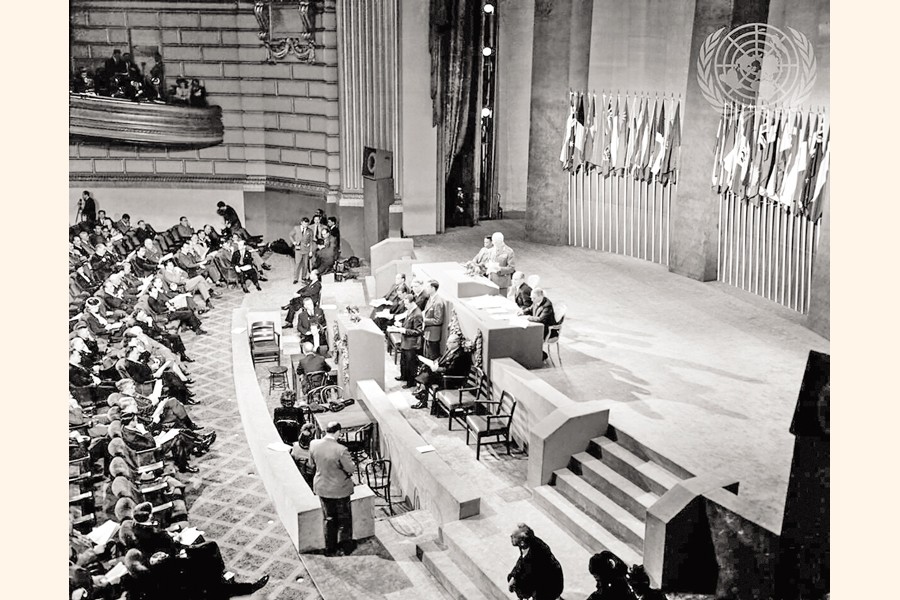
 Delegates of fifty nations met at San Francisco between April 25 and June 26, 1945 to finalise the Charter of the United Nations. — Agency Photo
  As the United Nations (UN) approaches its 80th anniversary in 2025, the global discourse surrounding its efficacy is at a fever pitch. On the one hand, multilateralism is unequivocally recognised as required to navigate the complexities of a "multiplex world". On the other, the organisation finds itself paralysed by structural inertia, financial fragility, and a crisis of legitimacy that deepens with every geopolitical conflict it fails to resolve.
From an academic perspective, a historical analysis of the UN's founding reveals why fundamental, rather than cosmetic, reforms are essential for its survival. The core problem is that the structure of global power we see today is not accidental; it is a direct inheritance. The United Nations and the Bretton Woods agreements, established in 1944-1945, were conceived towards the very end of the colonial powers. Consequently, the structure and the power dynamics embedded within the UN reflect that colonial history. Any attempt to motivate change today is proving to be incredibly difficult.
The founders of the UN had four fundamental, laudable objectives: the preservation of peace, the promotion of human progress, the establishment of a rule-based world order, and the prevention of future conflicts. However, as an academic looking behind the scene, I identify few more reasons for its establishment.
The UN structure was, in practice, designed for the continuation of power with the colonial rulers. They ensured this continuity through the organization's very architecture. For instance, knowing that the newly independent developing countries would face a shortage of capital, the dominant powers sought to capture that market. While this could be argued as being "for good," it simultaneously resulted in a dominance in the financial market, which largely translates to the dominance of the dollar. This dominance, rooted in post-colonial financial control, is the underlying story that runs beneath the surface of multilateral rhetoric.
This historical power dynamic led to the fundamental flaw that continues to plague global governance: the division of the whole world between developed countries and developing countries. This narrative itself is the core problem because we are not equal under this structure. If the goal is to establish a global multilateralism based on fairness and justice, we must change that narrative. Success stories, such as ASEAN, thrive precisely because there is no developed and developing partners dividing the organization. When the governing logic is built on "you and me, and I'm the powerful one," that narrative inevitably leads to the frustration that we observe today.
THE PARALYSIS OF THE PRESENT STRUCTURE: Our analysis confirms that the challenge of improving multilateralism is two-fold: structural and behavioural. Structurally, we have been discussing reforms for the last 10 years, and they have not worked. This is because nobody wants to be left behind; everybody wants to be part of decision-making. This political gridlock demonstrates the second biggest challenge: the unwillingness of incumbents to surrender power.
Behaviourally, the UN's authority is being increasingly challenged and bypassed. The creation of exclusive blocs like NATO and BRICS, while potentially good initiatives because they apply pressure on the United Nations to function, also illustrate the UN's perceived failure. For example, the UN did not function during the Middle Eastern uprising; it was NATO who executed the operation, bypassing the United Nations entirely. The world was left frustrated by this unilateral action and the UN's helplessness.
Furthermore, the failure of the UN to address the aggressive actions of its most powerful members demonstrates its paralysis. The United States is out of quite a lot of organizations, including UNESCO, and the UN either could not or did not deal with it. This is the very helplessness of the United Nations.
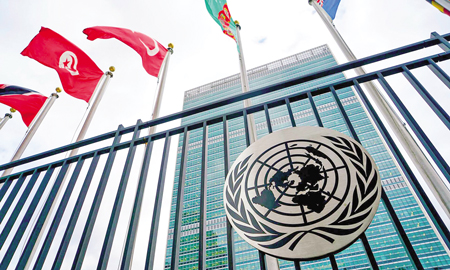 To understand the depth of the structural problem, we must also consider the World Trade Organization (WTO) as a comparative model. The UN Security Council has five permanent, veto-producing countries. The WTO, by contrast, has none. Yet, the WTO is not working either. The failure of the WTO serves as a potent example that simply removing the veto structure may not solve the underlying problems of power, trade, and financial dominance. We must be careful in reorganising multilateralism based solely on either the UN or the WTO model, as both are fundamentally struggling.
Beyond established geopolitical conflicts, new threats further undermine the rules-based order. This year, the US passed a very interesting new presidential order that has the potential to change the dynamics of the world. This order allows any company of the United States to invest anywhere in international waters, and the US government will protect it. This is an action that strikingly parallels the historical mechanism by which the East India Company came to India and occupied it, with the British government's support. This action, along with the fact that powerful countries like the US, China and few others have not signed the International Seabed Authority rule, signals that the future discourse is going into a different direction-one based on unilateral claim rather than collective governance. Similarly, the absence of global agreements regarding global resources in space means countries can bypass regulation, as conditions for proper governance have not been created. These disturbances demand that the UN recognise the challenge and formulate a new strategy.
The Imperative of Narrative Transformation: Moving beyond GDP. If structural change is impossible without political will, then we must begin by altering the narrative. The old narratives, the "you and me" logic, the "west versus east" dichotomy, and the focus on richer countries versus poorer countries-must be forgotten.
The core of the new narrative must shift the foundation of global valuation. We must move beyond the GDP concept. What must come to an agreement to measure progress as development is Humanity, environment, and the rights of all people. These are the new paradigms that must guide our collective future.
The UN has previously experimented with a formula of equal but differentiated roles. However, this formula did not work. The roles were differentiated, allowing the richer country to play a better, more significant role than poorer countries, often due to the latter's financial inability. As new powers are coming up, signaling a changing era, the narrative must adapt. We must demand equal partners.
Structural Solutions: Geographical Rotation and Equal Partnership. Given that the superpowers of the past will not give up their current advantages, making existing negotiations very difficult, the only viable path to structural reform lies in changing the representation model entirely.
I suggest that the UN Security Council and other high-level decision-making bodies should be represented by geographic groups. This does not mean simply expanding from five countries to twenty. It must be a system where representation is equally divided among nearly similar countries.
To navigate the difficulty inherent in selecting which country represents a region, we can easily adopt a rotational system. This rotational concept is already successfully implemented, with the rotational chairmanship of the European Union serving as an example. This system ensures that the regional voice remains present while guaranteeing that one country is not superior to the other country. This mechanism directly addresses the historical power asymmetry.
Therefore, for the UN's 80th birthday, academic thought must crystallise into a clear demand: look at the narrative, and change the narrative. That must be the job of Asian and other developing nations-to establish this new, agreed-upon narrative.
CONCLUSION: Multilateralism is required. But if the UN is to thrive past its 80th year and serve the true interests of all nations, it must fundamentally divest itself of its colonial structure. This transformation demands: (1) A complete rejection of the "developed vs. developing" and "GDP-first" narratives; (2) A commitment to a geographically representative, rotational governance structure to ensure all nations are equal partners; and (3) A strategic response to new threats, such as unilateral assertions of power and the lack of governance in new domains like space.
The failure of the UN to deal with contemporary challenges, including the extreme unilateralism of major powers, is a demonstration of its helplessness. It is time to recognise this helplessness and force a new, equal reality. This is the only way to ensure that the UN is not merely an archaic relic, but a foundation for a fair global future.
Professor A K Enamul Haque is Director General, Bangladesh Institute of Development Studies (BIDS). akehaque@gmail.com
© 2026 - All Rights with The Financial Express

