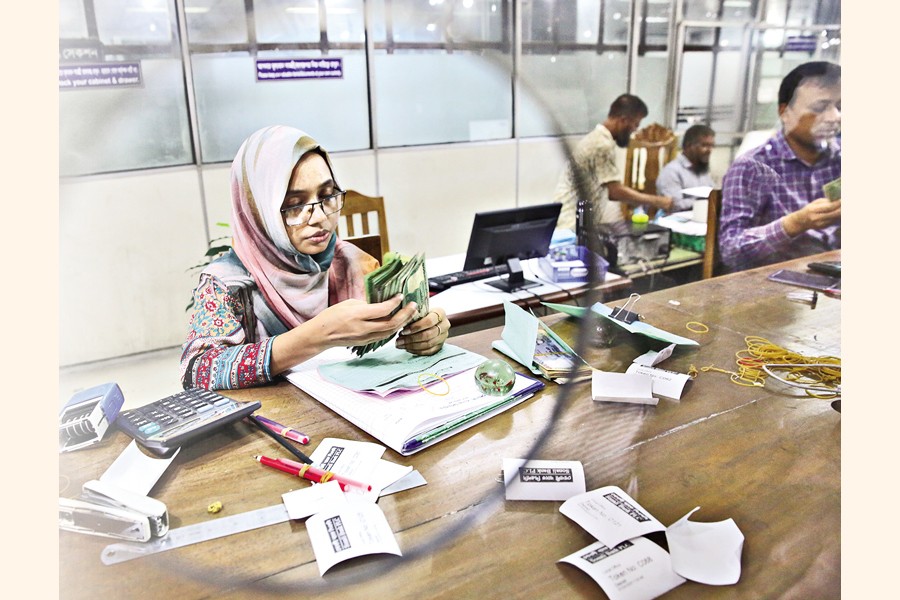
 We are constantly moving towards the future. Modernity is reflected in the latest versions of various types of services. Similarly, various service providers are also busy thinking about the future and improving the service sector. Therefore, with the aim of improving the banking service sector, those concerned are moving forward with a focus on the distant future.
Brett King, a top-10 global futurist, international best-selling author, and media personality, visited Dhaka a few months ago. He shared insights into the future of global banking and where Bangladesh needs to take its banking sector. Brett King said, “AI and other emerging technologies are transforming financial services, and Bangladesh must move past legacy systems to build the banks of the future.” He also said that Bangladesh has an amazing opportunity right now to adopt AI in banking. “Banking is not just banking today; it is now a technology-driven industry,” he added.
If we do not consider his words, perhaps it is time to think deeply about three things: legacy systems of the past, adoption of AI, and the amazing opportunities ahead.
Past Legacy Systems
The departure from legacy systems and the beginning of modern ones often occur simultaneously, and the banking system is no exception. At one time, no one imagined transactions taking place anywhere other than a bank branch. Later, the Automated Teller Machine (ATM) was introduced. The world’s first ATM was installed in England in 1967, and after more than two and a half decades, an ATM was installed in Bangladesh in 1994. Since then, ATM-based transactions have continued for more than three decades. Today, customer perceptions of ATM-related services are quite positive, and ATMs continue to hold priority in financial transactions.
After this, the journey of online banking in Bangladesh began in 2000, and later, Mobile Financial Services (MFS) started full-fledged operations in 2014. This shows that after the introduction of online banking, it took nearly two decades for the service to become widely recognised in the country. The same is true for MFS – it was introduced almost a decade and a half later.Now let’s turn to branchless banking. The concept emerged around fifteen years ago, although it only gained popularity about a decade later. This form of banking is widely known as neobanking, and such institutions are called neobanks. In 2023, an initiative was taken to establish this type of bank in Bangladesh, which is known as the Digital Bank. Considerable progress has already been made in this regard.Therefore, it has taken Bangladesh a long time to adopt nearly every modern banking innovation – from ATMs and online banking to MFS and Digital Banks. While many countries are now embracing emerging technologies, we are still in the process of adopting those they have already moved past.
Therefore, some questions may arise in everyone’s mind. Are we delaying our preparation to provide modern banking services? Are we slow in making decisions? Are we facing too many obstacles in the process? Or are we simply not yet fully capable of adopting emerging technologies? The answer may lie somewhere among these possibilities, or perhaps none of them.
Modern banking services are constantly evolving and improving. Therefore, it is essential to be proactive in adopting them. Quick decisions are also necessary to embrace emerging technologies. In the developed world, the use of such technologies is modernising banking services. Why are we not modernising ours in the same way?
Which technology is playing the leading role in this transformation? In other words, what is the true driver of this change? We need to identify the force that has taken banking services to new heights of modernity—and continues to do so. When we search for it, one name stands out: artificial intelligence. If we want to make banking services fit for the future, we must move forward by integrating AI into the core of our financial systems.
Adoption of AI-enabled Future
It would not be very wrong to call artificial intelligence (AI) in banking a technology that transforms banking. AI has brought a huge revolution in the banking world. Many countries of the world have now brought many banking services under the ambit of AI.So it is clear from now on that the future of banking will depend on AI. Therefore, to make the country’s banking services international standard, we have to move forward keeping AI in mind. If we want to move forward with AI in the future, several things must be taken into account.
Developing a Digital Mindset
To provide digital services to our country’s bank customers, it is essential for banks to first have a digital mindset. Digital transformation is an essential prerequisite for success in the changing business environment of financial institutions. Despite the fact that many banks are experimenting with digitalisation, most have not yet made strong, consistent and clear moves toward a complete technology-enabled transformation. Businesses will keep expanding because of technology, which is also necessary to offer a variety of services with a satisfying client experience.
Embracing Emerging Technologies
It is not enough to simply develop a digital mindset; banks must also take initiatives to digitise their operations by embracing emerging technologies. These technologies have already brought about radical changes in the banking and capital markets industry across the front, middle, and back offices.AI and automation are becoming more important and useful than ever imagined. Similarly, blockchain has spurred innovation across various industries and will continue to do so in the future. Cloud computing is exerting an unprecedented influence and transforming the banking sector.Banks must understand where and how these technologies can be applied and how to modernise existing systems to further enhance their services. Otherwise, banking services will remain outdated, and we will fall behind in adopting emerging technologies.
Utilisation of Platforms and Data
Data is the power of any organisation. If it is easily accessible, along with having enough data, banks can think of new business strategies to retain customers. By leveraging the abundance of data, banks can optimise the products and services that customers prefer. Banks can utilise their own data and platforms to grow themselves.
Cyber Risk and Financial Crime (CyFi)
The ecosystem surrounding financial crime is changing as offenders use more creative and novel methods of committing crimes. Regulators are also continuing to strengthen criminal penalties and enforce the compliance regime. Financial institutions’ reputations could be seriously jeopardised if consumers are no longer protected from intricate and sophisticated financial crimes by traditional and compartmentalised preventative techniques. For banks to efficiently detect fraud and enhance threat visibility, they must adopt cutting-edge technologies like artificial intelligence and analytics.
Organise the Ecosystem
The financial services ecosystem is constantly expanding. Banks, regulators, big tech, fintechs, and other stakeholders must move forward together to build the banking system of the future. Each of these actors provides essential skills and services that others rely on to serve their clients. A strategic vision for the entire ecosystem and efficient coordination among all parties will be crucial.
Amazing Opportunity for Digital Transformation
Bangladesh now has an extraordinary opportunity to adopt artificial intelligence and other emerging technologies in banking. As emerging technologies continue to transform banking services worldwide, it is vital for Bangladeshi banks to align with this global trend. To remain competitive, banks must undergo digital transformation and embrace emerging technologies across their operations.
If we want Bangladeshi banks to take their place in the global banking platform of the future, we must gradually move away from traditional systems and accelerate the use of artificial intelligence and other advanced technologies in providing banking services. Otherwise, the global banking system of the future will leave us far behind.
The writer is a Banker and Certified Digital Finance Practitioner (CDFP).ahabib46@gmail.com
© 2026 - All Rights with The Financial Express

