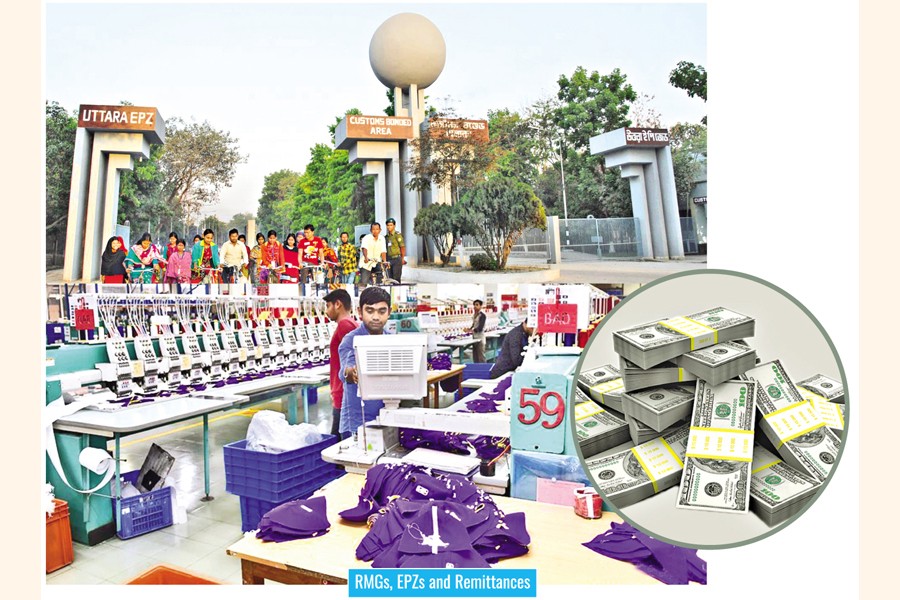
 Over the past fifteen years, the country's economic resilience has rested on three enduring pillar exports, export processing zones (EPZs), and expatriate remittances. These are not merely sources of income but the arteries that have kept growth flowing through shocks, political disruptions, and global crises. When the world slowed, these three streams sustained momentum; when domestic governance faltered, they anchored stability. Together they tell the story of a nation that learned to remain resilient by selling its labour, enterprise, and perseverance to the world.
The global environment since 2010 has been anything but tranquil. The aftershocks of the financial crisis lingered well into the decade, followed by the COVID-19 pandemic, Russia's war in Ukraine, commodity inflation, and recurring energy insecurity. Yet despite these pressures, the economy managed to record an average annual growth of more than six per cent-an outcome credited not to policy genius but to the relentless toil of workers, migrants, and entrepreneurs who turned adversity into exportable value. The resilience that outsiders often celebrate was not conjured by fiscal stimulus or monetary innovation; it was produced by sweat and remittances, garments and grit.
PILLAR I -- READYMADE GARMENTS: No sector captures this better than the ready-made garments (RMG) industry-the mainstay of exports and employment. Over four decades it has evolved from a cottage initiative into a global manufacturing powerhouse, employing about four million workers and accounting for more than four-fifths of total export earnings. The last fifteen years were transformative: compliance reforms after the Rana Plaza tragedy, expansion into knitwear and high-value apparel, digitalisation of supply chains, and gradual adoption of green factories that now number over 200-the highest in the world. These changes were driven largely by private initiative and international pressure, not bureaucratic foresight. Buyers demanded safer workplaces and transparency; producers complied, upgraded, and survived.
But survival has its costs. The RMG sector still thrives on low wages and razor-thin margins. Workers' pay remains among the lowest in Asia-barely adequate to offset rising inflation and housing costs. Each wage revision triggers strikes, reflecting the unending tension between profitability and human dignity. Meanwhile, global competition intensifies. Vietnam, Cambodia, and India have steadily captured market share through diversified product baskets, higher productivity, and trade pacts such as the Comprehensive and Progressive Agreement for Trans-Pacific Partnership (CPTPP). The European Union's GSP-plus scheme, which will replace the Everything-But-Arms (EBA) privilege after graduation from least-developed status, will require compliance with stringent labor and environmental standards. Meeting those benchmarks will test both governance and industry discipline.
The RMG sector now demands serious policy attention to mitigate recurring labour unrest by ensuring workers receives a fairer share of the surplus value they create. Beyond periodic wage adjustments, genuine welfare measures must include improved working and living conditions, childcare access, and strict enforcement of occupational safety and hygienic standards in workplaces. The health and dignity of the labour force are not moral ornaments but essential components of sustained productivity and social stability.
PILLAR II --EXPORT PROMOTION ZONES AND ECONOMIC ZONES: Parallel to garments, the network of export processing zones and economic zones has become the industrial arsenal of diversification. Managed by the Bangladesh Export Processing Zones Authority (BEPZA) and later by the Bangladesh Economic Zones Authority (BEZA), these enclaves represent an experiment in disciplined capitalism-a contrast to the bureaucratic chaos outside their fences. Over the past decade, the number of operational zones expanded, foreign investors from South Korea, Japan, and China set up plants, and new sectors-electronics, automotive parts, leather goods, footwear, and pharmaceuticals-began to flourish alongside garments. The model has worked because it combines infrastructure readiness, one-stop clearance, and relative insulation from local political interference.
The performance of these zones offers a quiet rebuttal to the common argument that governance failure is destiny. Within clearly demarcated rules, investors respond rationally; productivity rises when policy uncertainty is reduced. The EPZs have demonstrated that even in a politically noisy environment, islands of order can produce steady industrialisation. The challenge is to extend this discipline beyond the fences-to make the rest of the economy behave with the same predictability that investors find inside the zones.
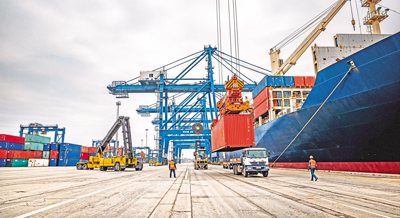
The contribution of these zones is more than their export share. They have become laboratories of skills transfer and technology adoption. Thousands of mid-level technicians, engineers, and supervisors trained inside EPZ factories later migrate to domestic industries, raising standards across the board. The spill over effects reach the supply chain in packaging, logistics, and transport. In that sense, EPZs are not merely export enclaves but catalysts of modernization. However, they too face constraints: inadequate port capacity, erratic power supply, and slow land acquisition. Unless these bottlenecks are removed, the promise of becoming a diversified export platform could remain partially fulfilled.
PILLAR III -- EXPATRIATE REMITTANCES: If exports and zones represent the formal face of globalisation, expatriate remittances form its invisible heart. For four decades, millions of migrant workers have carried the nation's hopes abroad-first to the Gulf, later to Southeast Asia, Europe, and beyond. Over the past fifteen years, their remittances have averaged between 6 and 8 per cent of gross domestic product (GDP), often exceeding $20 billion annually. During the pandemic, when global trade slumped, remittances paradoxically rose as migrants sent extra support to families back home. Those flows stabilised foreign exchange reserves, kept rural consumption afloat, and prevented a deeper contraction. Without remittances, the balance of payments would have been perilously fragile, and the currency far weaker.
The economic role of remittances goes beyond reserves. They finance education, healthcare, housing, and small enterprises. Villages once isolated from the formal economy now display modern homes and schools built with migrant savings. The social impact is profound: a generation of children educated through remittance income has entered the middle class, altering rural aspirations and consumption patterns. Yet the system is also vulnerable. Migration remains heavily skewed toward low-skill labour, dependent on volatile oil economies of the Gulf. Fees charged by recruiting agencies are exorbitant, and protections for workers abroad remain weak. A comprehensive migration policy emphasising skills development, cost reduction, and bilateral lab or agreements is overdue.
 TOWARD SUSTAINABLE RESILIENCE: Together, the three pillars form a triangular system of interdependence. Each reinforces the other in what might be called an economic sympathetic resonance. The RMG sector creates employment and export earnings; remittances sustain domestic demand; EPZs attract investment that diversifies exports and absorbs returning migrants. When one pillar weakens, the others compensate. During the remittance slowdown of 2016, rising apparel exports cushioned reserves; when global demand shrank during COVID-19, remittances surged. This dynamic equilibrium has allowed the economy to absorb shocks that might have crippled less diversified developing nations.
However, resilience should not be mistaken for sustainability. The structure remains heavily dependent on cheap labour, limited technological depth, and external demand. Export diversification into high-value goods and services has been slow. The share of RMG in total exports has barely declined from around 84 per cent a decade ago. Attempts to promote IT services, agro-processing, and light engineering have shown promise but not yet scale. Infrastructure, particularly in ports, railways, and energy--continue to erode competitiveness. The Padma Bridge and on-going port expansions offer hope, but without logistics efficiency and transparent regulation, the gains may not fully materialise.
Policy incoherence adds to vulnerability. Exchange-rate management has often prioritised short-term stability over export competitiveness. Subsidised credit schemes favour politically connected businesses rather than productive exporters. Bureaucratic delays in VAT refunds and customs clearances tie up working capital. The financial sector's weaknesses--non-performing loans exceeding 10 per cent, recurrent liquidity shortages, and governance lapses--pose systemic risks. An export-led economy cannot thrive indefinitely if its banking system remains a conduit of moral hazard rather than a channel of efficiency.
Still, the achievements deserve recognition. From a low-income agrarian base, the nation transformed into the world's second-largest apparel exporter and one of the top ten remittance-receiving countries. Extreme poverty declined dramatically; literacy, health, and gender indices improved. Women's participation in the workforce, driven by the garment industry, reshaped social norms. EPZs became magnets for foreign investment in a region often criticised for red tape. Migrant workers, often ignored in policy discourse, emerged as the country's largest single source of foreign exchange. These are not small feats. They represent the collective labour of millions who turned vulnerability into virtue.
Looking ahead to the next decade, the question is how to convert this resilience model into a sustainable growth model. Three priorities stand out. First, technological upgrading of the export base is imperative. The world is moving toward automation, digital design, and carbon-neutral production. Future competitiveness will depend on innovation, not imitation. Incentives for research, vocational training, and digital infrastructure must replace the obsession with cash incentives and tax breaks. Second, energy and logistics reform must accelerate. Industrial zones need uninterrupted power and efficient transport to remain attractive. Public-private partnerships can fill financing gaps if regulatory transparency is ensured. Third, migration policy must shift from volume to value--from exporting labour to exporting skills. Overseas employment in healthcare, technology, and services can multiply remittance inflows without increasing headcount.
Underlying these reforms is the larger imperative of governance. Corruption, bureaucratic inertia, and policy inconsistency continue to extract invisible tolls on every exporter and migrant. The same workers who earn foreign exchange often face harassment in passport offices, banks, and customs. Restoring institutional integrity is not a moral luxury; it is an economic necessity. Without it, the pillars of resilience may erode under their own weight.
The coming graduation from least-developed country (LDC) status in 2026 will mark both an achievement and a challenge. Preferential trade access will diminish; concessional financing will shrink. The economy will have to compete on equal footing with more advanced peers. That transition will test the robustness of its export machine and the adaptability of its labour force. Yet history suggests that resilience is embedded in the national character. Each crisis has produced renewal, each setback a new strategy of endurance.
Ultimately, the story of the last fifteen years is one of human endeavour more than institutional design. Factories built by entrepreneurs, zones maintained by technocrats, and remittances earned by migrants--all have sustained an economy that often lacked coherent leadership. Their combined contribution is nothing less than the quiet heroism of ordinary people sustaining an extraordinary experiment in development. If policy now matches their perseverance with vision and integrity, the next fifteen years could transform resilience into genuine prosperity.
The road ahead will demand a shift from reactive endurance to proactive innovation-from exporting labour to exporting knowledge, from surviving shocks to shaping opportunities. The triple pillars that once secured economic resilience can still safeguard the future--if strengthened by better governance, technological ambition, and social justice. The same forces that stitched garments, built zones, and sent remittances can now weave a more equitable and self-sustaining fabric of growth. That, more than any statistical milestone, will define the true measure of economic resilience.
Dr. Abdullah A Dewan, Professor Emeritus of Economics, Eastern Michigan University (USA); former physicist and nuclear engineer, Bangladesh Atomic Energy Commission (BAEC). aadeone@gmail.com
© 2026 - All Rights with The Financial Express

