JAMALPUR, July 12 (BSS): Sitting on the bank of the Brahmaputra River, Sukhi Begum aged 70 recalled the misery she experienced during her life hit hardest by floods and river erosion.
Her family was first displaced about 50 years ago when she was only 20. And she has, since then, lost her homes seven times to the erosion of the mighty river.
"We came to Pakuar Char of Sariakandi in Bogura around 50 years ago. But I still remember the day when we were first displaced due to river erosion," said Sukhi Begum, a mother of five, living in Pakuar Char.
"That time, I was younger and we were compelled to move to another char of Brahmaputra seeking a safe shelter. We built homes there to start a new life but the river devoured our homes making us destitute time and again," she recalled.
Sukhi was born and grew up in chars and has passed almost her entire life on the chars. So, she knows how to maintain the char life.
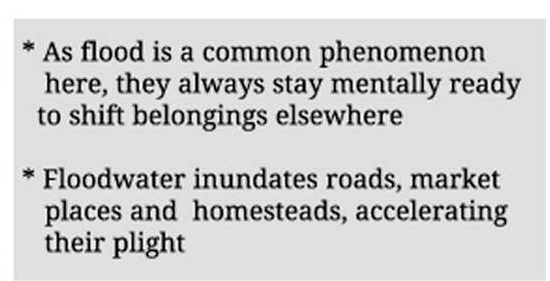
She said flood is a common phenomenon on the chars of Brahmaputra River and that is why they always remain mentally ready to shift their homes, as flood often causes river erosion and the erosion makes them displaced.
"Despite having experiences of dealing with floods, we do not want to leave our homes. We stay at home during flooding by setting up the increased structures at our houses. But when the river eats up our homesteads, we have no choice but to shift homes," she added.
Sukhi said she wants to breathe her last on the char as its fertile land gives her shelter and livelihood options. "I was born in char and want to breathe my last in the char too," she added.
Despite having uncertainty, farmer Ziaur Rahman aged 34 had sowed jute seed on a fallow land of a newly-emerged char in the Brahmaputra River but flood washed away his crop this year too.
"We, the char dwellers, face normal flooding every year and I knew we would face such a devastating flood this year. Despite that, I sowed the jute seeds on the char because we live in char with hope. Although my jute field got damaged by flooding this year, I will get bumper production of the next crops in dry season," he said.
Explaining how he can predict about flooding, Ziaur said the char dwellers can understand when a flood will hit.
"Based on the water coming from the upstream areas in the Chaitra month of Bangla calendar, we can understand whether a flood is coming or not in the monsoon," he added.
As a huge volume of water came from the upstream areas in this Chaitra month, a big flood swept in Brahmaputra basin earlier during this monsoon, Zillur said.
Before the flood hit, Ziaur shifted his house to another char of Brahmaputra, which was relatively safe, from Pakuar Char where he had been living for the last four years.
"As I assumed that a big flood was coming in this monsoon, I relocated my house to a char of Sariakandi," he said.
People living in the Brahmaputra chars know that their miseries will worsen during the monsoon as their neighborhoods will be inundated even in a normal flood. The floodwater inundates the roads, local markets and homesteads in the chars, accelerating their plights.
When flood comes, the people must take shelter on boats, banana-plant-made rafts and lofts (platform) built inside their houses.
"When flood inundates our homesteads, we must live on lofts built inside our houses or on boats or the rafts. When the situation gets worst, people go to the shelter centres. But we do not want to go there leaving all belongings behind," Ziaur said.
Mozam Mondal of Char Shovagacha said they must keep their domestic animals on floating platforms made of banana plants and face problems in managing fodder for those.
© 2026 - All Rights with The Financial Express

