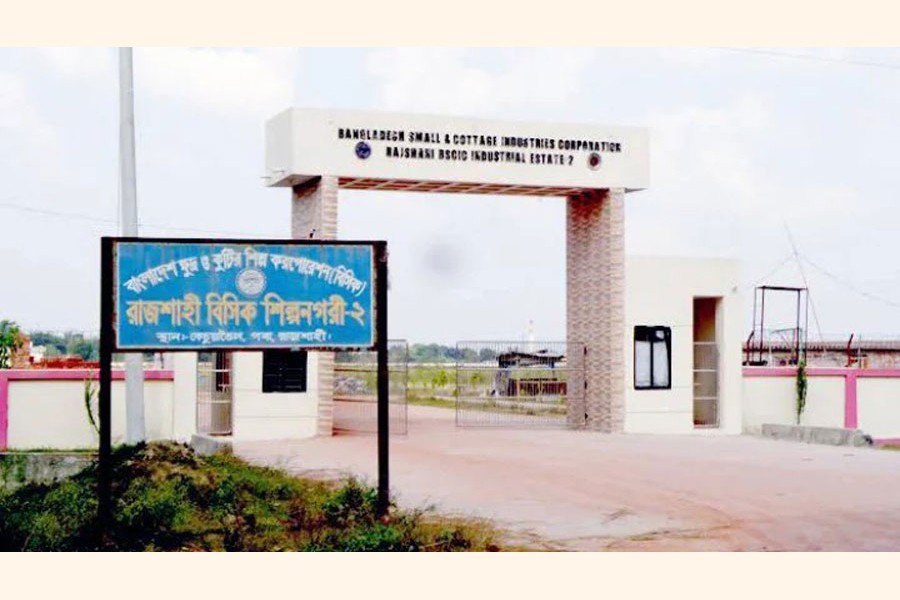
 Photo shows the frontal view of the BSCIC Industrial Estate-2 established in Rajshahi city at a cost of around Tk1.5 billion- FE Photo
 RAJSHAHI, June 27: Nearly four years have already elapsed since its inauguration, but the BSCIC Industrial Estate-2 in Rajshahi has yet to emerge as the industrial hub it was envisioned to be.
Despite being developed at a cost of around Tk1.5 billion, the estate continues to struggle with low investor interest, leaving most of its plots unused and its promise of large-scale employment largely unrealised.
 Launched in July 2022 at Kechuatol on the outskirts of Rajshahi city, the industrial estate was expected to accelerate industrialisation, attract new investment and create employment opportunities for thousands of people. However, progress has remained slow.
The estate, built on 150 bighas of land, comprises 286 industrial plots. According to Bangladesh Small and Cottage Industries Corporation (BSCIC) data, only 71 plots have so far been allocated, accounting for roughly 20 per cent of the total. More importantly, only a handful of allottees have started industrial operations, while most of the allocated plots remain undeveloped.
A recent visit to the site revealed little sign of industrial activity. Large stretches of land remain overgrown with grass and shrubs, while plots designated for women entrepreneurs also remain largely vacant.
Entrepreneurs attribute the sluggish response to the lack of essential infrastructure. The absence of gas connections has emerged as the most significant obstacle, while water supply and drainage facilities are yet to be fully functional.
Plot owner Mohayminul Haque said water pipelines have been installed but connections are yet to be provided despite repeated assurances from the authorities.
Another entrepreneur, Zahirul Islam, pointed to the comparatively high land prices within the estate, saying industrial plots are available at lower prices outside the project area. He also cited inadequate transport connectivity, the absence of cargo handling facilities at the local airport and limited presence of large investors as factors discouraging investment.
Industry stakeholders argue that the project was launched without adequately addressing key infrastructure requirements or assessing investors' needs and capacities. As a result, the estate has failed to generate the expected level of interest from entrepreneurs.
Syed Ahmed Zaki, member secretary of the Bangladesh Small and Cottage Industries Association, said many small entrepreneurs lack the financial capacity to invest in such projects. Without targeted support and incentives, attracting them to the estate will remain difficult.
Rajshahi Women Chamber of Commerce and Industry President Rosetti Naznin echoed similar concern, saying women entrepreneurs, despite having reserved plots, often face capital constraints and difficulties in accessing bank financing.
BSCIC officials, however, remain optimistic. They say efforts are underway to attract new investors and improve services, including gas and utility connections.
Regional Director of BSCIC Rajshahi Jafar Bayezid said initiatives have been taken to accelerate plot allocation and encourage both small and medium-scale industries to invest in the estate.
However, entrepreneurs argue that investment cannot be expected without first ensuring adequate infrastructure. The stalemate has left the project caught between policy ambition and practical realities.
Ahmed Shafi Uddin, president of the Rajshahi district unit of Citizens for Good Governance (SHUJAN), said the authorities launched the second industrial estate without fully resolving the challenges facing the existing BSCIC estate. He also suggested that Rajshahi would benefit more from an Export Processing Zone (EPZ), which could attract larger investments and create substantial employment opportunities.
anaetru@gmail.com
© 2026 - All Rights with The Financial Express

