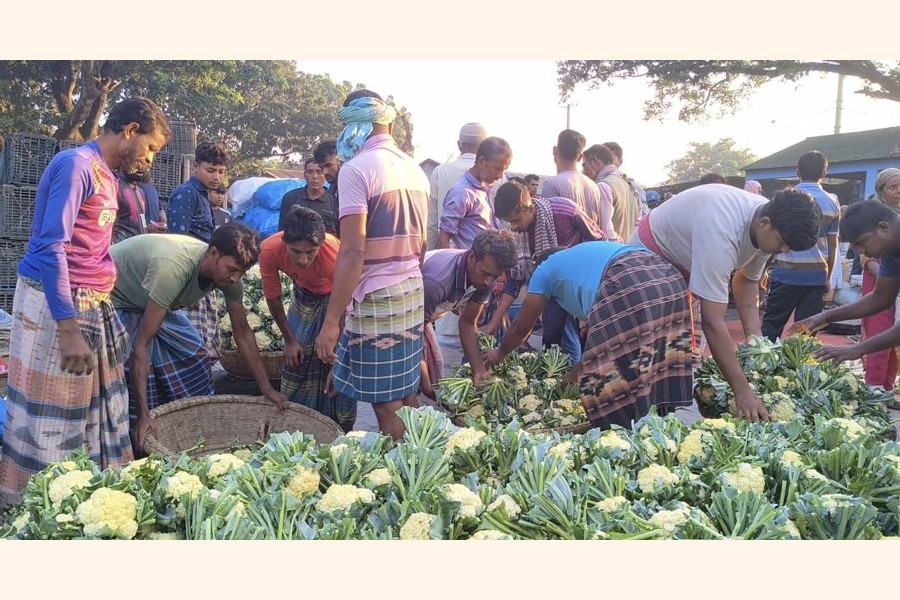
 A vender busy arranging cauliflowers in a right order in his shop at Shalbagan Market in Rajshahi city- FE Photo
 Unseasonal early-November rainfall has pushed up winter vegetable prices across Rajshahi, and Sylhet districts piling pressure on consumers already battling against the rising living costs.
Our Rajshahi correspondent reports: Untimely downpour in early-November caused extensive damage to winter vegetables making their prices prohibitive in the entire Rajshahi region, of which the consumer consumers are bearing the brunt.
Prices of most seasonal vegetables have nearly doubled within a week, triggered by large-scale crop losses and disrupted supply chains.
A visit to major kitchen markets-including Shaheb Bazar, Laxmipur, New Market and Shalbagan-reveals a sharp 30-50 percent rise in prices across key winter vegetables.
Traders say the abrupt supply shock will continue for at least two more weeks, until fresh produce enters the market.
 According to the Department of Agricultural Extension (DAE), Rajshahi, Naogaon, Natore and Chapainawabganj districts recorded 19,568 hectares of crop damage in two days of intense rainfall earlier this month. Of this, 1,649 hectares have been completely destroyed while 13,860 hectares suffered partial losses.
Aman paddy has taken the biggest hit- with crops on 585 hectares completely and 12,501 hectares partially damaged. Winter vegetables also suffered heavily, with crops on 108 hectares fully damaged and 434 hectares partially affected. Early-season garlic, mustard, onions and potatoes are among the crops severely impacted.
Farmer Abdur Rahman from Tanore said his early-variety potato, onion and cauliflower fields on five hectares of land have been ruined. "Rehabilitation will take an entire season. Land preparation, seedling purchase and labour-everything will cost more this time," he said.
Market prices reflected the shock. On Tuesday, round potatoes sold for Tk 35 a kilogram, up from Tk 25 last week while potatoes (Holland) at Tk 28, up from Tk 15-18 last week.
Beans and eggplants rose to Tk 120-130 a kg from Tk 80-90, while tomatoes climbed to Tk 160-180 a kg from Tk 140-160.
Cauliflowers sold for Tk80 a kg, compared with Tk 35-40 a week earlier. Kidney vetch increased to Tk 80 a kg from Tk 60, sweet pumpkin to Tk 50 from Tk 40, edible root to Tk 60 from Tk 40 and radish to Tk 40 from Tk 20.
Prices of leafy vegetables - including spinach, red amaranth and coriander leaves - also went up, though the price of bottle gourd remained unchanged.
Besides, onion prices continued to surge, selling for Tk 100-110 a kg, up from Tk 65-70 last week, while locally grown garlic rose to Tk 120 a kg from Tk 100.
Abdul Malek, a trader at Shalbagan Market, said, "Many vegetable fields remained under water for days. Farmers are unable to harvest, so supply is down. We are buying at higher prices and selling accordingly."
Low- and middle-income families are facing the brunt of the price shock. Shalbagan resident Ferdousi Khatun said her weekly budget no longer covers essentials. "We could buy several items for Tk 200-250. Now even Tk 400 falls short. Vegetables have become a luxury."
She added, "With meat and fish already expensive, if vegetables remain out of reach, managing household expenses will be impossible."
Shahana Akhter Jahan, deputy director of the Agricultural Marketing Department for Rajshahi Division, said supply may remain unstable for another fortnight. "Once water recedes, farmers will restart seedling plantation. Prices should ease when the next batch of winter vegetables hits the market in early December," she noted.
Our Correspondent from Sylhet adds: Commoners in general, especially the middle-income people as well as the poor, in Sylhet have been in much trouble with the high prices of vegetables of all types for weeks although the winter has already set in. The supply is well but no sign of downtrend in prices has been seen yet.
Some retailers, however, claimed that the supply had increased for days against a rising demand too. This is why it might take time for price reduction, they noted.
Some business leaders alleged that regular market monitoring is yet to be ensured alongside increase of production of various items including vegetables and others locally for a stable market.
Kabir Hossain, a grocer at the city's Rikabibazar, alleged, "The sellers, especially the wholesale-level ones, take advantage of any small crisis for manipulating market. We see no activity of the marketing department regarding monitoring in the markets, even on special occasions."
Azharul Islam, a trader at Darga Moholla in Sylhet city, said high prices of vegetables is quite unjust at this very time of winter. We had never witnessed it in the past while there had been no calamities this year."
Cucumber sells at Tk 80 to 100 per kg while radish sells at Tk 90 to 100. Tomato is available at Tk100 to 120 and green chili at Tk 200 while okra sells at Tk 90 each kg, cauliflower at Tk100 apiece, and brinjal at Tk 90 to 100 per kg. Potato sells at Tk 30 per kg. Egg sells at Tk150 to 160 per dozen.
The present short supply is artificial, believed Amzad Hossain, an employee of a private concern.
The wholesale market at the city's Sobhanighat has a syndicate, which controls the prices every morning.
Business leaders like Shahabuddin said, "For keeping the market stable, we need to raise production of farm products in Sylhet region alongside regular monitoring of markets, ensuring regular supply of items. Otherwise it is hard to have a stable market here."
anaetru@gmail.com
forsylhet@gmail.com
© 2026 - All Rights with The Financial Express

