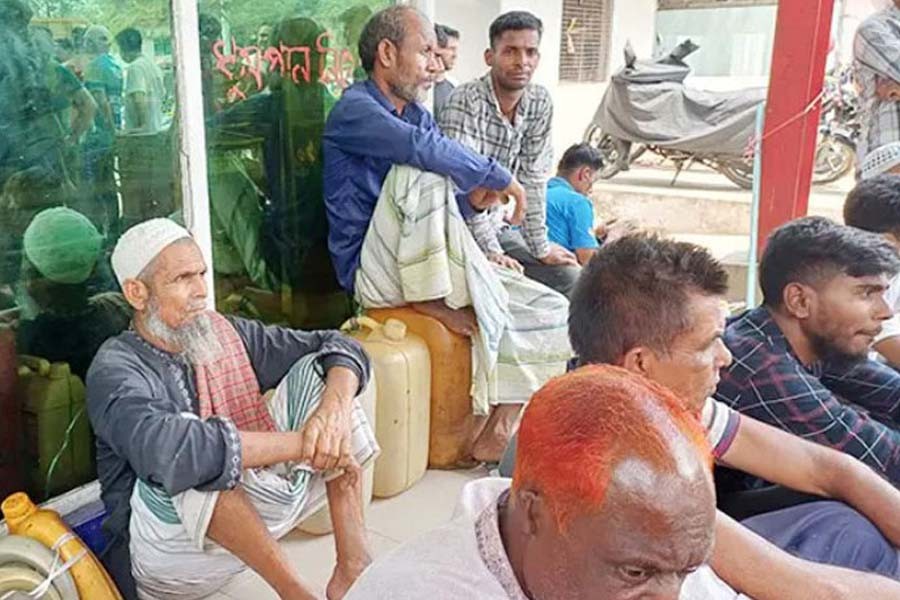
 Farmers wait to collect fuel at the SM Farid Filling Station in Pabna town - FE Photo
 Farmers in Pabna and Gaibandha fear rising costs and crop damage as they have been unable to run their irrigation pumps sufficiently due to fuel shortage, which is possibly an impact of the war in the Middle East. Workers at filling stations, who provide fuel to sub-dealers in the local markets, - often through unofficial agreements -- say they are unable to meet the demand amid the prohibition to distribute oil in bottles.
Our correspondent from Pabna reports, farmers are unable to get enough fuel oil after going from filling stations to filling stations amid Boro season and many of them have to buy fuel at an excessive price which increased their production costs and the resulting crop damage may trigger a "rice crop disaster."
Even though the seedlings are ready, many farmers are unable to adequately irrigate their lands. According to farmers Mannan, Jahurul and Ripon of Pabna Sadar Upazila, shallow pumps consume about 50 litres of oil for three months to irrigate a bigha of paddy field. At the current market price of diesel at filling stations, irrigation per bigha should cost about Tk 5,000-6,000, but currently it costs about Tk 2,500-3,000 more upon purchase from sub dealers.
Farmers said it costs about Tk 20,000 for fertilisers, pesticides, weeding and labour to cultivate 22-23 maunds of paddy per bigha which can be sold at Tk 1,000-1,200.
Farmers said that the prices of some fertilisers in some areas have also increased compared to last year. They said they are helpless if their cultivation costs rise and no one really cares about them.
Nurul Islam, a farmer from Char Sadirajpur in Pabna Sadar Upazila, said he needs an average of two liters of oil every day and depending on the condition of the soil, the requirement can be more sometime. He added that although it takes him hours to get to the filling station, he does not get fuel.
Al-Amin, a boro paddy farmer of Char Sadipur of the same upazila, was at Ananta Bazar area of Pabna to collect fuel. He said he had to wait for five to six hours to get 05-10 litres of oil and he will have to come and sit again after a couple of days. He added that there is not a sufficient amount of fuel and farming is not possible in such a situation.
Filling station staff said they are also helpless in the situation. Sanjay Kundu, manager of M/S Highway Petrol Pump in Ananta Bazar, said typically they need 4,000 litres of diesel per day and the requirement has been a maximum of 5,000 litres during the Boro season. He added that the fuel is running out quickly now and they do not know the exact requirement of fuel to meet current demand.
He said the number of farmers seeking fuel have risen which has increased pressure on the filling stations. Some 56, 285 hectares were brought under boro cultivation and of them 20,528 hectares were brought under irrigation through diesel powered machinery, according to sources at the Department of Agricultural Extension (DAE), Pabna. They also said the shortage will not have "much impact" on production.
Md. Jahangir Hossain Pramanik, deputy director at the DAE, Pabna, said interests of farmers have been given utmost importance and officials have been appointed at the filling stations to ensure that farmer get adequate amount of diesel properly. "All kinds of cooperation will be provided."
Our correspondent from Gaibandha adds, the ongoing fuel shortage across the country has significantly impacted farmers living in remote char areas. Upon a visit to Kochkhali Char in Gaibandha's Fulchhari Upazila, this correspondent has seen that daily work for agriculture and transportation via boats came to a standstill.
Lacking electricity connection, these char areas are heavily reliant on fuel oil to operate their shallow machines for irrigation, corn threshing machine and powering engine-run boats. However, as supply of fuel oil has almost stopped at local river ports, farmers are forced to travel to central areas 20 to 30 kilometres away for the oil that raised their costs. Some farmers are also unable to collect fuel oil at all due to prohibition of selling oil in bottles.
Farmers in the char areas said oil was easily available from local terminal even a few days ago, but now every day after work they have to travel for two litres of oil, availability of which is not guaranteed. They also said that irrigation of the land is being delayed as a result and many fields have crop damage risk.
Many people are unable to travel via boats to work due to a lack of fuel to operate the vessels. Shoppers and sick patients have been significantly suffering as a result. Rabiul Islam, a boat driver from the terminal, said they can not travel to filling stations as they do not mostly provide fuel oil in jars. They also said they can not ferry people anywhere far.
Atiqul Islam, deputy director at the DAE, Gaibandha, said, "We cannot control the issue of fuel oil, it will be done by the district administration. Besides, farmers will also get fuel oil according to the government's policy."
motiarfe@gmail.com
atik.mms2014@gmail.com
© 2026 - All Rights with The Financial Express

