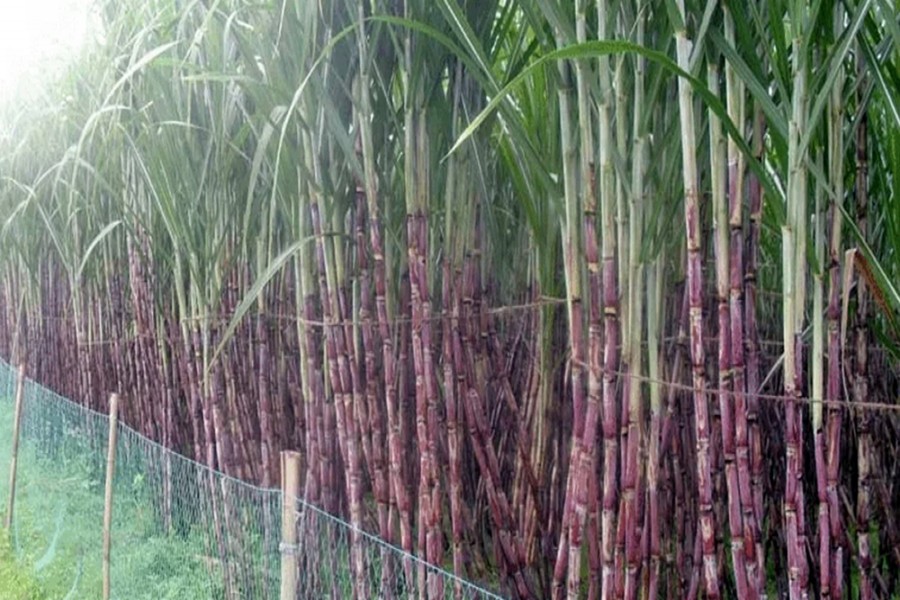
 A partial view of 'Philippine Black' sugarcane garden at a village in Bagha upazila of Rajshahi district — FE Photo
 OUR CORRESPONDENT
RAJSHAHI, Oct 28: Farmers in Bagha upazila in Rajshahi district are increasingly turning to a new variety of sugarcane called 'Philippine Black'.
The variety is more profitable than typical varieties, as farmers said Philippine Black sugarcane stems are softer, contain more juice and are sweeter -- making it easy to chew or make juice.
According to the Rajshahi Department of Agricultural Extension, the new variety of sugarcane is dark brown in colour and is usually 12 to 16 feet tall. It has several differences from typical local varieties, including a softer stem, more juice and a sweeter taste.
Shafiqul Islam Sana, a farmer in Pakuria area of Bagha Upazila, started cultivating Philippine Black sugarcane on an experimental basis last year. He said that he spent about Tk 50,000 and expects to earn Tk 0.3 million (3 lakh) if he sells the sugarcane at an average price of Tk 50 per stick.
However, Sana plans to replant the sugarcane instead of selling it this year, as he said many farmers are interested in cultivating the variety due to its good yield and market demand.
He mentioned that the fields need to be fenced with nets to protect the sugarcane from foxes due to its softness. If the sugarcane is big, it should be tied to a bamboo pole to support its height.
Rafiqul Islam, another sugarcane farmer, said, "A lot of sugarcane was grown in Bagha upazila to keep the Rajshahi sugar mill running. However, sugarcane cultivation has reduced significantly due to the lack of expected profits in this crop in the long term. But now that Philippine Black sugarcane cultivation is profitable, many people in the region are taking a renewed interest."
Although sugarcane is grown in almost all the districts of the country, the principal growing areas are Chittagong, Comilla, Sylhet, Dhaka, Faridpur, Jamalpur, Kishoreganj, Tangail, Jessore, Kushtia, Bogra, Dinajpur, Pabna, Rajshahi, and Rangpur.
Because it is an annual crop, sugarcane keeps the land occupied throughout the year. Consequently, some farmers are inclined to cultivate other profitable crops rather than sugarcane. This has resulted in a decline in crop acreage as well as the production of the commodity in recent years. Cane is harvested by cutting down the plant stalk. In Bangladesh, the harvesting season extends from October to March.
Shafiullah Sultan, Bagha Upazila Agriculture Officer, said, "In addition to its various qualities, Philippine Black sugarcane cultivation is low-cost and high-profit. About 10 to 15 more seedlings grow from each root of this variety, and each plant grows about 14 to 15 feet tall. It does not require much fertiliser or water. As a result, sugarcane can be cultivated at a low cost."
"Once this seedling is planted, there is no need to replant it for the next three years. A new sugarcane plant grows from the root of the cut sugarcane and produces another crop in the following year. Also, about three kg of juice can be extracted from each sugarcane," he added.
He also said that it is possible to earn Tk 0.2 million (2 lakh) per bigha by cultivating Philippine Black sugarcane, which is not possible from indigenous sugarcane.
Sultan also said that the Bangladesh Sugarcane Research Institute has recently started experimental cultivation of the variety in different districts.
He said as this sugarcane matures in just eight to ten months and has a juicy and abundant yield, there has been a great interest among farmers in commercial cultivation of this variety.
anaetru@gmail.com
© 2026 - All Rights with The Financial Express

