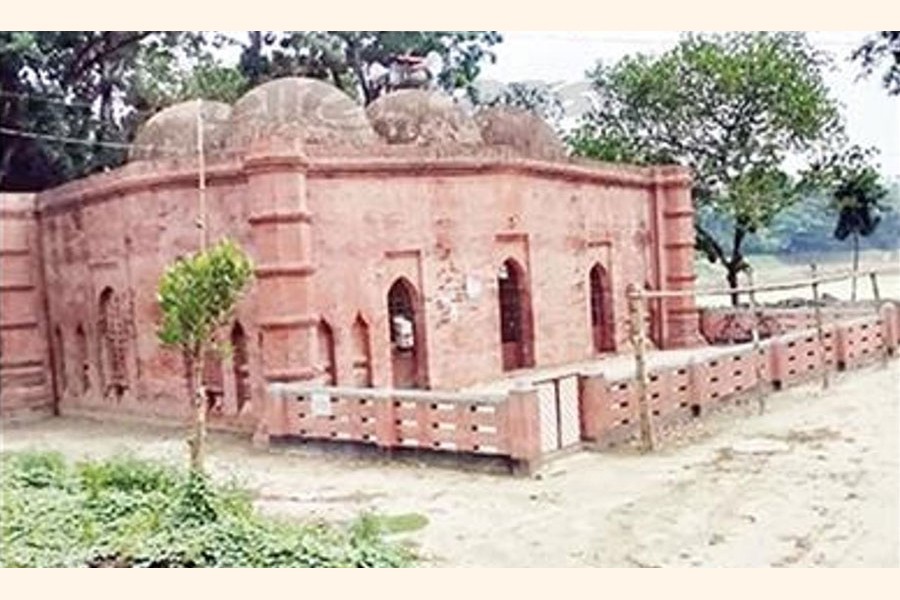
 A view of the Golakata Mosque at Barobazar in Kaliganj upazila of Jhenaidah district, which carries evidence of a once-thriving medieval settlement —FE Photo
 BENAPOLE, July 30: Located at Barobazar in Kaliganj upzila along the Jashore-Jhenaidah highway, the Golakata Mosque stands strikingly as one of the most remarkable archaeological monuments from Bengal's Sultanate period.
The area is home to numerous archaeological remains dating back nearly 800 years, offering evidence of a once-thriving medieval settlement.
Within a radius of just three to four kilometres around Barobazar, lie several significant archaeological sites. These relics indicate that the region was a prosperous urban centre some 500 years ago during the Sultanate era. Over time, however, successive periods of political change led to the gradual decline of the settlement.
During the 1980s, the Department of Archaeology excavated a number of large earthen mounds scattered across Barobazar and uncovered a wealth of historical structures buried beneath the soil.
While the surrounding landscape remained largely flat, these elevated mounds concealed traces of a forgotten civilisation.
Among the discoveries were 19 Sultanate-era mosques, including the renowned Golakata Mosque. Measuring approximately 21 feet in length and 18 feet in width, the mosque was excavated by the Department of Archaeology in 1992-93.
Former chairman of Barobazar Union Parishad, Abul Kalam Azad, said many of the area's mosques had remained buried underground for centuries. Dense vegetation and large trees had grown over the mounds before archaeological excavations revealed the remarkable structures hidden beneath.
During the excavation, several stone inscriptions written in Arabic and Persian from the reign of Shah Sultan Mahmud Ibn Husain (around 800 Hijri) were discovered. These inscriptions suggest that the mosque dates back to the Sultanate period.
According to local accounts, ancient rulers once lived in this region. Today, lush greenery surrounds the site, while the beautifully restored mosque rises prominently amid the dense foliage.
The mosque features six domes and contains two black stone pillars inside. Archaeologists also reportedly recovered a handwritten copy of the Holy Quran and a sword during the excavation, both of which are preserved within the mosque premises.
The structure stands on four large hexagonal pillars, each measuring around 25 feet in height. Its walls are approximately five feet thick. The eastern façade contains three entrance doors, while two entrances on both the northern and southern sides were later sealed with brickwork.
Each doorway is crowned with pointed arches. Inside, the western wall contains three mihrabs adorned with terracotta ornamentation featuring floral motifs, vines, bells and chain patterns. Two black stone columns, each about eight feet high, rise to meet the roof structure. The domes are positioned both in front of and behind these columns.
Architectural historians have noted similarities between Golakata Mosque and several other notable medieval mosques in Bangladesh, including the Dhichak Mosque of Gaur, Baba Adam Mosque, Shahi Mosque of Shailkupa and the famed Sixty Dome Mosque in Bagerhat.Adjacent to the mosque lies the historic Golakata Dighi, a large reservoir believed by local tradition to date back to the time of Khan Jahan Ali. Including its embankments, the dighi (pond) covers roughly 12 bighas of land.Local folklore offers various explanations for the name "Golakata" (literally, "beheaded"). One legend claims that a tyrannical ruler of Barobazar used to execute his subjects and throw their bodies into the dighi.”
benapolejessore@gmail.com
© 2026 - All Rights with The Financial Express

