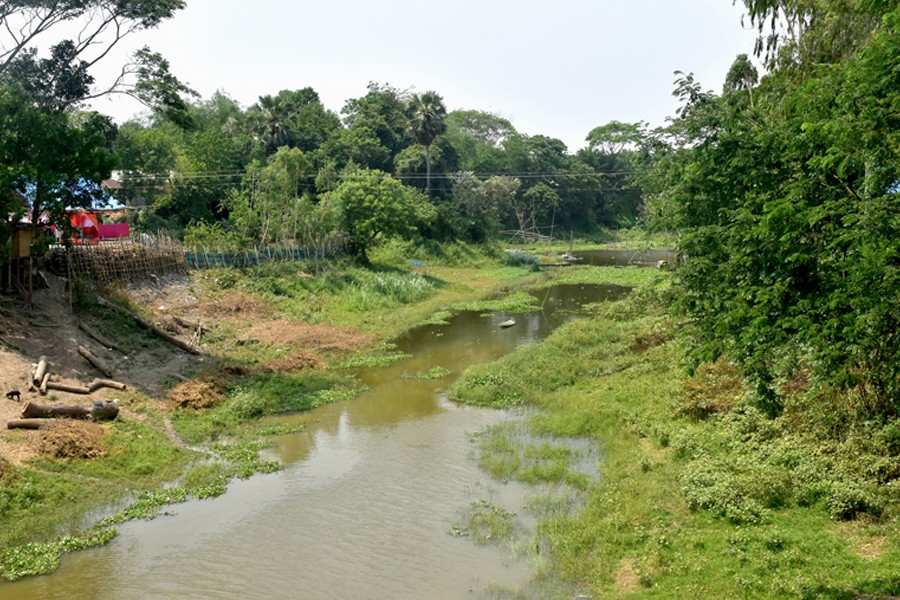
 Photo shows an unplanned embankment which disrupts the natural flow of water in the Ichamati River in Harirampur upazila of Manikganj district- FE Photo
 MANIKGANJ, Oct 07: The Ichamati River, which was once a lifeline for farmers and fishermen, is now battling to exist in Harirampur upazila of Manikganj district due to
unhindered encroachment and pollution by an unscrupulous quarter.
 Once its flowing waters irrigated paddy fields and filled fishermen's nets with shimmering catches, but today the river stands choked by grabbing, pollution, and a series of unplanned embankments.
During the monsoon, the river's water stagnates as hyacinths accumulate and rot, releasing a foul odour and polluting the environment. Garbage and human waste dumped into the river have worsened the situation, leaving thousands of families in the region without access to safe drinking water.
Stretching about 38 kilometers, the Ichamati once flowed from Daulatpur through Ghior, Shibalaya, and Harirampur before merging with the Padma at Bahadurpur. Despite the Padma's erasing much of its course, one branch of the river still remains, linking Bakhchar, Dorikandi, Bahirchar, and Lechraganj Bazar before joining the Kaliganga. However, this lifeline is now strangled by at least 10-12 embankments, many of which have long-defunct sluice gates.
As a result, major wetlands like Bhatsala, Diyar, and Gopinathpur remain parched even during the monsoon, devastating farming and fishing communities.
A field visit revealed roads, houses, and even shops constructed atop embankments, completely blocking the natural water flow. At Bahirchar, several families have even built permanent settlements on the embankment, renting out shops for business.
Locals expressed their frustration and grief. Sheikh Nurul of Andharmanik village, who lost his home to Padma erosion 25 years ago, said, "Back then, this river was full of life. Now, there is no water, only hardship."
Muhammad Muntazur Rahman, a farmer, lamented, "Because of the embankments, water cannot flow. We cannot raise livestock, and drinking water has become scarce. In the monsoon, rotting hyacinths and sewage create unbearable stench, while mosquitoes make our lives miserable."
Local trader Aminur Rahman Dolon of Bahirchar added, "Embankments were built to prevent erosion two decades ago, but now they have caused severe waterlogging. In the dry season, we suffer terribly for lack of water."
Farid Ahmed Khalek, resident of Agrail village, said, "The once vibrant Ichamati is now a dead river, filled with silt and devoid of fish. Our Bhatsala wetland used to overflow during this season, but because of the embankments, no water reaches it anymore. Hundreds of farmers and fishing families are now in distress."
Environmentalists warn of further ecological disaster. Mahidul Islam Mahi, joint general secretary of Shyamal Nisorgo, said, "Unplanned embankments are crippling agriculture and fisheries, while people cry out for water. Biodiversity is being destroyed. The Ichamati must be revived without delay."
Officials, however, insist that efforts are underway. Akhtaruzzaman, executive engineer of the Water Development Board in Manikganj, said, "We are working to restore the river's natural flow. Several embankments built by locals for their own benefit have already been identified. Under an ongoing project, these will be removed and replaced with hydraulic structures to ensure free water flow."
Manikganj Deputy Commissioner Dr. Manowar Hossain Molla confirmed his personal inspection of the river and added, "Initially, embankments were built to protect crops. But now they have created serious problems. I have instructed the UNO and Water Development Board engineers to resolve the issue. We hope that once the project is completed, the Ichamati will regain its life."
asadlimon@gmail.com
© 2026 - All Rights with The Financial Express

