Lakshmi Baidya, a tea garden worker at Sreemangal in Moulvibazar, was diagnosed with breast cancer in 2019. Following a mastectomy, or the surgical removal of a breast, eight cycles of chemotherapy plus radiotherapy led Lakshmi to recovery, reports bdnews24.com.
She suffered side effects like severe hair loss, but Lakshmi keeps smiling to celebrate her win over cancer thanks to Sabina Yeasmin Madhobi, a woman from Netrokona's Mohonganj, who took it upon herself to help many women like Lakshmi suffering from breast or cervical cancer.
Helping women from marginal groups in rural areas fight gynaecological cancers and creating awareness is not easy in Bangladesh, where talking about a woman's organs even for medical purposes is taboo.
Still, she has directly helped around 400 women survive cancer, with information, money, space to stay in, connections with doctors, and most of all - courage since 2017.
As Madhobi was in the business of handicrafts and Nakshi Kantha, soft hand-embroidered quilts known for their unique design, she was travelling across the country on a bicycle to do her own research.
"Then I thought that I already started to cycle to different parts of the country and reach marginal groups in remote areas where I can help people in some way or the other," said the 27-year-old owner of Madhobi Mart.
She realised that women in Bangladesh fall behind in receiving health services, especially for diseases like cancer. And it is more difficult if the disease is breast cancer, uterine cancer or cervical cancer. Many of them do not seek help and sometimes the disease is not even diagnosed.
"Women in rural areas are not much educated and they aren't financially stable. Any woman who gets cancer doesn't know where to seek proper treatment. So I thought I would work to help them."
Madhobi began visiting schools, colleges, universities and garment factories to create awareness about breast and cervical cancers.
Then she started receiving phone calls from many women, especially the students who attend her awareness sessions and their mothers. "They told me, 'Sister, I feel something solid in my breast and it hurts a lot.' It means they started sharing with me their fear of having breast cancer."
It was then Madhobi realised that creating awareness was not enough and those women seeking help from her needed immediate help from specialists.
She started her bicycle trip to create awareness about breast cancer in Chattogram, where she also found the first patient to help in 2017. The patient, a garment worker in her fifties, was taken to Chattogram Medical College Hospital.
After a biopsy, the patient was diagnosed with a malignant tumour and the cancer was already spreading.
"The woman got her breast removed but had to take chemotherapy and radiotherapy as cancer had spread around the breast. She is still alive and keeping healthy. She goes for medical follow up every three months," Madhobi said.
Madhobi said some male patients also sought her help. Most of them are family members of female patients. "Sometimes my relatives or acquaintances come too. I can't deny help. But I'm serious about women's health."
Making phone calls to remind the patients of visiting a doctor or any medical procedure has become routine work for Madhobi. Her company staff also help her do this.
Madhobi allows many patients to stay at her home in Dhaka while receiving treatment. Lakshmi Baidya from Sreemangal, Ayesha from Jashore, and many others stayed at her place in the capital while undergoing chemotherapy and radiotherapy.
"I saw that the patients couldn't even afford to travel to Dhaka. They had no money to bear transport fare, or the costs of medicine, food and lodging. They did not have support from their families who thought it was a shameful act for them to seek treatment for breasts or show it to the doctor. Some patients had financial capacity but no moral support from the family."
In such cases, Madhobi sends them money. The patients then come to Dhaka, complete treatment and then Madhobi buys them bus or train tickets to return home.
Lakshmi Baidya needed a huge amount of funds for medical treatment as it was done both in government and private hospitals.
"I know a lot of expatriates and raised a fund with their help to provide treatment to Lakshmi," Madhobi said.
Although patients can receive chemotherapy and radiotherapy for free in government hospitals, they need to be taken to private hospitals under certain circumstances
"When I take responsibility for a patient, I just can't leave them halfway to recovery. Because the patient goes back to square one if they don't follow up."
"When I take responsibility for a patient, I bear their treatment cost from the beginning to end. I spend the earnings from my business on it," she said.
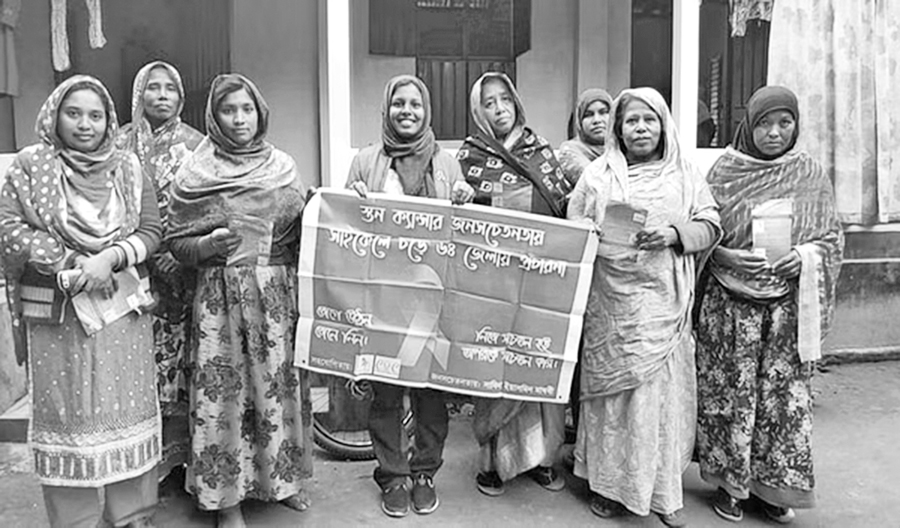
As she takes the cancer patients to hospitals, Madhobi has noticed several issues.
The National Cancer Institute and Hospital in Mohakhali has five of its radiotherapy machines broken, and is struggling to serve the patients. The negligence, shortcomings or disinterest in the government hospitals are "really unfortunate", she said.
The limitations in the existing government medical facilities in Bangladesh have pushed up the treatment costs for diseases like cancer.
"The hospital in Mohakhali has a small workforce. My patients visit it most of the time. They need to do a core biopsy test of the flesh or blood from their breasts. When I take one patient, we get a serial number to do the test 15 days later. If 100 patients visit the hospital, they provide treatment to 20 of them. Then the remaining 80 patients have no option but to visit private hospitals."
Madhobi said if the government hospitals charge Tk 5,000 to do a core biopsy, private hospitals charge Tk 10,000 to 15,000 for it.
As the patients and their families have no idea about the disease and start the treatment late, the treatment costs shoot up.
Treatment for the third or fourth stage of cancer is quite expensive. If a woman is diagnosed with cancer at an early stage, treatment can be done at a minimum cost. Also, the government hospitals provide free treatment, Madhobi said.
"In Bangladesh, women don't go to doctors even after cancer symptoms manifest. In many cases, they don't know the symptoms as well. They hide it as long as they can endure. When the breast starts to melt or the nipple starts bleeding or oozing puss, they visit a doctor."
© 2026 - All Rights with The Financial Express

