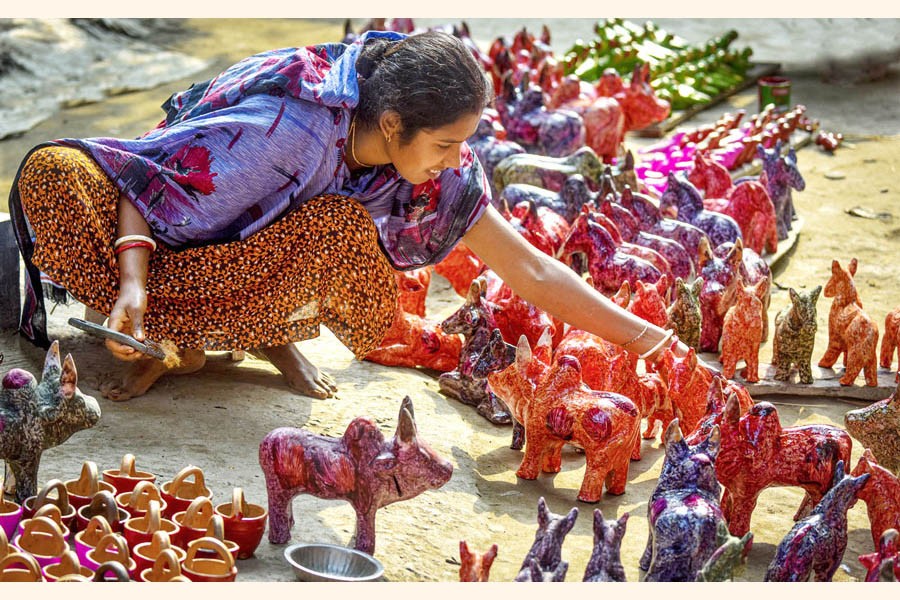
 A woman artisan busy painting earthen toys for Pahela Baishakh sale. The photo was taken from Palpara in Badiakhali union of Gaibandha district on Wednesday — Focus Bangla
 Kamrul Islam, a caretaker of a residential building in Dhaka's Mirpur, always buys new clothes for his family, if not for himself, on Bengali New Year.
But this year marks an exception as another major festival, Eid-ul-Fitr, looms. Mindful of the expenses relating to Eid, Kamrul has decided against buying anything for Pahela Boishakh, the first day of the Bangla calendar, reports bdnews24.com.
"I'm already struggling to meet household expenses. We have extra expenditures during Ramadan and then Eid is a few days away. I feel like celebrating Pahela Boishakh but I can't afford to." he said.
Eid-ul-Fitr and Pahela Boishakh are two of the most lucrative periods of the year for fashion and boutique stores in Bangladesh. But this year, the two festivals will be just two weeks apart.
The garment sector experienced a slump in the sales in 2020 and 2021 as Eid and Bengali New Year celebrations were put on hold due to the coronavirus pandemic.
As the pandemic has ebbed, Pahela Boishakh and Eid-ul-Fitr are expected to be celebrated with the usual vim and vigour. But the short time gap between the two festivals has compelled traders to scale down their sales target and customers to reevaluate their purchasing capacity and wants.
The sale this year is already showing a downtrend and most customers are prioritising Eid-ul-Fitr over Pahela Boishakh, according to traders.
According to the Bangladesh Local Garment Manufacturers Association, the apparel sector made sales worth Tk 300 billion during Eid-ul-Fitr and Tk 50 billion in Pahela Baishakh in 2019, when there was no pandemic.
As the Bengali New Year falls in Ramadan, sales are likely to be lower than usual this year, said the president of the association Alauddin Malik. He said the sales target encompassing both festivals this year stands at Tk 200 billion.
"Eid is the biggest festival for Muslims. We hope shoppers will buy garments to celebrate both festivals."
People have always purchased new clothes for Eid but the shopping spree surrounding the Bengali New Year is a more recent trend, spanning the last two decades. Fashion houses have tried to capitalise on it by catering to the lower-middle class demographic during Pahela Boishakh.
Local cotton attires are always in demand for Pahela Boishakh. The prevalent colours for the festival are red and white, with some other bright shades.
For Eid, customers prefer half silk, georgette, tissue, muslin, satin, and linen as dress material beside cotton. There is no specific colour that is associated with the festival.
Most shopkeepers said customers have been eyeing clothes for Eid rather than Pahela Boishakh. But some customers have bought clothes with both festivals in mind.
Fashion house Rong has used truck art as the theme for their fashion line this year. They used block print, screen print, hand embroidery on red, blue, white, off white and green cotton, half silk and linen material.
They have scaled down production for Pahela Boishakh as it overlaps with Ramadan, said Rong Bangladesh owner Shoumik Das.
"Some people are reluctant to buy a dress just for a day to celebrate Pahela Boishakh and some prefer to buy clothes that they can wear during both festivals. That's why we geared our entire product line towards both the festivals."
© 2026 - All Rights with The Financial Express

