Unremitting soil erosion by the Jamuna River has triggered panic among the local residents in Manikganj's Daulatpur upazila with its widespread devastation in the past few days while erosion onslaughts have taken an alarming turn in Gaibandha district with the river water level swelling.
In Manikganj, a large number of dwelling houses and vast tracts of cropland have entered the gorge of the Jamuna River in Daulatpur upazila within a few days.
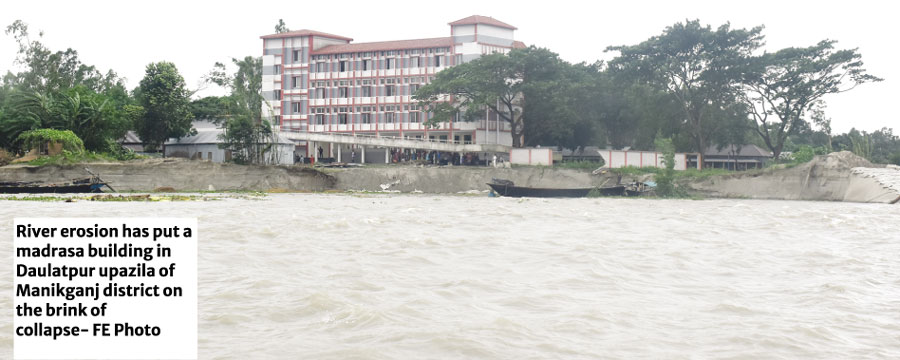
Several hundred families have been left homeless as severe erosion by the river continues to devour homesteads and cropland in the upazila, while the area's only secondary-level madrasa now stands on the brink of collapse.
Over the past several days, the river has washed away more than a hundred homesteads in Baghutia union, forcing many families to seek shelter with relatives or under the open sky.
Local residents said the erosion is advancing rapidly, with fresh areas disappearing into the river almost every day.
Having rebuilt her house nearly two decades ago after previous episodes of erosion, she had hoped the latest settlement would be permanent. That hope ended late Sunday night when the river swallowed her last remaining shelter.
"The river has taken my home three times. I thought it would not happen again. Now I have nowhere to live. I have no food, no money, nothing left," she said.
A visit to the area found local residents dismantling houses to salvage building materials before the river reaches them, while others watched helplessly as their homes collapsed into the water within hours.
River erosion has also put Charkalikapur Shukuria Dakhil Madrasa under serious threat. The Jamuna now flows only a few feet from the institution's four-storey academic building after already washing away its boundary wall and toilet facilities.
Local residents fear the madrasa's two buildings, constructed at a cost of around Tk70 million (Tk 7.0 crore) could be lost if urgent protection measures are not taken.
"There is no other high school in this area. If the madrasa is washed away, hundreds of students will lose access to education. The nearest school is three to four kilometres away, and reaching it requires crossing the river," said local resident Chan Mia.
Mohammad Ariful Islam, student of the madrasa, said he feared his education would come to an end if the institution is lost.
Locals alleged that years of illegal sand extraction from the Jamuna have accelerated the erosion by altering the river's natural course.
"Illegal dredging has continued for years despite repeated complaints. Sand is still being extracted downstream. That is one of the main reasons behind the increasing erosion," alleged local resident Harunur Rashid.
Another erosion victim, Nurunnahar, said she lost almost everything before she could react.
Meanwhile, The Bangladesh Water Development Board has started placing geo-bags along the riverbank in front of the madrasa in an attempt to slow the erosion.
However, residents said the measure would only provide temporary relief and demanded a permanent river training project as well as strict action against illegal sand extraction.
Muhammad Akhtaruzzaman, executive engineer of the Manikganj Water Development Board, said the entire char area consists of loose sandy soil, making it highly vulnerable to erosion.
In Gaibandha, although the water levels of the Teesta, Brahmaputra, Jamuna and Ghaghat rivers flowing through Gaibandha have not yet crossed the danger levels, river erosion has taken a terrible shape in the district in the past few days as the water level keeps swelling.
Homesteads and farmlands in large numbers along with people's lifelong dreams are disappearing one after another into the rivers.
Affected people have demanded that effective measures be taken immediately to protect them permanently from river erosion.
From Lalchamar, Haripur and Shokher Bazar in Sundarganj upazila of the district to Char Kunderpara in Kamarjani union in Gaibandha Sadar upazila, Dakshin Rasulpur in Kanchipara union in Balashighat of Fulchhari upazila, Haldia, Putimari, Singhajani and Gobindapur in Saghata upazila, at least 25 points have been affected by the terrible river erosion.
Every day, new areas are being lost to the riverbed. Some are demolishing their houses and moving them to safer places, while others are trying hard to save their last possessions.
Several thousand people have already been left destitute by the ruthless ravages of the river.
For many, this is not a new experience. Some have lost their homes three times, some up to four times due to river erosion.
These people, who have been fighting the river for years, now see only uncertainty and despair.
In Sundarganj upazila, over 500 houses, agricultural land and roads have been submerged in the riverbed due to the severe erosion by the Teesta River in the past week.
asadlimon@gmail.com
atik.mms2014@gmail.com