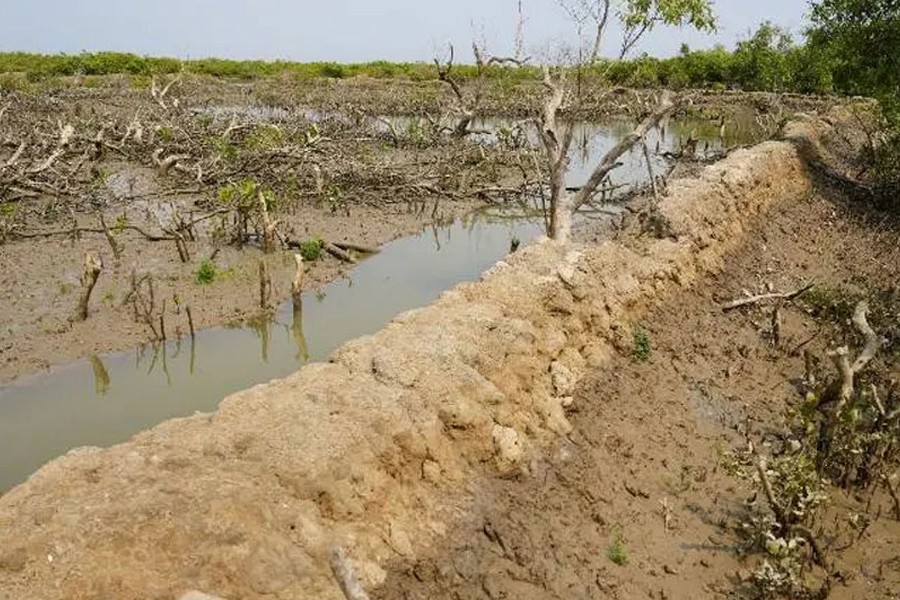
 A four to five foot high earthen dam has been constructed on Sonadia Island by cutting down the dense mangrove forest. Shrimp is being cultivated illegally there - FE Photo
 COX'S BAZAR, June 27: Once envisioned as the site of a deep-sea port, Sonadia Island in Moheshkhali Upazila of Cox's Bazar was later selected for the development of an eco-tourism park by the Bangladesh Economic Zones Authority (BEZA).\
However, neither project materialised. In the meantime, a prolonged dispute among government agencies over land control has created a vacuum that has fueled land grabbing, deforestation, shrimp farming and illegal tourism activities, placing one of Bangladesh's most important coastal ecosystems under severe threat.
Although the government eventually cancelled BEZA's land allocation following environmental concerns and legal challenges, the Forest Department has yet to regain full control of the island nearly two years later. Officials say this administrative deadlock has significantly worsened the environmental crisis on Sonadia Island.
In 2019, the government leased 9,467 acres of land on Sonadia Island to BEZA for a nominal fee of just Tk 1,001, with plans to develop an eco-tourism park on approximately 30 per cent of the island. As part of the initiative, India's Mahindra Group was engaged and a development plan covering nearly 500 acres was finalised.
However, from the outset, the government research organisation, the Center for Environmental and Geographic Information Services (CEGIS), warned that large-scale tourism development would severely impact migratory bird habitats, sea turtle nesting grounds, and the island's fragile ecosystem. Its report highlighted concerns that hotels, resorts, and other infrastructure would increase waste generation and cause irreversible environmental damage.
Following objections from environmentalists, court directives and growing concerns over ecological risks, the Ministry of Land, during the tenure of the interim government, revoked BEZA's land allocation and decided to return the land to the Forest Department. However, that decision has not yet been fully implemented.
Forest officials say influential local groups have taken advantage of the administrative uncertainty by clearing mangrove forests to build resorts, encroaching on forest land, establishing shrimp farms, and expanding illegal tourism operations.
On April 2, the Forest Department filed separate cases against 30 activists and leaders affiliated with the BNP, Jamaat-e-Islami, and Awami League, alleging involvement in illegal encroachment and forest destruction. Officials claim the cases were filed based on specific evidence.
One of the accused, Sheikh Kamal, denied the allegations, saying, "I do not own any resort on Sonadia Island, nor have I occupied any mangrove forest."
BNP leader Jahedul Haque Nahid also rejected the claims, stating, "I have never even visited Sonadia Island in my life. How could I possibly own a resort there?"
Khandaker Mahmud Pasha, deputy director of the Department of Environment's Cox's Bazar office, said that two cases have so far been filed against 53 individuals over the destruction and encroachment of mangrove forests. Investigation reports will be submitted to the court soon.
"Last month, authorities demolished around 25 illegal resorts in the Paschim Para area during a major operation," he said. "Due to the remoteness of the location, more than 100 personnel from the police, navy, and other law enforcement agencies participated in the drive."
"SONADIA LOSING FOREST GROUND, BIODIVERSITY EVERY DAY"
H.M. Faridul Alam Shahin, joint convener of environmental organisation Dharitri Rokkhay Amra (DHORA), Cox's Bazar, described Sonadia as an ecologically critical area.
Development initiatives must prioritise the load carrying capacity by the island's environment, including marine biodiversity and other natural characteristics, according to him.
"Even after the cancellation of the land allocation, the Forest Department has not received full control of the area. As a result, Sonadia's forests, sand dunes and biodiversity are gradually disappearing day by day."
M.A. Hasan, divisional forest officer, Coastal Forest Division, Chattogram, said that only about 9,000 acres of the nearly 21,000 acres spread across seven mouzas have been released from BEZA's allocation. The remaining 12,000 acres are still under BEZA's control.
"The ministry has repeatedly instructed that the land be handed over," he said. "However, legal proceedings related to the allocation are still ongoing, preventing completion of the process."
tahjibulanam18@gmail.com
© 2026 - All Rights with The Financial Express

