 Farmers harvesting submerged Aman paddy in Tanore upazila of Rajshahi district as unplanned excavation of fish ponds left the farmland under water- FE Photo
 RAJSHAHI, Nov 08: Unplanned excavation of fish ponds in fertile farmlands has emerged as a major threat to agriculture in Rajshahi region, as continuous rainfall triggered by a low-pressure system over the Bay of Bengal has left vast areas under water, damaging Aman paddy on several thousand hectares of land.
According to officials at the Department of Agricultural Extension (DAE), nearly 19,568 hectares of cropland across Rajshahi, Naogaon, Natore, and Chapainawabganj districts have been affected by recent heavy rains - most severely in Aman fields.
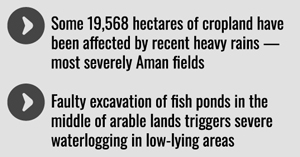 Experts and farmers have blamed the unregulated expansion of commercial fish ponds for the aggravation of waterlogging crisis, as rainwater can no longer drain out naturally through canals and lowlands.
"In the last decade, the number of ponds in Rajshahi district alone has risen by around 10,000, reaching a total of 51,275, most of which were dug right in the middle of agricultural land without keeping any designated drainage system," an official report shows.
The Rajshahi Meteorological Office recorded 61.6 millimetres of rainfall between Tuesday and Friday, inundating standing crops on several hundred hectares of land. Many ponds overflowed, washing fish into nearby lowlands and crop fields.
Sabrina Begum, deputy director of the DAE in Rajshahi, said, "The main reason behind prolonged waterlogging in low-lying areas is the unplanned excavation of fish ponds in the middle of farmlands.
These ponds were dug without following any design or drainage plan, so water has no outlet once it overflows."
She added that while damage assessments are still ongoing, the ultimate losses will depend on how quickly the water recedes.
"In some areas, plants are leaning but may recover; in others, the crops are completely submerged," she said.
Jahangir Alam, Rajshahi district fisheries officer, said that numerous ponds in Tanore and Bagmara upazilas had overflowed during rains, causing heavy losses for fish farmers. They expect preliminary damage estimates within a few days.
He said noting that blocked drainage due to excessive pond construction had worsened flooding in agricultural zones.
He explained that of 67 natural wetlands (bils) in Rajshahi, nearly 90% have already been converted into ponds, most of them enclosed with embankments.
Only about 10 per cent remain open, but even there, collective fish farming is being practiced. This has disrupted the natural flow of rainwater to rivers.
Saiful Islam, a farmer from Krishnapur in Tanore, said his eight bighas of Aman paddy have been flattened by rainwater.
He also said about 80 per cent of farmers in their area are face the same situation. They have no choice but to harvest early, even if the paddy is still half-ripe. Earlier, heavy rains did not cause this much damage because water could drain through nearby waterbodies. Now, with ponds surrounding the fields, the water just gets trapped.
Abdur Rahman, a fish farmer, said, "While many farmers are switching from rice to fish farming for higher profit, the imbalance is creating social and environmental conflict. I used to earn barely Tk 20,000 from Aman rice, but fish farming gives me twice that."
However, his neighbour Nurul Islam countered, "When his pond overflowed, all my seedlings went underwater. He made a profit, I lost everything."
Shahidul Islam, regional coordinator of the environmental research group BARCIK, said, "One after another, natural wetlands have been cut and enclosed for fish farming. Rainwater no longer flows through canals to rivers as it used to. Rajshahi's natural drainage system is collapsing."
He warned that development without ecological planning is destroying the natural water network, threatening both agriculture and biodiversity. So, If immediate control and scientific planning for pond excavation are not enforced, the region's food production could face a severe long-term crisis.
anaetru@gmail.com
© 2026 - All Rights with The Financial Express

